WB result of STK25 Recombinant Rabbit mAb
Primary antibody: STK25 Recombinant Rabbit mAb at 1/1000 dilution
Lane 1: HeLa whole cell lysate 20 µg
Lane 2: RD whole cell lysate 20 µg
Lane 3: HepG2 whole cell lysate 20 µg
Secondary antibody: Goat Anti- rabbit IgG, (H+L), HRP conjugated at 1/10000 dilution
Predicted MW: 48 kDa
Observed MW: 55 kDa
STK25 Recombinant Rabbit mAb (S-4088-17)
STK25 Recombinant Rabbit mAb (S-4088-17)
Price:
Regular price
$100 USD
Regular price
Sale price
$100 USD
Unit price
per
For shipping services or bulk orders, you may request a quotation.
Secure checkout with

View full details
Product Details
Product Details
Product Specification
| Host | Rabbit |
| Antigen | STK25 |
| Synonyms | Serine/threonine-protein kinase 25; Ste20-like kinase; Sterile 20/oxidant stress-response kinase 1 (SOK-1; Ste20/oxidant stress response kinase 1); SOK1; YSK1 |
| Immunogen | Synthetic Peptide |
| Location | Cytoplasm |
| Accession | O00506 |
| Clone Number | S-4088-17 |
| Antibody Type | Recombinant mAb |
| Isotype | IgG |
| Application | WB |
| Reactivity | Hu, Ms, Mk |
| Positive Sample | HeLa, RD, HepG2, Neuro-2a, mouse brain, COS-7 |
| Predicted Reactivity | Bv |
| Purification | Protein A |
| Concentration | 0.5 mg/ml |
| Conjugation | Unconjugated |
| Physical Appearance | Liquid |
| Storage Buffer | PBS, 40% Glycerol, 0.05% BSA, 0.03% Proclin 300 |
| Stability & Storage | 12 months from date of receipt / reconstitution, -20 °C as supplied |
Dilution
| application | dilution | species |
| WB | 1:1000 | Hu, Ms, Mk |
Background
STK25 (serine/threonine kinase 25, also known as YSK1 or SOK1) is a member of the GCK subfamily within the STE20 family. As a highly conserved protein kinase, it is involved in regulating cell polarity, migration, proliferation, and metabolic stress responses. STK25 contains an N-terminal kinase domain and a C-terminal coiled-coil domain, the latter being essential for its dimerization and subcellular localization (e.g., at the Golgi apparatus). Functionally, STK25 is an important regulator of the mammalian Ste20-like kinase (MST) signaling network, where it can be activated by oxidative stress and hyperosmotic conditions, subsequently regulating cytoskeletal rearrangement and survival through phosphorylation of downstream substrates. Notably, STK25 plays a critical role in metabolic regulation: it modulates lipid synthesis and gluconeogenesis by inhibiting the AMPK signaling pathway and promoting mTORC1 activity. Its deficiency or overexpression significantly affects the progression of non-alcoholic fatty liver disease (NAFLD) and type 2 diabetes mellitus. Furthermore, STK25 is involved in maintaining Golgi apparatus structure and vesicle trafficking, and exhibits dual functions in tumor development—potentially acting as a tumor suppressor in neuroblastoma and colorectal cancer, while possibly promoting tumor cell invasion and metastasis in certain other cancers.
Picture
Picture
Western Blot
WB result of STK25 Recombinant Rabbit mAb
Primary antibody: STK25 Recombinant Rabbit mAb at 1/1000 dilution
Lane 1: Neuro-2a whole cell lysate 20 µg
Lane 2: mouse brain lysate 20 µg
Secondary antibody: Goat Anti- rabbit IgG, (H+L), HRP conjugated at 1/10000 dilution
Predicted MW: 48 kDa
Observed MW: 55 kDa
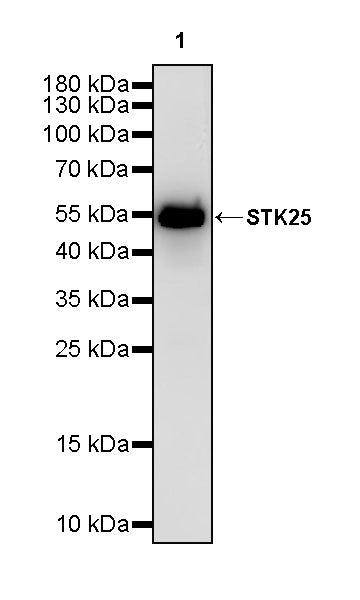
WB result of STK25 Recombinant Rabbit mAb
Primary antibody: STK25 Recombinant Rabbit mAb at 1/1000 dilution
Lane 1: COS-7 whole cell lysate 20 µg
Secondary antibody: Goat Anti- rabbit IgG, (H+L), HRP conjugated at 1/10000 dilution
Predicted MW: 48 kDa
Observed MW: 55 kDa