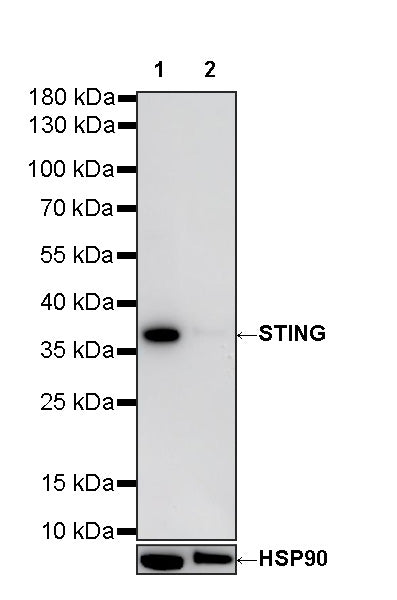
STING-Knockout HeLa Cell Lysate
WB result:
Primary antibody: STING Recombinant Rabbit mAb (S0B0906) at 1/1000 dilution
Lane 1: Wild-type HeLa whole cell lysate 20 μg
Lane 2: STING-Knockout HeLa whole Cell lysate 20 μg
Secondary antibody: Goat Anti-Rabbit lgG (H+L), HRP conjugated at 1/10000 dilution
Predicted band size: 42 kDa
Observed band size: 37 kDa
STING-Knockdown HeLa Cell Lysate
STING-Knockdown HeLa Cell Lysate
Price:
Regular price
$670 USD
Regular price
Sale price
$670 USD
Unit price
per
For shipping services or bulk orders, you may request a quotation.
Secure checkout with

View full details
Product Details
Product Details
Product Specification
| Host | Human |
| Application | WB |
| Concentration | 2 mg/ml |
| Physical Appearance | Liquid |
| Storage Buffer | Supplied in SDS Sample Buffer: 50 mM Tris-HCl (pH 6.8 at 25°C), 2% w/v SDS, 10% glycerol, 1% v/v β-Mercaptoethanol, 0.01% w/v bromophenol blue or phenol red. |
| Stability & Storage | -20 °C for 1 months under sterile conditions; |
Background
Stimulator of Interferon Genes (STING, encoded by STING1 / TMEM173) is an ER-resident transmembrane adaptor essential for innate immune sensing of cytosolic nucleic acids. Downstream of cyclic GMP-AMP synthase (cGAS), STING binds the cyclic dinucleotide 2'3'-cGAMP, triggering its translocation to the Golgi apparatus and subsequent recruitment and activation of TBK1 and IKK. This signaling cascade phosphorylates transcription factors IRF3 and NF-κB, driving the robust expression of type I interferons (IFN-α/β), pro-inflammatory cytokines, and interferon-stimulated genes (ISGs). STING also participates in non-canonical autophagy and cellular senescence programs. STING antibodies are widely utilized in Western blotting, immunofluorescence, and immunohistochemistry to monitor pathway activation and innate immune responses. STING knockout (KO) abolishes cytosolic DNA-driven innate immune signaling, blunting type I interferon induction upon pathogen infection or genomic stress, which dampens antitumor immune surveillance while protecting cells against pathological autoinflammation.
Picture
Picture
Western Blot