WB result of SPHK2 Recombinant Rabbit mAb
Primary antibody: SPHK2 Recombinant Rabbit mAb at 1/1000 dilution
Lane 1: HT-29 whole cell lysate 20 µg
Lane 2: Caco-2 whole cell lysate 20 µg
Lane 3: HEK-293 whole cell lysate 20 µg
Lane 4: HeLa whole cell lysate 20 µg
Secondary antibody: Goat Anti-rabbit IgG, (H+L), HRP conjugated at 1/10000 dilution
Predicted MW: 70 kDa
Observed MW: 70 kDa
SPHK2 Recombinant Rabbit mAb (S-5307)
SPHK2 Recombinant Rabbit mAb (S-5307)
Price:
Regular price
$100 USD
Regular price
Sale price
$100 USD
Unit price
per
For shipping services or bulk orders, you may request a quotation.
Secure checkout with

View full details
Product Details
Product Details
Product Specification
| Host | Rabbit |
| Antigen | SPHK2 |
| Synonyms | Sphingosine kinase 2; SK 2; SPK 2; SK2 |
| Location | Cytoplasm, Nucleus |
| Accession | Q9NRA0 |
| Clone Number | S-5307 |
| Antibody Type | Recombinant mAb |
| Isotype | IgG |
| Application | WB |
| Reactivity | Hu, Ms, Rt |
| Positive Sample | HT-29, Caco2, HEK-293, HeLa, mouse liver, mouse kidney, mouse spleen, rat liver |
| Purification | Protein A |
| Concentration | 1 mg/ml |
| Conjugation | Unconjugated |
| Physical Appearance | Liquid |
| Storage Buffer | PBS, 40% Glycerol, 0.05% BSA, 0.02% sodium azide |
| Stability & Storage | 12 months from date of receipt / reconstitution, -20 °C as supplied |
Dilution
| application | dilution | species |
| WB | 1:1000-1:2000 | Hu, Ms, Rt |
Background
SPHK2 (i.e., sphingosine kinase 2, encoded by the SPHK2 gene) is one of two isoenzymes that catalyze the phosphorylation of sphingosine to generate sphingosine-1-phosphate (S1P). S1P, as an important bioactive sphingolipid metabolite, broadly regulates key cellular processes including proliferation, survival, migration, and angiogenesis through either activation of S1P receptors (S1PR1-5) on the cell membrane or by acting as an intracellular second messenger. Unlike SPHK1, which is predominantly localized in the cytoplasm and rapidly responds to growth factor and inflammatory stimuli, SPHK2 exhibits more diverse subcellular distribution—it can simultaneously localize to the cytoplasm, endoplasmic reticulum, mitochondria, and nucleus—and this spatial heterogeneity enables its direct participation in local S1P production and mediation of more specific functional regulation. Notably, SPHK2 in the nucleus can bind to histone deacetylases (such as HDAC1/HDAC2), inhibiting their activity and thereby influencing epigenetic regulation of gene expression, revealing a direct connection between sphingolipid metabolism and transcriptional control. This protein plays complex roles in various physiological and pathological processes: in embryonic development and the nervous system, SPHK2 participates in neuronal survival and synaptic plasticity by regulating S1P levels; while in tumor biology, its function is dual-sided—in some cancers (such as glioblastoma and breast cancer), SPHK2 overexpression promotes malignant progression, whereas in others (such as hepatocellular carcinoma), it may exert tumor-suppressive effects by inducing cell cycle arrest. Additionally, aberrant activity of SPHK2 is also associated with diseases including inflammatory bowel disease, asthma, and ischemia-reperfusion injury, making it a complex but highly attractive potential target in the treatment of cancer and inflammatory disorders.
Picture
Picture
Western Blot
WB result of SPHK2 Recombinant Rabbit mAb
Primary antibody: SPHK2 Recombinant Rabbit mAb at 1/1000 dilution
Lane 1: mouse liver whole cell lysate 20 µg
Lane 2: mouse kidney whole cell lysate 20 µg
Lane 3: mouse spleen whole cell lysate 20 µg
Secondary antibody: Goat Anti-rabbit IgG, (H+L), HRP conjugated at 1/10000 dilution
Predicted MW: 70 kDa
Observed MW: 70 kDa
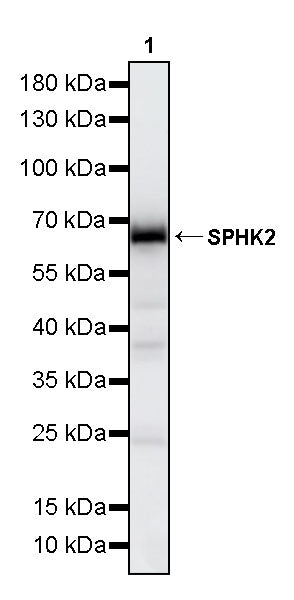
WB result of SPHK2 Recombinant Rabbit mAb
Primary antibody: SPHK2 Recombinant Rabbit mAb at 1/1000 dilution
Lane 1: rat liver whole cell lysate 20 µg
Secondary antibody: Goat Anti-rabbit IgG, (H+L), HRP conjugated at 1/10000 dilution
Predicted MW: 70 kDa
Observed MW: 68 kDa