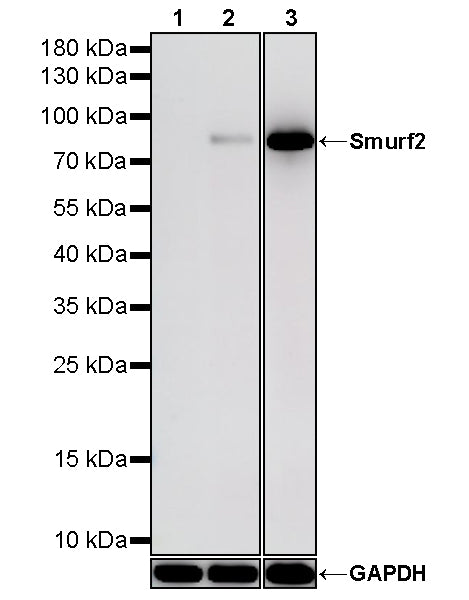
WB result of Smurf2 Recombinant Rabbit mAb
Primary antibody: Smurf2 Recombinant Rabbit mAb at 1/1000 dilution
Lane 1: Raji whole cell lysate 20 µg
Lane 2: U-2 OS whole cell lysate 20 µg
Lane 3: HCT 116 whole cell lysate 20 µg
Negative control: Raji whole cell lysate 20 µg
Secondary antibody: Goat Anti-Rabbit IgG (H+L), HRP conjugated at 1/10000 dilution
Predicted MW: 86 kDa
Observed MW: 86 kDa
This blot was developed with high sensitivity substrate
Smurf2 Recombinant Rabbit mAb (S-4815-23)
Smurf2 Recombinant Rabbit mAb (S-4815-23)
Price:
Regular price
$100 USD
Regular price
Sale price
$100 USD
Unit price
per
For shipping services or bulk orders, you may request a quotation.
Secure checkout with

View full details
Product Details
Product Details
Product Specification
| Host | Rabbit |
| Antigen | Smurf2 |
| Synonyms | E3 ubiquitin-protein ligase SMURF2; HECT-type E3 ubiquitin transferase SMURF2; SMAD ubiquitination regulatory factor 2; SMAD-specific E3 ubiquitin-protein ligase 2; SMURF2 |
| Immunogen | Synthetic Peptide |
| Location | Cytoplasm, Nucleus, Cell membrane |
| Accession | Q9HAU4 |
| Clone Number | S-4815-23 |
| Antibody Type | Recombinant mAb |
| Isotype | IgG |
| Application | WB |
| Reactivity | Hu |
| Positive Sample | U-2 OS, HCT 116 |
| Purification | Protein A |
| Concentration | 2 mg/ml |
| Conjugation | Unconjugated |
| Physical Appearance | Liquid |
| Storage Buffer | PBS, 40% Glycerol, 0.05% BSA, 0.02% sodium azide |
| Stability & Storage | 12 months from date of receipt / reconstitution, -20 °C as supplied |
Dilution
| application | dilution | species |
| WB | 1:1000 | Hu |
Background
Smurf2 (SMAD-specific E3 ubiquitin protein ligase 2) is a key HECT-type E3 ubiquitin ligase of the NEDD4 family, playing a central role as a "molecular switch" in cellular signaling regulation and homeostasis maintenance. Its structure features distinctive modular architecture: the N-terminal C2 domain mediates membrane binding and can interact with its own HECT catalytic domain to achieve auto-inhibition, preventing excessive enzyme activation; the central three WW domains are responsible for recognizing and binding to specific motifs on substrates or adaptor proteins (such as Smad7); and the C-terminal HECT catalytic domain contains a critical active-site cysteine (Cys716) that executes the transfer of ubiquitin from the E2 enzyme to the substrate. Functionally, the most core role of Smurf2 is negative regulation of the TGF-β/BMP signaling pathway: it forms a complex with Smad7 to target TGF-β type I receptors and receptor-regulated Smad proteins (Smad1/2/3) for ubiquitination and degradation, thereby effectively suppressing signal transduction of this pathway. Additionally, Smurf2 participates in ferroptosis activation (through mediating GSTP1 degradation), positive regulation of the Hedgehog signaling pathway, and various other biological processes. Its substrate spectrum is remarkably broad, including RUNX2, EZH2, RNF20, and others, thereby affecting osteogenic differentiation, cellular senescence, genomic stability, and multiple other aspects. In terms of disease association, Smurf2 exhibits a dual role: it can act as a tumor suppressor (by maintaining RNF20-mediated genomic stability) but may also promote tumorigenesis under specific contexts (such as enhancing colorectal cancer cell migration). Smurf2 dysfunction is closely associated with the development of diffuse large B-cell lymphoma, and mouse model studies have confirmed that its knockout is linked to increased tumor incidence and delayed cellular senescence.
Picture
Picture
Western Blot