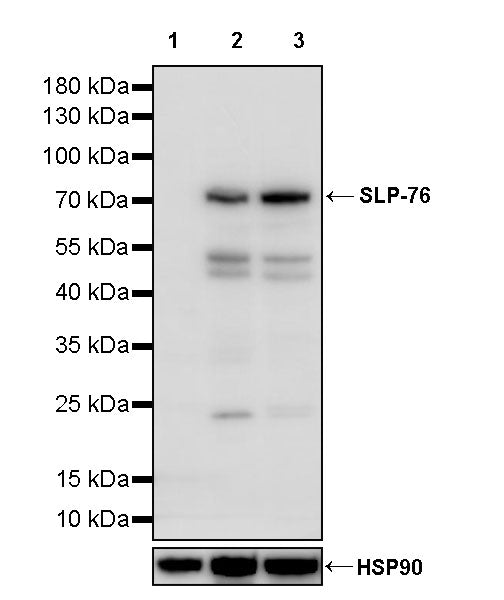
WB result of SLP-76 Recombinant Rabbit mAb
Primary antibody: SLP-76 Recombinant Rabbit mAb at 1/1000 dilution
Lane 1: HeLa whole cell lysate 20 µg
Lane 2: Jurkat whole cell lysate 20 µg
Lane 3: THP-1 whole cell lysate 20 µg
Negative control: HeLa whole cell lysate
Secondary antibody: Goat Anti- rabbit IgG, (H+L), HRP conjugated at 1/10000 dilution
Predicted MW: 60 kDa
Observed MW: 76 kDa
SLP-76 Recombinant Rabbit mAb (S-3472-13)
SLP-76 Recombinant Rabbit mAb (S-3472-13)
Price:
Regular price
$100 USD
Regular price
Sale price
$100 USD
Unit price
per
For shipping services or bulk orders, you may request a quotation.
Secure checkout with

View full details
Product Details
Product Details
Product Specification
| Host | Rabbit |
| Antigen | SLP-76 |
| Synonyms | Lymphocyte cytosolic protein 2; SH2 domain-containing leukocyte protein of 76 kDa; SLP-76 tyrosine phosphoprotein (SLP76); LCP2 |
| Immunogen | Recombinant Protein |
| Location | Cytoplasm |
| Accession | Q13094 |
| Clone Number | S-3472-13 |
| Antibody Type | Recombinant mAb |
| Isotype | IgG |
| Application | WB |
| Reactivity | Hu |
| Positive Sample | Jurkat, THP-1 |
| Purification | Protein A |
| Concentration | 2 mg/ml |
| Conjugation | Unconjugated |
| Physical Appearance | Liquid |
| Storage Buffer | PBS, 40% Glycerol, 0.05% BSA, 0.03% Proclin 300 |
| Stability & Storage | 12 months from date of receipt / reconstitution, -20 °C as supplied |
Dilution
| application | dilution | species |
| WB | 1:1000 | Hu |
Background
SLP-76 (SH2 domain-containing leukocyte protein of 76 kDa) is a 76 kDa adaptor protein encoded by the LCP2 gene. It is primarily expressed in hematopoietic cells such as T cells, natural killer (NK) cells, mast cells, and platelets, where it plays a central scaffolding role in immune receptor signal transduction. The protein contains multiple functional domains: an N-terminal acidic domain, three tyrosine-based signaling motifs (Tyr112, Tyr128, Tyr145), and three serine/proline-rich regions, while the C-terminus harbors an SH2 domain and a SAM domain. Upon T cell receptor (TCR) activation, the upstream kinase ZAP-70 first phosphorylates the N-terminal tyrosine residues of SLP-76; these phosphorylated tyrosine sites then recruit and activate multiple downstream effector molecules, including Vav1 (regulating cytoskeletal rearrangement), Nck (mediating actin polymerization), PLCγ1 (initiating calcium signaling and PKC activation), and Gads (connecting SLP-76 to LAT to form the signalosome). Through these interactions, SLP-76 precisely regulates key processes such as T cell activation, proliferation, differentiation, as well as cytoskeletal remodeling, adhesion, and migration. At the developmental level, SLP-76 is indispensable for positive selection and maturation of T cells in the thymus; knockout of SLP-76 leads to severe blockade of T cell development. Under pathophysiological conditions, dysfunction of SLP-76 is closely associated with immunodeficiency diseases, autoimmune disorders (such as systemic lupus erythematosus), and T cell leukemia/lymphoma.
Picture
Picture
Western Blot