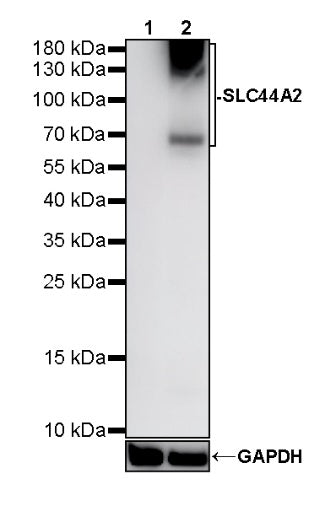
WB result of SLC44A2 Recombinant Rabbit mAb
Primary antibody: SLC44A2 Recombinant Rabbit mAb at 1/1000 dilution
Lane 1: 293F transfected with empty vector whole cell lysate 20 µg
Lane 2: 293F transfected with SLC44A2-Myc-His fusion protein whole cell lysate 20 µg
Secondary antibody: Goat Anti-rabbit IgG (H+L), HRP conjugated at 1/10000 dilution
Predicted MW: 80 kDa
Observed MW: 68-180 kDa
SLC44A2 Recombinant Rabbit mAb (S-4150-4)
SLC44A2 Recombinant Rabbit mAb (S-4150-4)
Price:
Regular price
$100 USD
Regular price
Sale price
$100 USD
Unit price
per
For shipping services or bulk orders, you may request a quotation.
Secure checkout with

View full details
Product Details
Product Details
Product Specification
| Host | Rabbit |
| Antigen | SLC44A2 |
| Immunogen | Synthetic Peptide |
| Location | Mitochondrion, Cell membrane |
| Accession | Q8IWA5 |
| Clone Number | S-4150-4 |
| Antibody Type | Recombinant mAb |
| Isotype | IgG |
| Application | WB |
| Reactivity | Hu, Ms, Rt |
| Predicted Reactivity | GP |
| Purification | Protein A |
| Concentration | 0.5 mg/ml |
| Conjugation | Unconjugated |
| Physical Appearance | Liquid |
| Storage Buffer | PBS, 40% Glycerol, 0.05% BSA, 0.02% sodium azide |
| Stability & Storage | 12 months from date of receipt / reconstitution, -20 °C as supplied |
Dilution
| application | dilution | species |
| WB | 1:1000 | Hu |
Background
SLC44A2, also known as Choline Transporter-Like Protein 2 (CTL2), is a transmembrane protein that plays multiple important roles in cells. It is primarily localized on the plasma membrane and mitochondria, where it is responsible for mediating the transmembrane transport of substances such as choline. Dysfunction or deficiency of this protein is closely associated with various diseases: it serves as the molecular basis for the human neutrophil antigen 3 (HNA-3) system, among which the HNA-3a phenotype is directly linked to the risk of transfusion-related acute lung injury (TRALI), a potentially fatal transfusion complication; additionally, this protein is the carrier for the newly discovered CTL2 rare blood group system, and its complete deficiency leads to a rare erythrocyte phenotype. Most notably, SLC44A2 is indispensable for the maintenance of auditory function, and its deficiency has been confirmed to cause progressive hearing impairment, as well as being associated with conditions such as aneurysms and epilepsy. Recent studies have also revealed its novel roles in immune regulation, such as participating in the maintenance of immune homeostasis by regulating type I interferon production and bone marrow egress in plasmacytoid dendritic cells (pDCs), while also being involved in the development of diseases such as venous thromboembolism (VTE) through mediating the interaction between neutrophils and platelets.
Picture
Picture
Western Blot