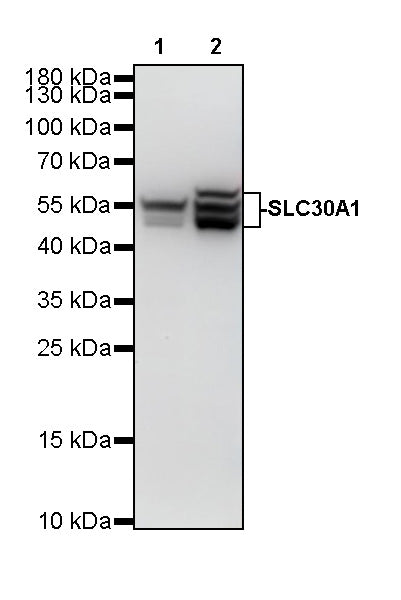
WB result of SLC30A1 Recombinant Rabbit mAb
Primary antibody: SLC30A1 Recombinant Rabbit mAb at 1/1000 dilution
Lane 1: RAW 264.7 whole cell lysate 20 µg
Lane 2: C2C12 whole cell lysate 20 µg
Secondary antibody: Goat Anti-rabbit IgG, (H+L), HRP conjugated at 1/10000 dilution
Predicted MW: 55 kDa
Observed MW: 50~60 kDa
SLC30A1 Recombinant Rabbit mAb (S-4322-3)
SLC30A1 Recombinant Rabbit mAb (S-4322-3)
Price:
Regular price
$100 USD
Regular price
Sale price
$100 USD
Unit price
per
For shipping services or bulk orders, you may request a quotation.
Secure checkout with

View full details
Product Details
Product Details
Product Specification
| Host | Rabbit |
| Antigen | SLC30A1 |
| Synonyms | Proton-coupled zinc antiporter SLC30A1; Solute carrier family 30 member 1Imported; Zinc transporter 1 (ZnT-1); Znt1; Slc30a1 |
| Immunogen | Recombinant Protein |
| Location | Cytoplasm, Cell membrane |
| Accession | Q60738 |
| Clone Number | S-4322-3 |
| Antibody Type | Recombinant mAb |
| Isotype | IgG |
| Application | WB |
| Reactivity | Ms |
| Positive Sample | RAW 264.7, C2C12 |
| Purification | Protein A |
| Concentration | 0.5 mg/ml |
| Conjugation | Unconjugated |
| Physical Appearance | Liquid |
| Storage Buffer | PBS, 40% Glycerol, 0.05% BSA, 0.02% sodium azide |
| Stability & Storage | 12 months from date of receipt / reconstitution, -20 °C as supplied |
Dilution
| application | dilution | species |
| WB | 1:1000 | Ms |
Background
SLC30A1, also known as zinc transporter 1 (ZnT1), is the only member of the SLC30A family primarily localized to the plasma membrane, functioning as a zinc efflux transporter. Structurally, SLC30A1 consists of 507 amino acids and forms a homodimer with six transmembrane domains, with the His43 residue serving as the key site for selective recognition and transport of zinc ions. At the physiological functional level, the most critical role of this protein is to mediate zinc efflux from intestinal epithelial cells across the basolateral membrane into the bloodstream, thereby playing an irreplaceable role in maintaining systemic zinc homeostasis; simultaneously, it prevents zinc-induced cytotoxicity by exporting excess intracellular zinc. Dysfunction of SLC30A1 is closely associated with various diseases: for instance, its loss of function leads to lethality in mice due to impaired intestinal barrier integrity and severe inflammatory responses, while gain-of-function somatic mutations serve as one of the drivers of endocrine hypertensive diseases such as aldosterone-producing adenomas and primary aldosteronism. Additionally, its aberrant expression has also been linked to the development and progression of various tumors, including cervical cancer, as well as poor prognosis.
Picture
Picture
Western Blot