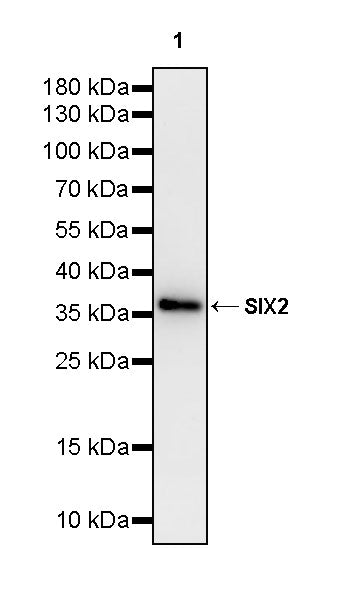
WB result of SIX2 Recombinant Rabbit mAb
Primary antibody: SIX2 Recombinant Rabbit mAb at 1/1000 dilution
Lane 1: RD whole cell lysate 20 µg
Secondary antibody: Goat Anti- rabbit IgG, (H+L), HRP conjugated at 1/10000 dilution
Predicted MW: 32 kDa
Observed MW: 37 kDa
This blot was developed with high sensitivity substrate
SIX2 Recombinant Rabbit mAb (S-4226-19)
SIX2 Recombinant Rabbit mAb (S-4226-19)
Price:
Regular price
$100 USD
Regular price
Sale price
$100 USD
Unit price
per
For shipping services or bulk orders, you may request a quotation.
Secure checkout with

View full details
Product Details
Product Details
Product Specification
| Host | Rabbit |
| Antigen | SIX2 |
| Synonyms | Homeobox protein SIX2 |
| Immunogen | Recombinant Protein |
| Location | Nucleus |
| Accession | Q9NPC8 |
| Clone Number | S-4226-19 |
| Antibody Type | Recombinant mAb |
| Isotype | IgG |
| Application | WB |
| Reactivity | Hu |
| Positive Sample | RD |
| Purification | Protein A |
| Concentration | 0.5 mg/ml |
| Conjugation | Unconjugated |
| Physical Appearance | Liquid |
| Storage Buffer | PBS, 40% Glycerol, 0.05% BSA, 0.02% sodium azide |
| Stability & Storage | 12 months from date of receipt / reconstitution, -20 °C as supplied |
Dilution
| application | dilution | species |
| WB | 1:500-1:1000 | Hu |
Background
SIX2, also known as Homeobox protein SIX2, is a transcription factor composed of 291 amino acids with a molecular weight of approximately 32 kDa, belonging to the SIX/sine oculis homeobox protein family and localized to the cell nucleus. This protein plays a critical role in embryonic development, particularly in kidney development, where it maintains the undifferentiated state of multipotent nephron progenitor cells in the cap mesenchyme, counteracting the inductive signals from the ureteric bud and promoting progenitor cell proliferation in cooperation with WNT9B, thereby ensuring proper renal morphogenesis. This function can be achieved through its interaction with TCF7L2 and OSR1 to prevent the transcription of differentiation genes such as WNT4 in a canonical Wnt-independent manner. In addition, SIX2 is involved in the development of multiple organs, including craniofacial development (regulating chondrocyte differentiation to promote basilar skull elongation), gastric organogenesis (regulating pyloric sphincter formation and mucosal growth), and pharyngeal arch development, and it may also be associated with the development of limb tendons and ligaments. Clinically, the SIX2 gene has been found to be aberrantly expressed in Wilms kidney tumors and serves as a biomarker for chronic kidney disease, with its dysfunction potentially leading to developmental defects or tumorigenesis.
Picture
Picture
Western Blot