WB result of SETDB1 Recombinant Rabbit mAb
Primary antibody: SETDB1 Recombinant Rabbit mAb at 1/1000 dilution
Lane 1: HeLa whole cell lysate 20 µg
Lane 2: HCT 116 whole cell lysate 20 µg
Lane 3: K562 whole cell lysate 20 µg
Lane 4: 293T whole cell lysate 20 µg
Secondary antibody: Goat Anti- rabbit IgG, (H+L), HRP conjugated at 1/10000 dilution
Predicted MW: 143 kDa
Observed MW: 180 kDa
This blot was developed with high sensitivity substrate
SETDB1 Recombinant Rabbit mAb (S-4094-31)
SETDB1 Recombinant Rabbit mAb (S-4094-31)
Price:
Regular price
$100 USD
Regular price
Sale price
$100 USD
Unit price
per
For shipping services or bulk orders, you may request a quotation.
Secure checkout with

View full details
Product Details
Product Details
Product Specification
| Host | Rabbit |
| Antigen | SETDB1 |
| Synonyms | Histone-lysine N-methyltransferase SETDB1; ERG-associated protein with SET domain (ESET); Histone H3-K9 methyltransferase 4 (H3-K9-HMTase 4); Lysine N-methyltransferase 1E; SET domain bifurcated 1; ESET; KIAA0067; KMT1E |
| Immunogen | Synthetic Peptide |
| Location | Cytoplasm, Nucleus |
| Accession | Q15047 |
| Clone Number | S-4094-31 |
| Antibody Type | Recombinant mAb |
| Isotype | IgG |
| Application | WB |
| Reactivity | Hu, Ms, Mk |
| Positive Sample | HeLa, HCT 116, K562, 293T, NIH/3T3, COS-7 |
| Purification | Protein A |
| Concentration | 2 mg/ml |
| Conjugation | Unconjugated |
| Physical Appearance | Liquid |
| Storage Buffer | PBS, 40% Glycerol, 0.05% BSA, 0.02% sodium azide |
| Stability & Storage | 12 months from date of receipt / reconstitution, -20 °C as supplied |
Dilution
| application | dilution | species |
| WB | 1:1000 | Hu, Ms, Mk |
Background
SETDB1 (SET domain bifurcated 1) is a histone methyltransferase that specifically catalyzes the trimethylation of lysine 9 on histone H3 (H3K9me3). This modification serves as a hallmark of heterochromatin formation, compressing chromatin structure by recruiting effector molecules such as HP1 proteins, thereby suppressing gene expression at the transcriptional level. Under physiological conditions, SETDB1 is essential for gene silencing during embryonic development, repression of endogenous retroviruses, and regulation of imprinted genes. However, in cancer, SETDB1 often exerts an oncogenic role through gene amplification or overexpression. It can be upregulated by MAPK signaling pathways driven by KRAS or EGFR, subsequently depositing H3K9me3 to silence tumor suppressor genes or interferon response pathways, helping tumor cells evade senescence and resist immune clearance. Furthermore, SETDB1 also plays a critical role in viral infections and autoimmune diseases, where its dysfunction may lead to the collapse of host defense against retroviruses or aberrant activation of inflammatory responses. Thus, SETDB1 serves as an important hub connecting epigenetic regulation, developmental programs, and tumor immune surveillance.
Picture
Picture
Western Blot
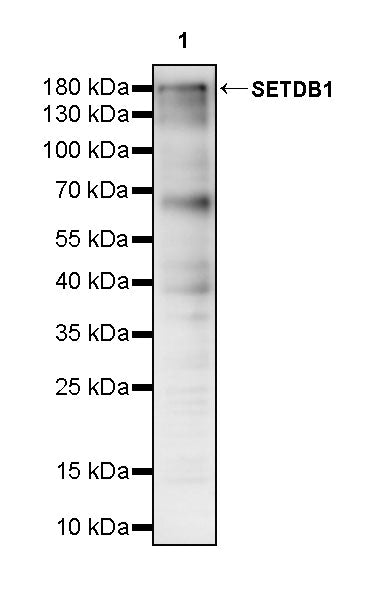
WB result of SETDB1 Recombinant Rabbit mAb
Primary antibody: SETDB1 Recombinant Rabbit mAb at 1/1000 dilution
Lane 1: NIH/3T3 whole cell lysate 20 µg
Secondary antibody: Goat Anti- rabbit IgG, (H+L), HRP conjugated at 1/10000 dilution
Predicted MW: 143 kDa
Observed MW: 180 kDa
This blot was developed with high sensitivity substrate
WB result of SETDB1 Recombinant Rabbit mAb
Primary antibody: SETDB1 Recombinant Rabbit mAb at 1/1000 dilution
Lane 1: COS-7 whole cell lysate 20 µg
Secondary antibody: Goat Anti- rabbit IgG, (H+L), HRP conjugated at 1/10000 dilution
Predicted MW: 143 kDa
Observed MW: 180 kDa
This blot was developed with high sensitivity substrate