

SerpinC1/Antithrombin III His Tag Protein, Mouse
SerpinC1/Antithrombin III His Tag Protein, Mouse
Price:
Regular price
$864 USD
Regular price
Sale price
$864 USD
Unit price
per
For shipping services or bulk orders, you may request a quotation.
Secure checkout with

View full details
Product Details
Product Details
Product Specification
| Species | Mouse |
| Antigen | SerpinC1/Antithrombin III |
| Synonyms | AT3, ATIII |
| Accession | P32261 |
| Amino Acid Sequence | His33-Asn465, with C-terminal 8*His |
| Expression System | HEK293 |
| Molecular Weight | 55-72kDa (Reducing) |
| Purity | >95% by SDS-PAGE |
| Endotoxin | <0.1EU/μg |
| Conjugation | Unconjugated |
| Tag | His Tag |
| Physical Appearance | Lyophilized powder |
| Storage Buffer | PBS, pH7.4 |
| Reconstitution | Reconstitute at 0.1-1 mg/ml according to the size in ultrapure water after rapid centrifugation. |
| Stability & Storage | · 12 months from date of receipt, lyophilized powder stored at -20 to -80℃. · 3 months, -20 to -80℃ under sterile conditions after reconstitution. · 1 week, 2 to 8℃ under sterile conditions after reconstitution. · Please avoid repeated freeze-thaw cycles. |
| Reference | 1.Zeyuan Lu. Feng Wang. SerpinC1/Antithrombin IIIin kidney-related diseases. Clinical Science (2017) 131 823–831. |
Background
The gene SerpinC1encodes a serine protease inhibitor named antithrombin III (ATIII).Thisprotease demonstrates both anticoagulant and anti-inflammatory action. ATIII isthe most important coagulation factor inhibitor, and even minor changes inATIII can significantly alter the risk of thromboembolism. ATIII can alsosuppress inflammation via a coagulation-dependent or -independent effect.Moreover, apart from ATIII deficiency, ATIII and its gene SerpinC1 may also berelated to many diseases (e.g. hypertension, kidney diseases). The presentreview summarizes how ATIII affects the progress of kidney disease and itsmechanism.
Picture
Picture
SDS-PAGE
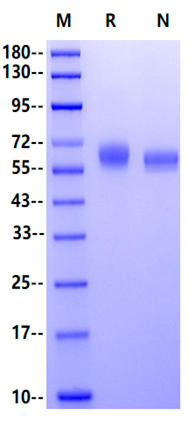
1μg (R: reducing condition, N: non-reducing condition).
