WB result of S1PR1 Recombinant Rabbit mAb
Primary antibody: S1PR1 Recombinant Rabbit mAb at 1/1000 dilution
Lane 1: HT-29 whole cell lysate 20 µg
Lane 2: SH-SY5Y whole cell lysate 20 µg
Lane 3: HepG2 whole cell lysate 20 µg
Lane 4: U-87 MG whole cell lysate 20 µg
Secondary antibody: Goat Anti-rabbit IgG (H+L), HRP conjugated at 1/10000 dilution
Predicted MW: 43 kDa
Observed MW: 52 kDa
This blot was developed with high sensitivity substrate
S1PR1 Recombinant Rabbit mAb (S-4464-22)
S1PR1 Recombinant Rabbit mAb (S-4464-22)
Price:
Regular price
$100 USD
Regular price
Sale price
$100 USD
Unit price
per
For shipping services or bulk orders, you may request a quotation.
Secure checkout with

View full details
Product Details
Product Details
Product Specification
| Host | Rabbit |
| Antigen | S1PR1 |
| Synonyms | Sphingosine 1-phosphate receptor 1; S1P receptor 1; S1P1; Endothelial differentiation G protein-coupled receptor 1; Sphingosine 1-phosphate receptor Edg-1 (S1P receptor Edg-1); CD363; CHEDG1; EDG1 |
| Immunogen | Synthetic Peptide |
| Location | Endosome, Cell membrane |
| Accession | P21453 |
| Clone Number | S-4464-22 |
| Antibody Type | Recombinant mAb |
| Isotype | IgG |
| Application | WB |
| Reactivity | Hu, Ms, Rt |
| Positive Sample | HT-29, SH-SY5Y, HepG2, U-87 MG, rat testis, rat brain, mouse testis, mouse brain |
| Purification | Protein A |
| Concentration | 0.5 mg/ml |
| Conjugation | Unconjugated |
| Physical Appearance | Liquid |
| Storage Buffer | PBS, 40% Glycerol, 0.05% BSA, 0.02% sodium azide |
| Stability & Storage | 12 months from date of receipt / reconstitution, -20 °C as supplied |
Dilution
| application | dilution | species |
| WB | 1:1000 | Hu, Ms, Rt |
Background
Sphingosine-1-phosphate receptor 1 (S1PR1), also known as CD363 or EDG1, is a G protein-coupled receptor that specifically binds the bioactive lipid mediator sphingosine-1-phosphate (S1P) to regulate critical physiological processes including lymphocyte trafficking, vascular development, endothelial barrier integrity, and neuroinflammation. Highly expressed on lymphocytes and endothelial cells, S1PR1 signaling through Gi proteins promotes cytoskeletal rearrangement and cell migration, which is essential for lymphocyte egress from secondary lymphoid organs; consequently, pharmacological modulation of this receptor with agonists like fingolimod induces reversible internalization and functional antagonism that sequesters lymphocytes in lymph nodes, thereby reducing autoimmune neuroinflammation in conditions such as multiple sclerosis. Beyond immunomodulation, S1PR1 plays a pivotal role in maintaining vascular homeostasis by strengthening endothelial adherens junctions and inhibiting vascular permeability, making it a significant therapeutic target not only for autoimmune diseases but also for disorders involving vascular leakage, fibrosis, and cancer metastasis, although its widespread expression necessitates careful management of potential side effects related to cardiovascular and pulmonary function.
Picture
Picture
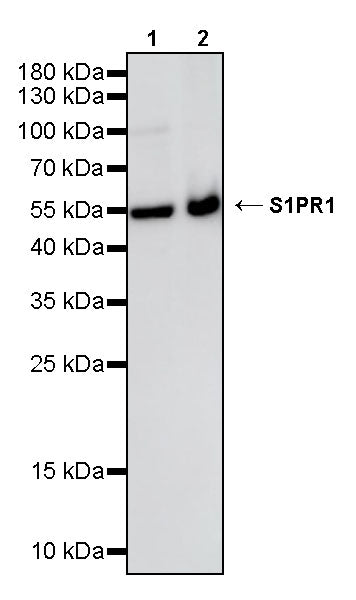
Western Blot
WB result of S1PR1 Recombinant Rabbit mAb
Primary antibody: S1PR1 Recombinant Rabbit mAb at 1/1000 dilution
Lane 1: mouse testis lysate 20 µg
Lane 2: mouse brain lysate 20 µg
Secondary antibody: Goat Anti-rabbit IgG (H+L), HRP conjugated at 1/10000 dilution
Predicted MW: 43 kDa
Observed MW: 52 kDa
WB result of S1PR1 Recombinant Rabbit mAb
Primary antibody: S1PR1 Recombinant Rabbit mAb at 1/1000 dilution
Lane 1: rat testis lysate 20 µg
Lane 2: rat brain lysate 20 µg
Secondary antibody: Goat Anti-rabbit IgG (H+L), HRP conjugated at 1/10000 dilution
Predicted MW: 43 kDa
Observed MW: 52 kDa