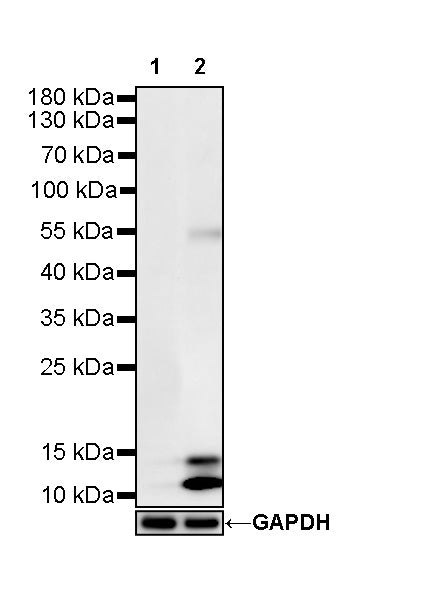
WB result of S-RMabMix™ Propionyllysine Rabbit mAb
Primary antibody: S-RMabMix™ Propionyllysine Rabbit mAb at 1/1000 dilution
Lane 1: untreated HeLa whole cell lysate 20 μg
Lane 2: HeLa treated with Sodium propionate (20mM, 48h) then add Trichostatin A (500ng/mL, 24h) whole cell lysate 20 μg
Secondary antibody: Goat Anti-Rabbit IgG (H+L), HRP conjugated at 1/10000 dilution
Predicted MW: Multiple
Observed MW: Multiple
S-RMabMix™ Propionyllysine Rabbit mAb
S-RMabMix™ Propionyllysine Rabbit mAb
Price:
Regular price
$185 USD
Regular price
Sale price
$185 USD
Unit price
per
For shipping services or bulk orders, you may request a quotation.
Secure checkout with

View full details
Product Details
Product Details
Product Specification
| Antibody Type | Recombinant mAb Mix |
| Isotype | IgG |
| Application | WB |
| Reactivity | Species independent |
| Purification | Protein A |
| Concentration | 1 mg/ml |
| Conjugation | Unconjugated |
| Physical Appearance | Liquid |
| Storage Buffer | PBS, 40% Glycerol, 0.05% BSA, 0.02% sodium azide |
| Stability & Storage | 12 months from date of receipt / reconstitution, -20 °C as supplied |
Dilution
| application | dilution | species |
| Dot Blot | 1:500 | |
| WB | 1:1000 | Species Independent |
Background
Propionyllysine (PRL) is a form of post-translational modification on lysine residues, in which a propionyl group is covalently attached to the ε-amino group of lysine. As a dynamically regulated modification, it was first identified in histones in 2007, and subsequent studies further identified p53, p300, and CREB-binding protein (CBP) as among the first non-histone substrates in vivo, confirming that p300/CBP also possesses propionyltransferase activity and that Sirt1 functions as a depropionylase. In terms of origin, propionyllysine formation occurs through two main routes: first, enzyme-catalyzed, site-specific modification using propionyl-CoA as the donor; second, adducts generated by non-enzymatic reaction of lysine residues with oxidation products of n-3 polyunsaturated fatty acids. In terms of function and pathological significance, enzymatic propionylation shares part of its regulatory machinery with acetylation and may influence chromatin structure and transcriptional activity by competing for or recruiting different effector proteins; non-enzymatic propionyllysine is regarded as a potential biomarker of n-3 fatty acid-derived oxidative stress, and elevated levels have been detected in atherosclerotic lesions and in the urine of diabetic patients. In addition, propionylation is prevalent in human lens proteins, and its levels are negatively regulated by SIRT3 and SIRT5.
Picture
Picture
Western Blot
Dot Blot
Dot blot result of Propionyllysine Rabbit mAb
Lane 1: Modified peptide library (Propionyl lysine)
Lane 2: Unmodified peptide library control
Lane 3: Modified peptide library (Fumaryl lysine)
Lane 4: Modified peptide library (Crotonyl lysine)
Lane 5: Modified peptide library (Succinyl lysine)
Lane 6: Modified peptide library (lactyl lysine)
Lane 7: Modified peptide library (Actyl lysine)
Primary antibody: Propionyllysine Rabbit mAb at 1/500 dilution
Secondary antibody: Goat Anti-rabbit IgG, (H+L), HRP conjugated at 1/10000 dilution