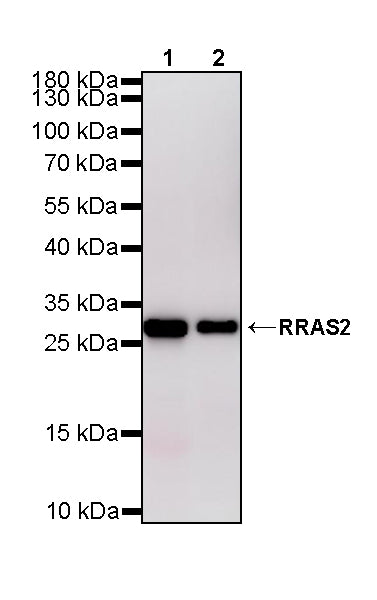
WB result of RRAS2 Recombinant Rabbit mAb
Primary antibody: RRAS2 Recombinant Rabbit mAb at 1/1000 dilution
Lane 1: U-937 whole cell lysate 20 µg
Lane 2: A-431 whole cell lysate 20 µg
Lane 3: SK-OV-3 whole cell lysate 20 µg
Lane 4: Raji whole cell lysate 20 µg
Negative control: U-937 whole cell lysate
Secondary antibody: Goat Anti-rabbit IgG, (H+L), HRP conjugated at 1/10000 dilution
Predicted MW: 23 kDa
Observed MW: 28 kD
RRAS2 Recombinant Rabbit mAb (S-4292-21)
RRAS2 Recombinant Rabbit mAb (S-4292-21)
Price:
Regular price
$100 USD
Regular price
Sale price
$100 USD
Unit price
per
For shipping services or bulk orders, you may request a quotation.
Secure checkout with

View full details
Product Details
Product Details
Product Specification
| Host | Rabbit |
| Antigen | RRAS2 |
| Synonyms | Ras-related protein R-Ras2; Ras-like protein TC21; Teratocarcinoma oncogene; TC21 |
| Immunogen | Synthetic Peptide |
| Location | Cell membrane |
| Accession | P62070 |
| Clone Number | S-4292-21 |
| Antibody Type | Recombinant mAb |
| Isotype | IgG |
| Application | WB |
| Reactivity | Hu, Ms, Rt |
| Positive Sample | A431, SK-OV-3, Raji, NIH/3T3, C2C12, mouse kidney, PC-12, rat kidney |
| Purification | Protein A |
| Concentration | 0.5 mg/ml |
| Conjugation | Unconjugated |
| Physical Appearance | Liquid |
| Storage Buffer | PBS, 40% Glycerol, 0.05% BSA, 0.02% sodium azide |
| Stability & Storage | 12 months from date of receipt / reconstitution, -20 °C as supplied |
Dilution
| application | dilution | species |
| WB | 1:1000-1:2000 | Hu, Ms, Rt |
Background
RRAS2 (Ras-related protein 2) is a member of the RRAS branch of the Ras superfamily, belonging to the small GTPases that function as molecular switches in cellular signal transduction, regulating key processes such as cell proliferation, differentiation, survival, and migration through cycling between GTP-bound (active) and GDP-bound (inactive) states. Unlike classical Ras proteins (HRAS, KRAS, NRAS), RRAS2 exhibits a higher intrinsic GDP/GTP exchange rate and a unique biochemical property of adopting a more active conformation at basal state, enabling it to respond more sensitively to upstream signals. At the functional level, RRAS2 primarily mediates its biological effects through activating PI3K-AKT and RALGDS signaling pathways, rather than the classical RAF-MEK-ERK pathway, and plays particularly important roles in regulating cell adhesion, cytoskeletal rearrangement, and integrin-mediated signal transduction. Given its critical role in cell survival and migration, aberrant expression or activity of RRAS2 is closely associated with the development and progression of various tumors—in multiple malignancies including breast cancer, ovarian cancer, melanoma, and acute myeloid leukemia, upregulated expression or mutational activation of RRAS2 confers enhanced proliferative capacity and invasiveness to tumor cells, and is correlated with poor patient prognosis and chemotherapy resistance. Therefore, RRAS2 is regarded as a promising anti-cancer therapeutic target, and small-molecule inhibitors as well as intervention strategies targeting its activity are currently under active research and development.
Picture
Picture
Western Blot
WB result of RRAS2 Recombinant Rabbit mAb
Primary antibody: RRAS2 Recombinant Rabbit mAb at 1/1000 dilution
Lane 1: NIH/3T3 whole cell lysate 20 µg
Lane 2: C2C12 whole cell lysate 20 µg
Lane 3: Mouse Kidney lysate 20 µg
Secondary antibody: Goat Anti-rabbit IgG, (H+L), HRP conjugated at 1/10000 dilution
Predicted MW: 23 kDa
Observed MW: 28 kD
WB result of RRAS2 Recombinant Rabbit mAb
Primary antibody: RRAS2 Recombinant Rabbit mAb at 1/1000 dilution
Lane 1: PC-12 whole cell lysate 20 µg
Lane 2: Rat Kidney lysate 20 µg
Secondary antibody: Goat Anti-rabbit IgG, (H+L), HRP conjugated at 1/10000 dilution
Predicted MW: 23 kDa
Observed MW: 28 kD