WB result of RNF166 Recombinant Rabbit mAb
Primary antibody: RNF166 Recombinant Rabbit mAb at 1/1000 dilution
Lane 1: SH-SY5Y whole cell lysate 20 µg
Lane 2: K562 whole cell lysate 20 µg
Lane 3: MCF7 whole cell lysate 20 µg
Lane 4: U-87 MG whole cell lysate 20 µg
Lane 5: THP-1 whole cell lysate 20 µg
Lane 6: Raji whole cell lysate 20 µg
Secondary antibody: Goat Anti- rabbit IgG, (H+L), HRP conjugated at 1/10000 dilution
Predicted MW: 26 kDa
Observed MW: 26 kDa
RNF166 Recombinant Rabbit mAb (S-3509-12)
RNF166 Recombinant Rabbit mAb (S-3509-12)
Price:
Regular price
$100 USD
Regular price
Sale price
$100 USD
Unit price
per
For shipping services or bulk orders, you may request a quotation.
Secure checkout with

View full details
Product Details
Product Details
Product Specification
| Host | Rabbit |
| Antigen | RNF166 |
| Synonyms | E3 ubiquitin-protein ligase RNF166; RING finger protein 166; RING-type E3 ubiquitin transferase RNF166 |
| Immunogen | Synthetic Peptide |
| Location | Cytoplasm |
| Accession | Q96A37 |
| Clone Number | S-3509-12 |
| Antibody Type | Recombinant mAb |
| Isotype | IgG |
| Application | WB |
| Reactivity | Hu, Ms, Rt |
| Positive Sample | SH-SY5Y, K562, MCF7, U-87 MG, THP-1, Raji, mouse heart, mouse brain, rat heart, rat brain |
| Purification | Protein A |
| Concentration | 0.5 mg/ml |
| Conjugation | Unconjugated |
| Physical Appearance | Liquid |
| Storage Buffer | PBS, 40% Glycerol, 0.05% BSA, 0.03% Proclin 300 |
| Stability & Storage | 12 months from date of receipt / reconstitution, -20°C as supplied |
Dilution
| application | dilution | species |
| WB | 1:1000 | Hu, Ms, Rt |
Background
RNF166 (RING Finger Protein 166) is a RING-type E3 ubiquitin ligase (~26.1 kDa, 237 amino acids) containing an N-terminal catalytic RING domain and C-terminal ubiquitin-interacting motifs (UIMs) that functions as a "reader-writer" enzyme capable of recognizing MARUbylation (mono-ADP-ribosylated ubiquitin) and catalyzing atypical K11-, K29-, and K33-linked polyubiquitination chains on diverse substrates. Originally identified as a key regulator of antibacterial autophagy (xenophagy), RNF166 recruits autophagy adaptors p62/SQSTM1 and NDP52 to intracellular pathogens such as Salmonella and Listeria by specifically ubiquitinating p62 at lysines 91 and 189 with K29/K33 linkages, thereby promoting LC3 recruitment and bacterial clearance without altering general autophagic flux. Beyond host defense, RNF166 plays multifaceted roles in immune signaling by enhancing TRAF3/6 ubiquitination to positively regulate RNA virus-induced interferon-β production, in neurodegeneration by acting as a pro-apoptotic factor that ubiquitinates and degrades XIAP (X-linked inhibitor of apoptosis protein) to activate caspase-dependent cell death in Parkinson's disease models, and in metabolic disease by regulating podocyte mitochondrial function and apoptosis via CYLD signaling in diabetic nephropathy. Additionally, recent studies reveal that RNF166, together with its paralog RNF114, stabilizes tankyrase enzymes through K11-linked diubiquitylation, counteracting RNF146-mediated K48-linked degradation and modulating Wnt/β-catenin cancer signaling pathways.
Picture
Picture
Western Blot
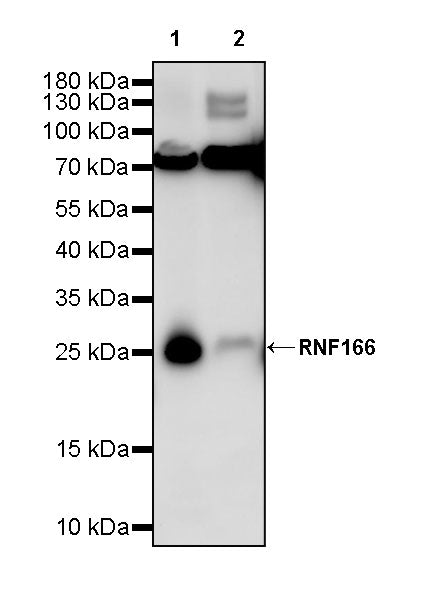
WB result of RNF166 Recombinant Rabbit mAb
Primary antibody: RNF166 Recombinant Rabbit mAb at 1/1000 dilution
Lane 1: mouse heart lysate 20 µg
Lane 2: mouse brain lysate 20 µg
Secondary antibody: Goat Anti- rabbit IgG, (H+L), HRP conjugated at 1/10000 dilution
Predicted MW: 26 kDa
Observed MW: 26 kDa
WB result of RNF166 Recombinant Rabbit mAb
Primary antibody: RNF166 Recombinant Rabbit mAb at 1/1000 dilution
Lane 1: rat heart lysate 20 µg
Lane 2: rat brain lysate 20 µg
Secondary antibody: Goat Anti- rabbit IgG, (H+L), HRP conjugated at 1/10000 dilution
Predicted MW: 26 kDa
Observed MW: 26 kDa