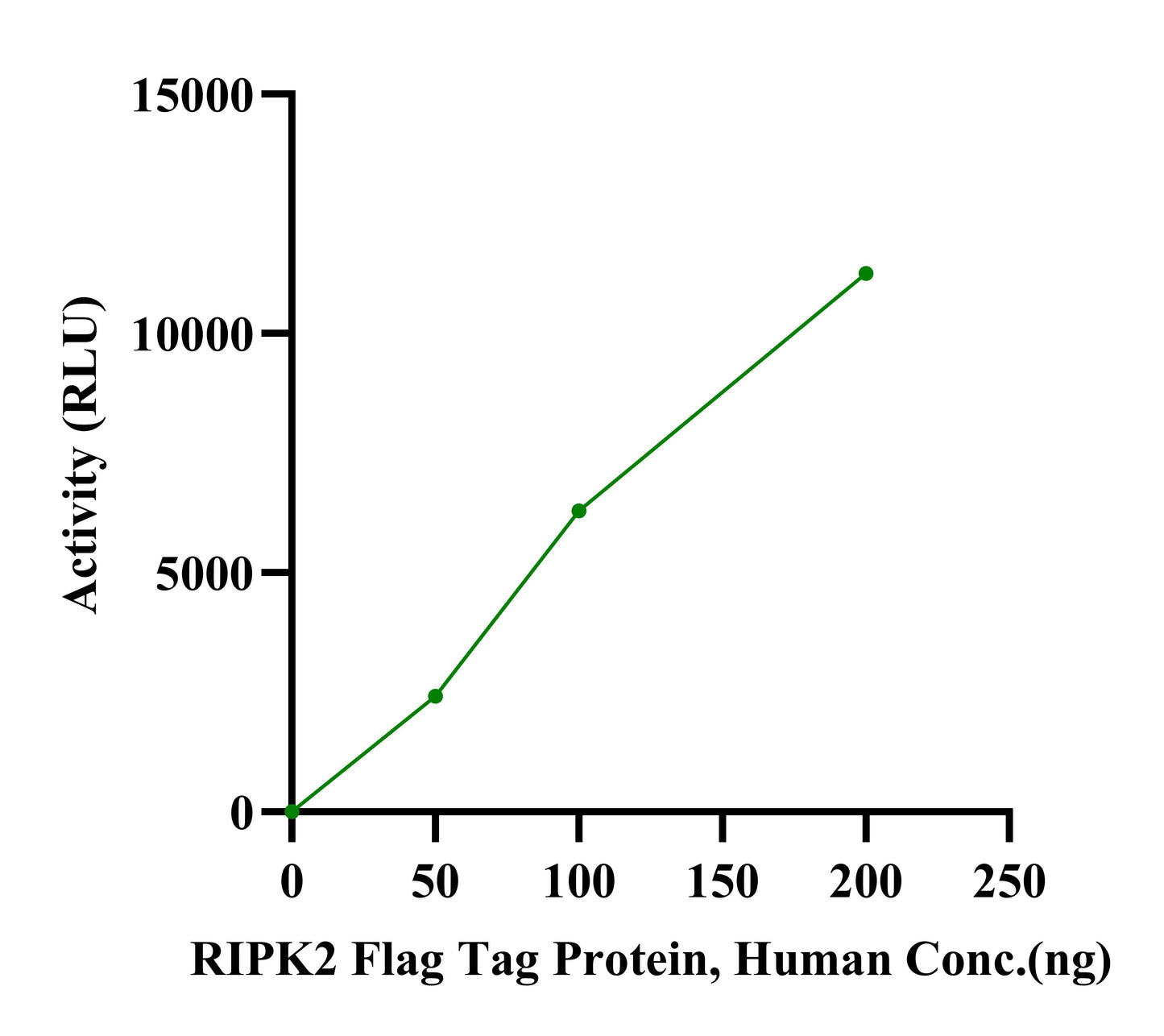
The specific activity of RIPK2 Flag Tag Protein, Human was determined to be >35 pmol/min/ug.
RIPK2 Flag Tag Protein, Human
RIPK2 Flag Tag Protein, Human
Price:
Regular price
$505 USD
Regular price
Sale price
$505 USD
Unit price
per
For shipping services or bulk orders, you may request a quotation.
Secure checkout with

View full details
Product Details
Product Details
Product Specification
| Species | Human |
| Synonyms | RICK, RIP2, CARDIAK,CARD3 |
| Accession | O43353 |
| Amino Acid Sequence | Met1-Ala305 with Flag Tag at the N-Terminus |
| Expression System | Baculovirus-InsectCells |
| Molecular Weight | 35-40kDa (Reducing) |
| Purity | >90% by SDS-PAGE,>95% by HPLC |
| Conjugation | Unconjugated |
| Tag | Flag Tag |
| Physical Appearance | Liquid |
| Storage Buffer | 50mM Tris, 150mM NaCl, PH7.5, 1mM DTT, 10%Glycerol |
| Stability & Storage | Stable for 12 months upon stored at -80℃ from the date of receipt. And avoid repeated freeze-thaws cycles. |
| Reference | 1. Kobayashi, K., et al. (2002). Nod2-dependent regulation of innate and adaptive immunity in the intestinal tract. Science, 307(5710), 731-734. |
Background
RIPK2 (Receptor-Interacting Protein Kinase 2), also known as RICK or CARDIAK, is a serine/threonine kinase that plays a pivotal role in innate and adaptive immune signaling. It functions as a crucial adaptor and signaling kinase downstream of two distinct classes of pattern recognition receptors (PRRs): NOD1 and NOD2 (Nucleotide-binding oligomerization domain-containing proteins). Structurally, RIPK2 contains an N-terminal kinase domain and a C-terminal caspase activation and recruitment domain (CARD), which mediates its homotypic interactions with the CARD domains of NOD1/NOD2.
Given its central role in NOD signaling, dysregulated RIPK2 activity is strongly implicated in the pathogenesis of chronic inflammatory diseases. Genome-wide association studies have linked RIPK2 variants to inflammatory bowel disease (IBD; Crohn's disease and ulcerative colitis), multiple sclerosis, and Blau syndrome. Consequently, RIPK2 has emerged as a promising therapeutic target for these conditions, with significant efforts focused on developing selective small-molecule inhibitors to modulate its kinase activity and disrupt pathogenic signaling.
Protocol
Assay protocol
Principle: The RIPK2 assay is performed using the ADP-GloTM Kinase Assay kit which quantifies the amount of ADP produced by the RIPK2 reaction. The ADP-GloTM Reagent is added to terminate the kinase reaction and to deplete the remaining ATP, and then the Kinase Detection Reagent is added to convert ADP to ATP and to measure the newly synthesized ATP using luciferase/luciferin reaction.
Materials
1.Kinase assay buffer(5X): 200 mM Tris-HCl, pH 7.4, 100 mM MgCl2 and 0.5 mg/mL BSA, 250 μM DTT
2.Kinase assay buffer(1X): 40 mM Tris-HCl, pH 7.4, 20 mM MgCl2, 0.1 mg/mL BSA, 50 μM DTT
3.RIPK2 Flag Tag Protein, Human
4.ADP-Glo Kinase Assay (Promega, Catalog # V6930)
5.Substrate: Myelin basic protein (MBP) (Sinobiological, Catalog #M42-51N)
6.Solid white multi-well plate (384-well plate) (Corning, Catalog #3572)
7.Plate Reader (PerkinElmer)
Produce
1.Prepare a substrate/ATP mixture as follows (25 μM ATP example).
Sample Name |
Amount (μL) |
10 mM ATP Solution |
1 |
Kinase Assay Buffer III (5x) |
79 |
Substrate at 0.5 mg/mL |
80 |
2. Dilute the RIPK2 to 67 μg/mL, 33.5 μg/mL and 16.75 μg/mL in Kinase Assay Buffer (1x) and dispense 3 μL into each well of a 384-well plate.
3. Initiate the reaction by adding 2 μL of the detection system prepared in Step 1 to each well. Include a detection system with 3 μL Kinase Assay Buffer (1x) as Blank. The reaction volume is 5 μL.
4. Incubate the reaction at room temperature (22–25℃) for 40 minutes.
5.Add 5 μL of ADP-Glo Reagent to the completed reaction, mix briefly and incubate for 40 minutes at room temperature (22–25 ℃).
6.Add 10 μL of Detection Reagent and incubate the plate for 30 minutes at room temperature (22–25 ℃).
7.Read at luminescence, respectively in endpoint mode.
8.Calculate specific activity.
• Standard Curve
1.Dilute the ATP and ADP to 25 μM in Kinase Assay Buffer (1x).
2.Mix 25 μΜ ATP and 25 μM ADP to form an ATP+ADP solution provided below and dispense 5 μL into each well of a 384-well plate.
Well Number |
1 |
2 |
3 |
4 |
5 |
6 |
7 |
8 |
9 |
10 |
11 |
12 |
25μM ADP (μL) |
100 |
80 |
60 |
40 |
20 |
10 |
5 |
4 |
3 |
2 |
1 |
0 |
25μM ATP (μL) |
0 |
20 |
40 |
60 |
80 |
90 |
95 |
96 |
97 |
98 |
99 |
100 |
3.Add 5 μL of ADP-Glo Reagent to the completed reaction, mix briefly and incubate for 40 minutes at room temperature (22–25 ℃).
4.Add 10 μL of Detection Reagent and incubate the plate for 30 minutes at room temperature (22–25 ℃).
5.Read at luminescence, respectively in endpoint mode.
6.Detect optical signals and establish conversion curves.
Specific Activity (pmol/min/μg) = |
ATP (pmol)-Blank |
Incubation time(min) ×amount of enzyme (μg) |
Picture
Picture
Bioactivity
SDS-PAGE
2μg (R: reducing condition, N: non-reducing condition).
SEC-HPLC
The purity of RIPK2 Flag Tag Protein, Human is more than 95% determined by SEC-HPLC.