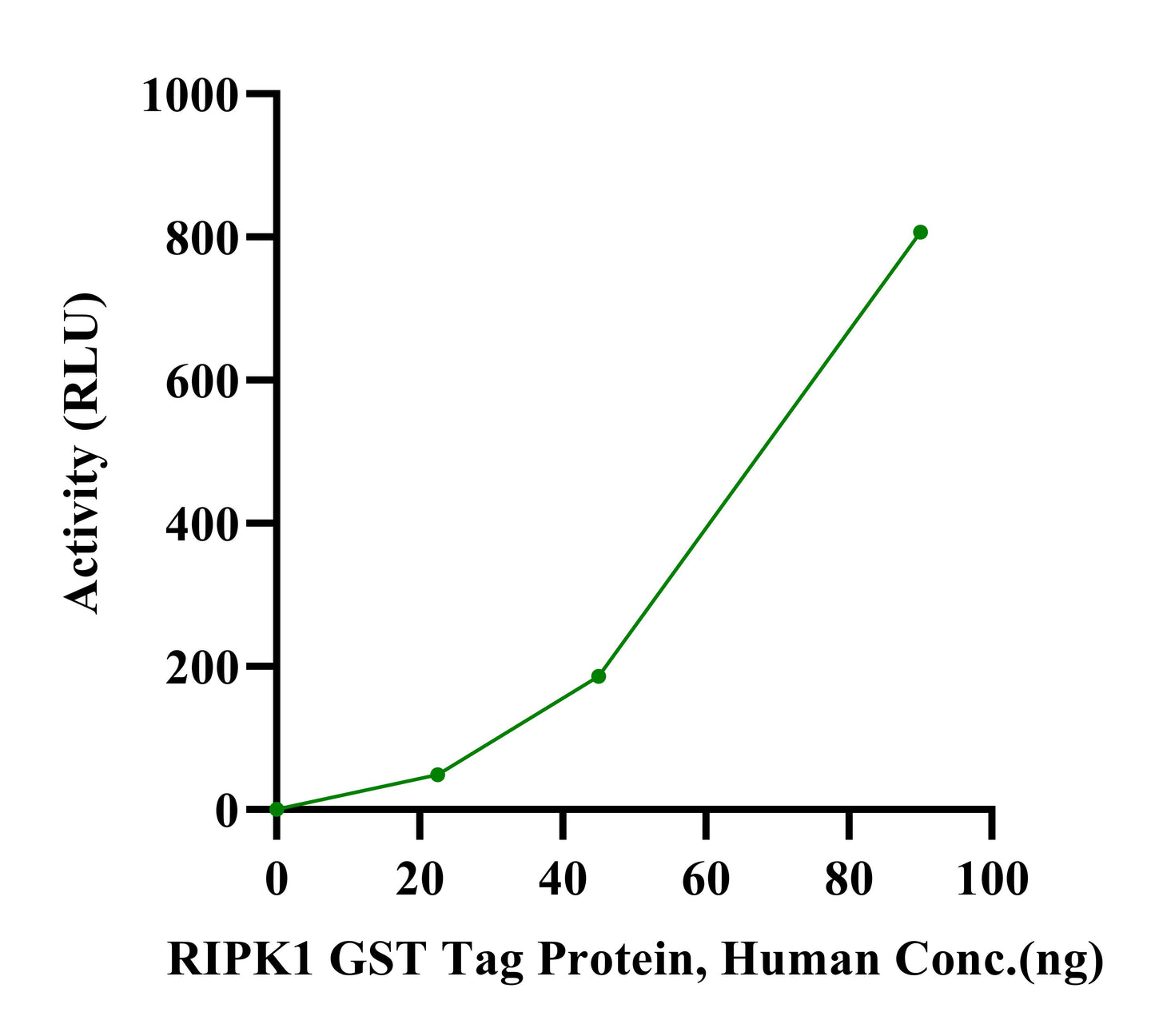
The specific activity of RIPK1 GST Tag Protein, Human was determined to be > 1.1 nmol /min/mg as per activity assay protocol.
RIPK1 GST Tag Protein, Human
RIPK1 GST Tag Protein, Human
Price:
Regular price
$510 USD
Regular price
Sale price
$510 USD
Unit price
per
For shipping services or bulk orders, you may request a quotation.
Secure checkout with

View full details
Product Details
Product Details
Product Specification
| Species | Human |
| Synonyms | RIP, RIP1 |
| Accession | Q13546 |
| Amino Acid Sequence | Met1-Ala327 with GST Tag at the N-Terminus |
| Molecular Weight | 55-70kDa (Reducing) |
| Purity | >90% by SDS-PAGE & HPLC |
| Conjugation | Unconjugated |
| Tag | GST Tag |
| Physical Appearance | Liquid |
| Storage Buffer | 50mM Tris, 150mM NaCl, pH7.5, 1mM DTT, 10%Glycerol |
| Stability & Storage | Stable for 12 months upon stored at -80℃ from the date of receipt. And avoid repeated freeze-thaws cycles. |
| Reference | 1. Clucas, J., & Meier, P. (2023). Roles of RIPK1 as a stress sentinel coordinating cell survival and immunogenic cell death. Nature Reviews Molecular Cell Biology, 24(11), 757-772. |
Background
RIPK1 (Receptor-Interacting Protein Kinase 1), also known as RIP-1, is a multidomain serine/threonine protein kinase encoded by the human RIPK1 gene (located at 6p25.2). It is a master regulator of inflammatory and cell death signaling pathways, acting as a critical "molecular switch" that determines cell fate (survival or death).
RIPK1 exhibits dual functions—its scaffold function (kinase-independent) and its kinase function—which collectively determine the cell's ultimate fate.
RIPK1 activity is tightly controlled by post-translational modifications including ubiquitination, phosphorylation, and Caspase-8-mediated cleavage. Its dysregulation is implicated in various human diseases.
Protocol
Assay protocol
Principle: The RIPK1 assay is performed using the ADP-GloTM Kinase Assay kit which quantifies the amount of ADP produced by the RIPK1 reaction. The ADP-GloTM Reagent is added to terminate the kinase reaction and to deplete the remaining ATP, and then the Kinase Detection Reagent is added to convert ADP to ATP and to measure the newly synthesized ATP using luciferase/luciferin reaction.
Materials
1.Kinase assay buffer(5X): 200 mM Tris-HCl, pH 7.4, 100 mM MgCl2 and 0.5 mg/mL BSA, 250 μM DTT
2.Kinase assay buffer(1X): 40 mM Tris-HCl, pH 7.4, 20 mM MgCl2, 0.1 mg/mL BSA, 50 μM DTT
3.RIPK1 GST Tag Protein, Human
4.ADP-Glo Kinase Assay (UA, Catalog # UA070101)
5.Substrate: MBP Protein (Sinobiological, Catalog # M42-51N)
6.MnCl2 (Sigma, CAS No: 7773-01-5)
7.Solid white multi-well plate (384-well plate) (Corning, Catalog #3572)
8.Plate Reader (PerkinElmer)
Produce
1.Prepare a substrate/ATP mixture as follows.
Sample Name |
Amount (μL) |
10 mM ATP Solution |
1 |
Kinase Assay Buffer III (5x) |
78 |
Substrate at 0.5 mg/mL |
80 |
MnCl2 |
1 |
2. Dilute the RIPK1 to 30 µg/mL, 15 µg/mL and 7.5 µg/mL in Kinase Assay Buffer (1x) and dispense 3 μL into each well of a 384-well plate.
3. Initiate the reaction by adding 2 μL of the detection system prepared in Step 1 to each well. Include a detection system with 3 μL Kinase Assay Buffer (1x) as Blank. The reaction volume is 5 μL.
4. Incubate the reaction at room temperature (22–25℃) for 40 minutes.
5.Add 5 μL of ADP-Glo Reagent to the completed reaction, mix briefly and incubate for 40 minutes at room temperature (22–25 ℃).
6.Add 10 μL of Detection Reagent and incubate the plate for 30 minutes at room temperature (22–25 ℃).
7.Read at luminescence, respectively in endpoint mode.
8.Calculate specific activity.
• Standard Curve
1.Dilute the ATP and ADP to 25 μM in Kinase Assay Buffer (1x).
2.Mix 25 μΜ ATP and 25 μM ADP to form an ATP+ADP solution provided below and dispense 5 μL into each well of a 384-well plate.
Well Number |
1 |
2 |
3 |
4 |
5 |
6 |
7 |
8 |
9 |
10 |
11 |
12 |
25μM ADP (μL) |
100 |
80 |
60 |
40 |
20 |
10 |
5 |
4 |
3 |
2 |
1 |
0 |
25μM ATP (μL) |
0 |
20 |
40 |
60 |
80 |
90 |
95 |
96 |
97 |
98 |
99 |
100 |
3.Add 5 μL of ADP-Glo Reagent to the completed reaction, mix briefly and incubate for 40 minutes at room temperature (22–25 ℃).
4.Add 10 μL of Detection Reagent and incubate the plate for 30 minutes at room temperature (22–25 ℃).
5.Read at luminescence, respectively in endpoint mode.
6.Detect optical signals and establish conversion curves.
Specific Activity (pmol/min/μg) = |
ATP (pmol)-Blank |
Incubation time(min) ×amount of enzyme (μg) |
Picture
Picture
Bioactivity
SDS-PAGE
2μg (R: reducing condition, N: non-reducing condition).
SEC-HPLC
The purity of RIPK1 GST Tag Protein, Human is more than 90% determined by SEC-HPLC.