Immobilized DcR3/TNFRSF6B Protein, Human (hFc) at 2 μg/mL (100 μL/well) can bind Rhesus macaque TNFSF15 Protein, His Tag with EC50 of 7.7-10.3 ng/ml.
Rhesus macaque TNFSF15 Protein, His Tag
Rhesus macaque TNFSF15 Protein, His Tag
Price:
Regular price
$85 USD
Regular price
Sale price
$85 USD
Unit price
per
For shipping services or bulk orders, you may request a quotation.
Secure checkout with

View full details
Product Details
Product Details
Product Specification
| Species | Rhesus macaque |
| Synonyms | Tumor necrosis factor ligand superfamily member 15, TNF ligand-related molecule 1, Vascular endothelial cell growth inhibitor, TNLG1B |
| Accession | F6S8F9 |
| Amino Acid Sequence | Protein sequence (F6S8F9, Leu72-Leu251, with N-His Tag) LKGQEFAPSHQQVYAPLRADGDKPRAHLTVVRQTPTQHLKNQFPALHWEHELGLAFTKNRMNYTNKFLLIPESGDYFVYSQVTFRGMTSECSEIRQAGRPNKPDSITVVITKVTDSYPEPTQLLMGTKSVCEVGSNWFQPIYLGAMFSLQEGDKLMVNVSDISLVDYTKEDKTFFGAFLL |
| Expression System | HEK293 |
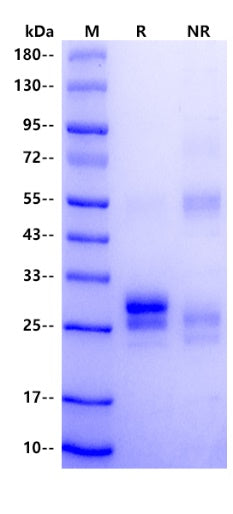
| Molecular Weight | Predicted MW: 22.1 kDaObserved MW: 25-30 kDa |
| Purity | >95% by SDS-PAGE |
| Endotoxin | <1EU/μg |
| Conjugation | Unconjugated |
| Tag | with N-His Tag |
| Physical Appearance | Lyophilized powder |
| Storage Buffer | Lyophilized from a 0.2 μm filtered solution of PBS, pH7.4 with 3% trehalose. |
| Reconstitution | Reconstitute no more than 1 mg/mL according to the size in deionized water after rapid centrifugation. |
| Stability & Storage | 12 months from date of receipt, -20 to -70 °C as supplied. |
Background
TNFSF15 (Tumor Necrosis Factor Superfamily Member 15), also known as TL1A, is a cytokine that binds to death receptor 3 (DR3) and decoy receptor 3 (DcR3). It plays a key role in modulating immune responses, particularly in T-cell activation, inflammation, and autoimmune diseases. TNFSF15 is highly expressed in endothelial cells and contributes to angiogenesis and vascular remodeling. Dysregulation of TNFSF15 is linked to inflammatory disorders (e.g., Crohn’s disease, rheumatoid arthritis) and cancers. Its dual role in pro-inflammatory and anti-angiogenic signaling makes it a potential therapeutic target for immune-mediated and vascular diseases.
Picture
Picture
Bioactivity
SDS-PAGE
2μg(R: reducing conditions; NR: non-reducing conditions)