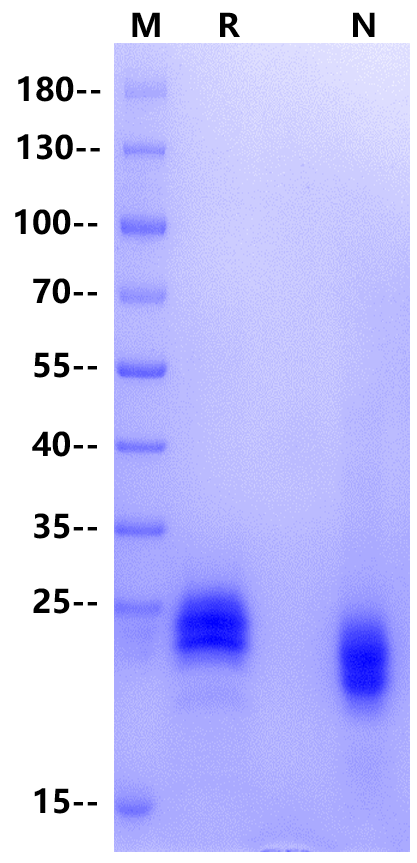
2μg (R: reducing condition, N: non-reducing condition).
Recombinant oxidized IL-33 Protein, Human
Recombinant oxidized IL-33 Protein, Human
Price:
Regular price
$150 USD
Regular price
Sale price
$150 USD
Unit price
per
For shipping services or bulk orders, you may request a quotation.
Secure checkout with

View full details
Product Details
Product Details
Product Specification
| Species | Human |
| Synonyms | Interleukin-33, IL-33, Interleukin-1 family member 11 (IL-1F11), Nuclear factor from high endothelial venules (NF-HEV) |
| Accession | O95760 |
| Amino Acid Sequence | Ser112-Thr270 with His Tag at the N-terminus |
| Expression System | HEK293 |
| Molecular Weight | 20-26 kDa (Reducing) |
| Purity | >95% by SDS-PAGE. |
| Endotoxin | <0.1EU/μg |
| Conjugation | Unconjugated |
| Tag | No Tag |
| Physical Appearance | Lyophilized powder |
| Storage Buffer | PBS, pH7.4 |
| Reconstitution | Reconstitute at 0.1-1 mg/ml according to the size in ultrapure water after rapid centrifugation. |
| Stability & Storage | ·12 months from date of receipt, lyophilized powder stored at -20 to -80℃. |
| Reference | Nature Communications. 2015;6:8327. |
Background
Human Interleukin-33 (IL-33) is an IL-1 family alarmin cytokine released from damaged epithelial and endothelial barriers to elicit immune responses. The reduced form (IL-33red) canonically signals through the ST2 receptor, recruiting IL-1 receptor accessory protein to activate inflammatory pathways. However, IL-33 contains redox-sensitive cysteine residues that form disulfide bonds upon oxidation, generating an oxidized form (IL-33ox). Under physiological conditions, IL-33 is released in an active reduced form but is rapidly oxidized (<4 hours) and inactivated. This conformational switch prevents IL-33ox from binding to membrane-bound ST2. Instead, IL-33ox signals through a novel ST2-independent pathway via the receptor for advanced glycation end products (RAGE) in complex with the epidermal growth factor receptor (EGFR).
Picture
Picture
SDS-PAGE