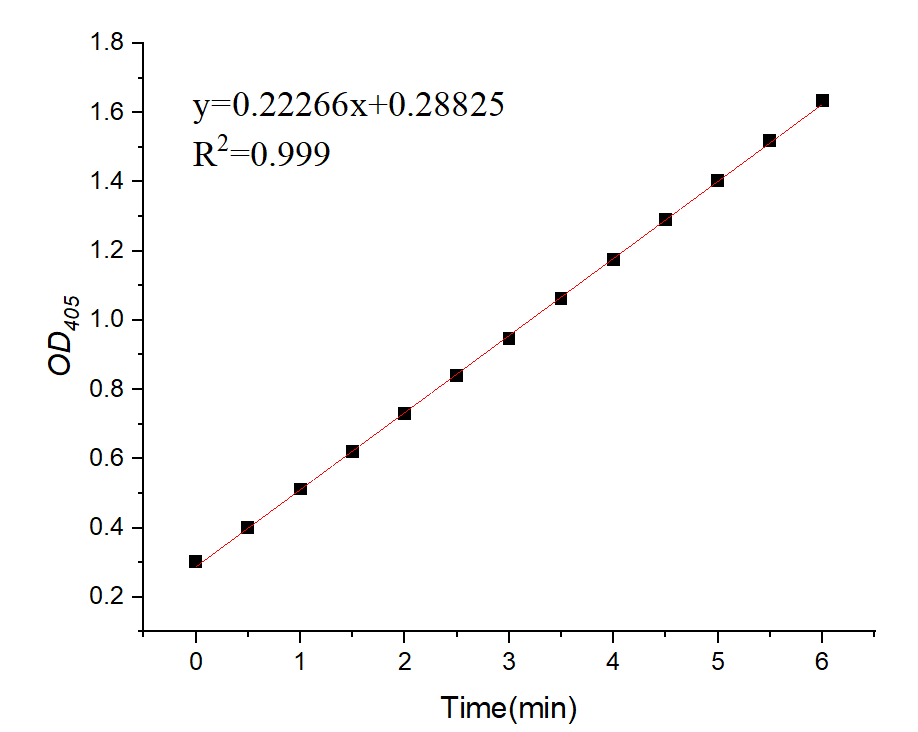
In the experimental design, 250 mM N-p-tosylglycyl-L-prolyl-L-lysine pNitroanilide substrate was prepared, and Recombinant Lys-C (Mass spectrometry grade) was added to the 96-well plate, and the absorption value of 405 nm was read every 30 seconds at 25 ℃.
Recombinant Lys-C (Mass spectrometry grade)
Recombinant Lys-C (Mass spectrometry grade)
Price:
Regular price
$135 USD
Regular price
Sale price
$135 USD
Unit price
per
For shipping services or bulk orders, you may request a quotation.
Secure checkout with

View full details
Product Details
Product Details
Product Specification
| Synonyms | Lys-c (lysyl-endopeptidase), API, Lysyl endopeptidase, Protease I |
| Expression System | E.coli |
| Molecular Weight | 27±2 kDa (Reducing) |
| Purity | >95% by SDS-PAGE |
| Tag | No Tag |
| Storage Buffer | 20 mM Hepes-NaOH,pH 8.0 |
| Reconstitution | Recombinant Lys-C(Mass spectrometry grade) should be reconstituted by the addition of 20~200 μL of 50mM acetic acid. |
| Stability & Storage | Store at -25 ~ -15℃ for 2 years |
| Reference | Takeharu Masaki, et al. Studies on a new proteolytic enzyme from Achromobacter lyticus M497-1 I. Purification and some enzymatic properties, Biochimica et Biophysica Acta (BBA) - Enzymology,Volume 660, Issue 1,1981,Pages 44-50, |
Background
Lys-C is a serine protease originally isolated from the Gram-negative soil bacterium Achromobacter lyticus. It exhibits strict specificity for cleavage at the carboxyl terminus of lysine and S-aminoethylcysteine residues in peptides and proteins. With an optimal temperature range of 30–37 °C, Lys-C serves as a key enzymatic tool in protein sequencing and the synthesis of Lys-X derivatives. Notably thermostable and detergent- and denaturant-tolerant, the enzyme retains full catalytic activity following 6-hour incubation at 30 °C in the presence of 4 M urea or 0.1% SDS—enabling efficient digestion of highly structured, aggregated, or chemically denatured substrates. These properties render Lys-C particularly well suited for diverse proteomics applications, including bottom-up protein identification, peptide mapping by HPLC, and sequence analysis.
Components
Recombinant Lys-C(Mass spectrometry grade) lyophilized
Protocol
1.Reconstitute recombinant Lys-C (mass spectrometry grade) by adding an appropriate volume of 50 mM acetic acid to achieve a final concentration of 0.2mg/mL or the desired working stock concentration. Concurrently, prepare 2*Reaction buffer (50 mM Tris-HCl, 2 mM EDTA, pH 8.5@ 25°C)
2. Set-up a typical reaction as follows
1)Add the following components in sequence
Components |
Volume |
Substrate protein |
5 μL (about 2 - 5 ug) |
ddH2O |
4.5 μL |
2*Reaction buffer |
10 μL |
0.2µg/µL rLys-C |
0.5 μL |
2)Incubate at 37°C for 2~ 4h or overnight
Guidelines
Avoid freeze/thaw cycles
The protocol serves only as guidelines, since digestion conditions vary depending on the objective of the experiment. Typical variables to optimize include: Enzyme-to-substrate ratio: 1:10 to 1:100
Unit Definition
Unit Definition: One unit will hydrolyze 1.0 umole of N-p-tosylglycyl-L-prolyl-L-lysine pNitroanilide per min at pH 7.7 at 25℃
Picture
Picture
Bioactivity