1. WB result of RCC1 Recombinant Rabbit mAb
Primary antibody incubation conditions: overnight at 4°C
Primary antibody: RCC1 Recombinant Rabbit mAb at 1/1000 dilution
Lane 1: HT-29 whole cell lysate 20 µg
Lane 2: Ramos whole cell lysate 20 µg
Lane 3: HeLa whole cell lysate 20 µg
Lane 4: SH-SY5Y whole cell lysate 20 µg
Lane 5: HUVEC whole cell lysate 20 µg
Secondary antibody: Goat Anti- rabbit IgG, (H+L), HRP conjugated at 1/10000 dilution
Predicted MW: 45 kDa
Observed MW: 45 kDa
RCC1 Recombinant Rabbit mAb (S-4864)
RCC1 Recombinant Rabbit mAb (S-4864)
Price:
Regular price
$100 USD
Regular price
Sale price
$100 USD
Unit price
per
For shipping services or bulk orders, you may request a quotation.
Secure checkout with

View full details
Product Details
Product Details
Product Specification
| Host | Rabbit |
| Antigen | RCC1 |
| Synonyms | Regulator of chromosome condensation; Cell cycle regulatory protein; Chromosome condensation protein 1; CHC1 |
| Location | Nucleus |
| Accession | P18754 |
| Clone Number | S-4864 |
| Antibody Type | Recombinant mAb |
| Isotype | IgG |
| Application | WB, ICC |
| Reactivity | Hu, Ms, Rt, Mk |
| Positive Sample | HT-29, Ramos, HeLa, SH-SY5Y, HUVEC, C2C12, PC-12, COS-7 |
| Purification | Protein A |
| Concentration | 0.5 mg/ml |
| Conjugation | Unconjugated |
| Physical Appearance | Liquid |
| Storage Buffer | PBS, 40% Glycerol, 0.05% BSA, 0.03% Proclin 300 |
| Stability & Storage | 12 months from date of receipt / reconstitution, -20 °C as supplied |
Dilution
| application | dilution | species |
| WB | 1:1000 | Hu, Ms, Rt, Mk |
| ICC | 1:500 | Hu |
Background
RCC1 (Regulator of Chromosome Condensation 1) is a highly conserved nuclear protein that functions as the guanine nucleotide exchange factor (GEF) for the small GTPase Ran, playing a fundamental role in nucleocytoplasmic transport and cell cycle regulation. By catalyzing the exchange of GDP for GTP on Ran, RCC1 generates a steep RanGTP gradient across the nuclear envelope, with high concentrations in the nucleus and low levels in the cytoplasm. This gradient serves as a critical spatial cue that directs the assembly and disassembly of transport complexes, enabling the selective trafficking of macromolecules such as proteins and RNAs through nuclear pore complexes. Beyond its canonical function in nucleocytoplasmic transport, RCC1 is essential for mitotic spindle assembly, nuclear envelope formation, and chromatin organization, as its chromatin-bound localization ensures proper coordination between these processes and the cell cycle. Mutations or dysregulation of RCC1 have been implicated in various cellular abnormalities and developmental disorders, underscoring its importance in maintaining genomic integrity and cellular homeostasis.
Picture
Picture
Western Blot
WB result of RCC1 Recombinant Rabbit mAb
Primary antibody incubation conditions: overnight at 4°C
Primary antibody: RCC1 Recombinant Rabbit mAb at 1/1000 dilution
Lane 1: C2C12 whole cell lysate 20 µg
Secondary antibody: Goat Anti- rabbit IgG, (H+L), HRP conjugated at 1/10000 dilution
Predicted MW: 45 kDa
Observed MW: 45 kDa
WB result of RCC1 Recombinant Rabbit mAb
Primary antibody incubation conditions: overnight at 4°C
Primary antibody: RCC1 Recombinant Rabbit mAb at 1/1000 dilution
Lane 1: PC-12 whole cell lysate 20 µg
Secondary antibody: Goat Anti- rabbit IgG, (H+L), HRP conjugated at 1/10000 dilution
Predicted MW: 45 kDa
Observed MW: 45 kDa
WB result of RCC1 Recombinant Rabbit mAb
Primary antibody incubation conditions: overnight at 4°C
Primary antibody: RCC1 Recombinant Rabbit mAb at 1/1000 dilution
Lane 1: COS-7 whole cell lysate 20 µg
Secondary antibody: Goat Anti- rabbit IgG, (H+L), HRP conjugated at 1/10000 dilution
Predicted MW: 45 kDa
Observed MW: 45 kDa
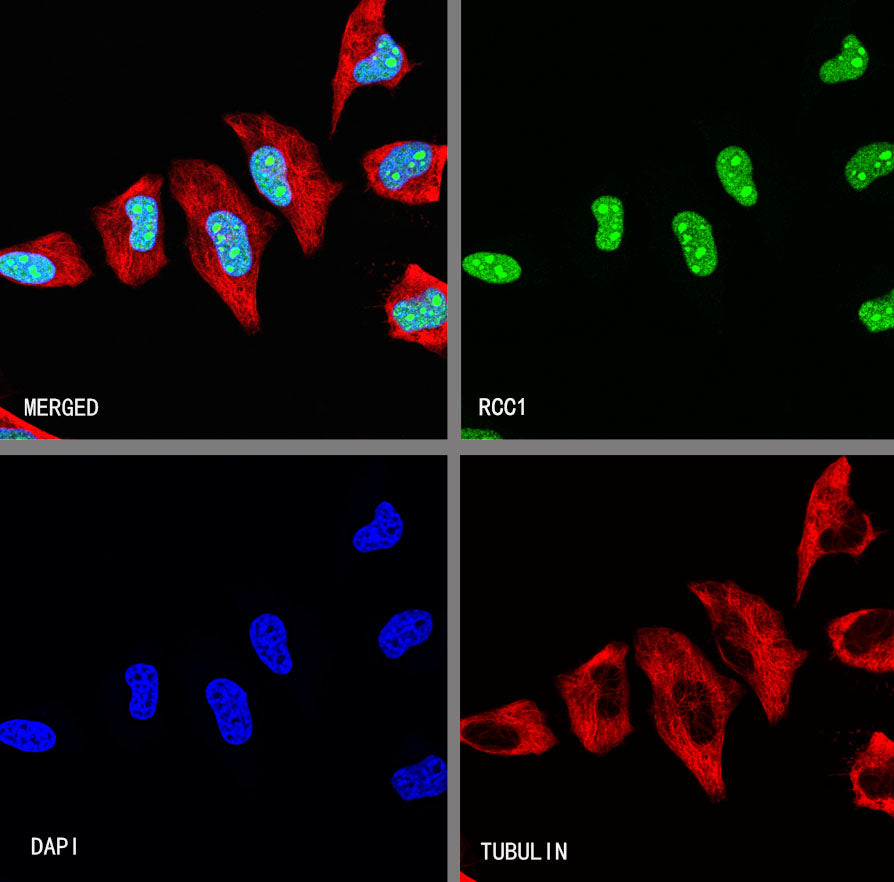
Immunocytochemistry
ICC shows positive staining in HeLa cells. Anti-RCC1 antibody was used at 1/500 dilution (Green) and incubated overnight at 4°C. Goat polyclonal Antibody to Rabbit IgG - H&L (Alexa Fluor® 488) was used as secondary antibody at 1/1000 dilution. The cells were fixed with 4% PFA and permeabilized with 0.1% PBS-Triton X-100. Nuclei were counterstained with DAPI (Blue). Counterstain with tubulin (Red).