WB result of RBM15 Rabbit pAb
Primary antibody: RBM15 Rabbit pAb at 1/1000 dilution
Lane 1: 22Rv1 whole cell lysate 20 µg
Lane 2: HeLa whole cell lysate 20 µg
Lane 3: 293T whole cell lysate 20 µg
Lane 4: HT-29 whole cell lysate 20 µg
Lane 5: SW480 whole cell lysate 20 µg
Lane 6: A431 whole cell lysate 20 µg
Secondary antibody: Goat Anti- rabbit IgG, (H+L), HRP conjugated at 1/10000 dilution
Predicted MW: 107 kDa
Observed MW: 110 kDa
RBM15 Rabbit Polyclonal Antibody
RBM15 Rabbit Polyclonal Antibody
Price:
Regular price
$100 USD
Regular price
Sale price
$100 USD
Unit price
per
For shipping services or bulk orders, you may request a quotation.
Secure checkout with

View full details
Product Details
Product Details
Product Specification
| Host | Rabbit |
| Antigen | RBM15 |
| Synonyms | RNA-binding protein 15; One-twenty two protein 1; RNA-binding motif protein 15; OTT; OTT1 |
| Immunogen | Synthetic Peptide |
| Location | Nucleus |
| Accession | Q96T37 |
| Antibody Type | Polyclonal antibody |
| Isotype | IgG |
| Application | WB, ICC |
| Reactivity | Hu, Ms, Rt |
| Positive Sample | 22Rv1, HeLa, 293T, HT-29, SW480, A431, NIH/3T3, PC-12, rat testis, C6 |
| Purification | Immunogen Affinity |
| Concentration | 0.5 mg/ml |
| Conjugation | Unconjugated |
| Physical Appearance | Liquid |
| Storage Buffer | PBS, 40% Glycerol, 0.05% BSA, 0.02% sodium azide |
| Stability & Storage | 12 months from date of receipt / reconstitution, -20 °C as supplied |
Dilution
| application | dilution | species |
| WB | 1:1000 | Hu, Ms, Rt |
| ICC | 1:500 | Hu |
Background
RBM15, or RNA-binding motif protein 15, is a member of the SPEN family composed of 977 amino acids with a molecular weight of approximately 106 kDa. Its protein structure contains three N-terminal RNA recognition motifs (RRMs) and a C-terminal SPOC domain. As a key adaptor protein within the m6A methyltransferase complex (the WMM complex), RBM15 lacks catalytic activity but is capable of recognizing and binding specific RNA sequences containing stem-loop structures through its RRMs, and it interacts with catalytic subunits such as METTL3 and WTAP via its SPOC domain, thereby precisely recruiting the entire complex to target RNAs and regulating site-specific m6A modification. Physiologically, RBM15 is involved in multiple critical processes, including hematopoietic stem cell homeostasis maintenance, B lymphocyte differentiation, X-chromosome inactivation, and alternative splicing and nuclear export of mRNA. In recent years, numerous studies have demonstrated that RBM15 is aberrantly expressed in various cancers, where it exerts pro-tumorigenic effects by regulating the mRNA stability of downstream genes involved in metabolism or proliferation, thereby promoting proliferation, invasion, and drug resistance in cancers such as lung adenocarcinoma, breast cancer, and cervical cancer, making it a promising new target for cancer therapy.
Picture
Picture
Western Blot
WB result of RBM15 Rabbit pAb
Primary antibody: RBM15 Rabbit pAb at 1/1000 dilution
Lane 1: NIH/3T3 whole cell lysate 20 µg
Secondary antibody: Goat Anti- rabbit IgG, (H+L), HRP conjugated at 1/10000 dilution
Predicted MW: 107 kDa
Observed MW: 110 kDa
WB result of RBM15 Rabbit pAb
Primary antibody: RBM15 Rabbit pAb at 1/1000 dilution
Lane 1: C6 whole cell lysate 20 µg
Lane 2: PC-12 whole cell lysate 20 µg
Lane 3: rat testis lysate 20 µg
Secondary antibody: Goat Anti- rabbit IgG, (H+L), HRP conjugated at 1/10000 dilution
Predicted MW: 107 kDa
Observed MW: 110 kDa
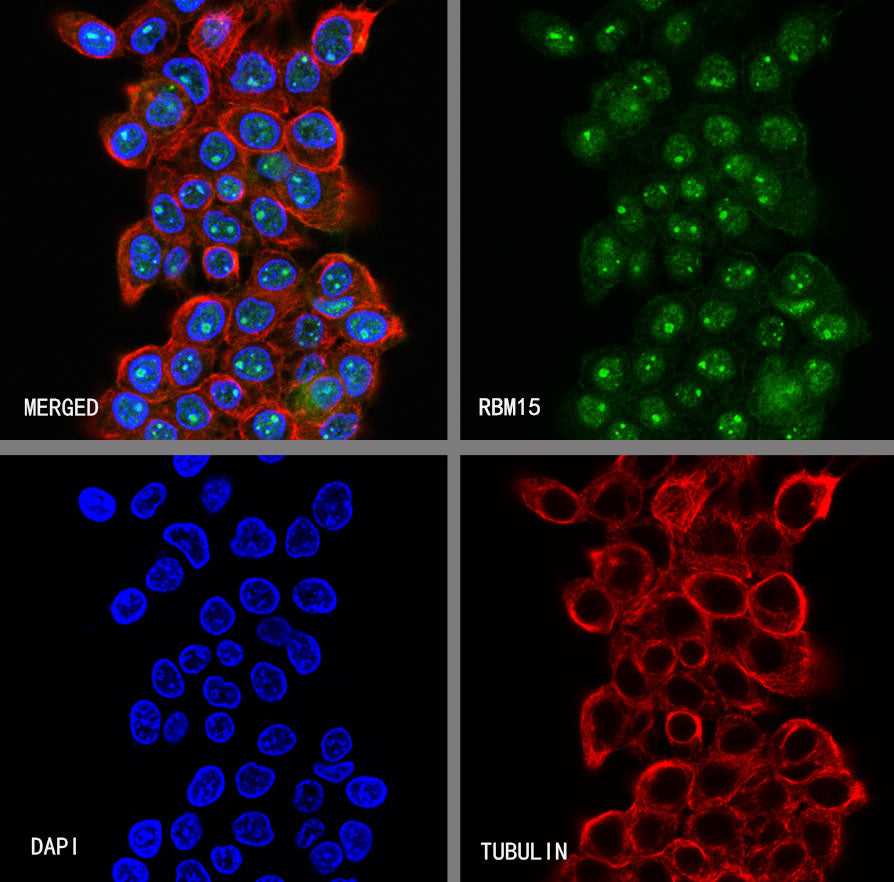
Immunocytochemistry
ICC shows positive staining in A431 cells. Anti- RBM15 antibody was used at 1/500 dilution (Green) and incubated overnight at 4°C. Goat polyclonal Antibody to Rabbit IgG - H&L (Alexa Fluor® 488) was used as secondary antibody at 1/1000 dilution. The cells were fixed with 100% ice-cold methanol and permeabilized with 0.1% PBS-Triton X-100. Nuclei were counterstained with DAPI (Blue). Counterstain with tubulin (Red).