Standard Curve
Example of Rat IL-6 BNP standard curve in Assay Diluent HE4. Plotted are the background-subtracted data.
This standard curve is provided for demonstration only.
Rat IL-6 OneStep ELISA Kit
Rat IL-6 OneStep ELISA Kit
Price:
Regular price
$120 USD
Regular price
Sale price
$120 USD
Unit price
per
For shipping services or bulk orders, you may request a quotation.
Secure checkout with

View full details
Product Details
Product Details
Product Specification
| Antigen | IL-6 |
| Immunogen | Recombinant Protein |
| Antibody Type | Recombinant mAb |
| Reactivity | Rt |
| Purification | Protein A |
| Stability & Storage | 12 months from date of receipt / reconstitution, 2 to 8°C as supplied. |
Kit
| Precision | Intra-assay: 6.2%; Inter-assay: 9.0% |
| Sample type | Serum; EDTA Plasma, Heparin Plasma, Citrate Plasma; Cell Culture Supernatant |
| Assay type | Sandwich (quantitative) |
| Sensitivity | 82.83 pg/mL |
| Range | 4125 pg/mL – 8000 pg/mL |
| Recovery | SD Serum: 104% SD EDTA Plasma: 106% SD Citrate plasma: 107% SD Heparin Plasma: 95% SHR Serum: 89% SHR EDTA Plasma: 97% SHR Citrate plasma: 98% SHR Heparin Plasma: 99% Wistar EDTA Plasma: 100% Leswia Citrate plasma: 106% Cell Culture Supernatant: 106% |
| Assay time | 60 minutes |
| Species reactivity | Ra |
| CROSS REACTIVITY | Mu |
Background
Rat IL-6 (interleukin-6) is a 187-amino acid polypeptide produced by a variety of lymphoid and non-lymphoid cells, including T cells, monocytes, fibroblasts, endothelial cells, and keratinocytes. It is a pleiotropic α-helical cytokine that exists as a single non-glycosylated chain with a molecular mass of approximately 21.7 kDa. Unlike many cytokines that act solely as pro-inflammatory mediators, IL-6 exhibits dual functionality, acting as both a pro-inflammatory cytokine and an anti-inflammatory myokine depending on the physiological context and signaling mode. Its secretion is induced by numerous signals such as mitogenic or antigenic stimulation, lipopolysaccharides, calcium ionophores, and viruses. In rat models, elevated IL-6 levels serve as a reliable biomarker for systemic inflammation, immune activation, and tissue injury. Researchers commonly measure Rat IL-6 to assess the severity of pathological conditions such as arthritis, inflammatory bowel disease, neuropathic pain, and sepsis. Because it can be accurately quantified in serum, plasma, and tissue homogenates by ELISA, IL-6 is a practical and sensitive indicator for preclinical studies of inflammation and immune dysregulation. Thus, it plays a valuable role in evaluating therapeutic interventions in rat models of inflammatory and autoimmune diseases.
Picture
Picture
ELISA
Spike Recovery
The recovery of Rat IL-6 BNP was evaluated in activated samples spiked with concentrations spanning the entire assay range.
Spike-and-dilution Linearity
To evaluate assay linearity, three samples were spiked with high levels of Rat IL-6 BNP in different matrices and serially diluted with the corresponding Calibrator Diluent to fall within the assay's dynamic range.
Intra-Assay Precision (Precision within an assay)
Three samples of known concentration were tested fifteen times on one plate to assess intra-assay precision.
Inter-Assay Precision (Precision between assays).
Three samples of known concentration were tested in separate assays to assess inter-assay precision. Assays were performed with at least three lots of components.
Determination of Minimum Detectable Dose (MDD)
The MDD was determined using three independent lots of assay components. For each lot, 19 replicate measurements of the diluent (zero calibrator) were performed. The mean (AVERAGE) and standard deviation (STDEV) of the 19 replicates were calculated. The MDD for each lot was then calculated according to the following formula:
MDD = 2 × STDEV + AVERAGE
Cross-reactivity
By testing both proteins in the same detection system, the cross-reactivity between rat IL-6, human IL-6, and mouse IL-6 was evaluated. Serial dilutions were performed for each protein and their dose-response curves were determined. The results showed that no significant cross-reactivity was observed when detecting human IL-6 in the rat IL-6 detection system, as the signal was always within the background range of the detection system. A significant cross-reactivity was observed when detecting mouse IL-6 in the rat IL-6 detection system.
HOOK Effect Threshold
The upper limit of the HOOK effect was established at 100× the highest calibrator concentration (equivalent to a 2-log10 increase). No HOOK effect was observed below this threshold, confirming that samples within this concentration range yield reliable quantitative results without signal depression.
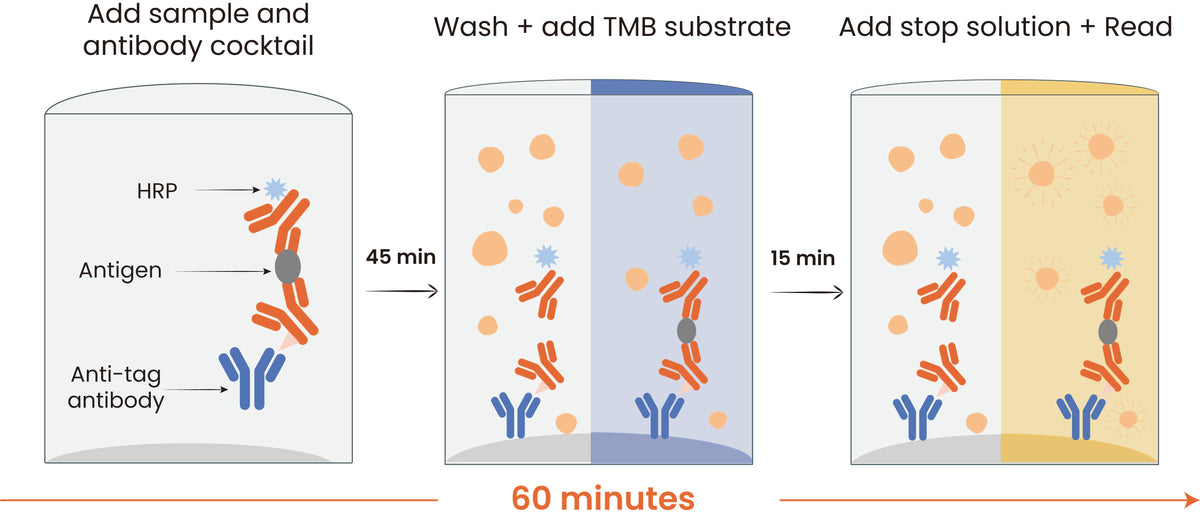
Protocol Diagram