

Rat IL-6 ELISA Kit
Rat IL-6 ELISA Kit
Price:
Regular price
$450 USD
Regular price
Sale price
$450 USD
Unit price
per
For shipping services or bulk orders, you may request a quotation.
Secure checkout with

View full details
Product Details
Product Details
Product Specification
| Usage |
Need to bring your own test equipment 1. Microplate reader (measurable 450nm Absorption value of detection wavelength and 540nm Or 570nm Absorption value of corrected wavelength) 2. High precision liquid dispenser and disposable tip 3. Distilled or deionized water 4. Bottle washer (spray bottle), multi-channel plate washer or automatic plate washer 5. 500mL Measuring cylinder 1. Preparation before the experiment 1. Sample collection and storage ① Cell culture supernatant: particulate matter should be removed by centrifugation; Test the sample immediately. If the sample is not tested in time after collection, it is recommended to pack it according to the amount used once and store it frozen in -20℃ In the refrigerator, avoid repeated freezing and thawing. The sample may need to be used with a diluent ( 1× ) dilution. ② Serum: Use serum separation tubes ( SST ) Collect samples and place samples at room temperature 30 Minutes. Centrifugation 15 Minutes, with a rotation speed of 1000g 。 The serum was removed immediately and tested immediately. If the sample is not tested in time after collection, it is recommended to pack it according to the amount used once and store it frozen in ≤-20℃ In the refrigerator, avoid repeated freezing and thawing. The sample may need to be used with a diluent ( 1× ) dilution. ③ Plasma: Use EDTA , heparin or citric acid as an anticoagulant to collect plasma, after collection 30 Centrifuge within minutes 15 Minutes, with a rotation speed of 1000g , and detect it immediately. If the sample is not tested in time after collection, it is recommended to pack it according to the amount used once and store it frozen in ≤-20℃ In the refrigerator, avoid repeated freezing and thawing. The sample may need to be used with a diluent ( 1× ) dilution. 2. Reagent Preparation ( Please place all reagents and samples at room temperature before use and let them stand 15 Minutes. All experimental samples and standards are recommended Do repeat hole detection ) ①1× Preparation of washing solution: The concentrated washing solution in the kit is 20× Mother liquor should be diluted with distilled water before use to 1× Working fluid. Example: Take 10mL Concentrated wash +190mL Distilled water to volume to 200mL In actual operation, the usage amount can be calculated first, and then prepared. ②1× Preparation of buffer for dilution: The concentration and dilution buffer in the kit is 10× Mother liquor, dilute with distilled water before use to 1× Working fluid. Example: Take 3mL Buffer for concentration and dilution +27mL Distilled water to volume to 30mL 。 In actual operation, the required amount of dilution buffer solution can be calculated according to the sample dilution factor, and then prepared. ③ Antibody detection: Centrifuge the dry powder to the bottom of the tube and use 110uL Buffer for dilution ( 1× ) Dissolve and let stand at room temperature 5 Get after minutes 100× Mother liquor; Before use, dilute to 1× Working fluid. According to the amount per well 100uL Calculate the required volume. Example: Used 10 Hole, then take 10uL Of 100 Double working concentration of detection antibody, using dilution buffer ( 1× ) Constant volume to 1mL , obtained 1mL Of 1× Detection antibody at working concentration. ④SA-HRP : SA-HRP For 40× Mother liquor, use dilution buffer before use ( 1× ) Diluted and formulated 1× Working fluid, the required amount per hole is 100uL 。 Example: Used 10 Hole, then take 25uL Of 40× Mother liquor +975uL Buffer for dilution ( 1× ) Constant volume to 1mL , obtained 1mL Of 1× Detection antibody at working concentration. ⑤ Developer: per well 100uL Calculate the dosage required for the current test, take out the corresponding volume of color developer, and protect it from light; The developer removed is for the same day use only. ⑥ Standard: Dilution buffer for lyophilized standard ( 1× ) Re-dissolved, redissolved volume 1000uL , obtaining a concentration of 8000pg/mL Standard mother liquor. Gently shake at least 5 Minutes, it is fully dissolved. Add to each dilution tube 300uL Buffer for dilution ( 1× )。 Make serial dilutions of the standard mother liquor according to the figure below, and each tube must be thoroughly mixed before pipetting to the next tube. Standard mother liquor without dilution can be used as the highest point of the standard curve ( 8000pg/mL ), buffer for dilution ( 1× ) can be used as a standard curve zero ( 0pg/mL )。 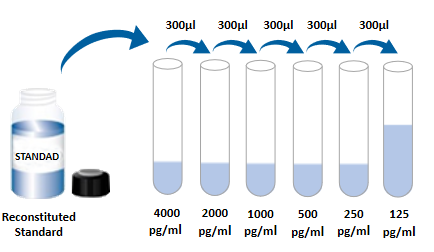 2. Operation steps 1. Prepare all required reagents and standards; 2. Take out the microplate from the sealed bag that has been equilibrated to room temperature. Please put the unused slats back into the aluminum foil bag and re-seal; 3. Add to the microplate 300uL Washing liquid, let stand and soak 30 Seconds, discard the lotion and pat the microplate dry on absorbent paper. Please use it immediately and do not let the microplate dry; 4. Add different concentration standards, experimental samples or quality control articles into the corresponding wells, and each well 100uL 。 Seal the reaction wells with plate sealing tape and incubate at room temperature 2 hour ; 5. Suck the liquid in the plate and wash the plate using a washing bottle, a multi-channel plate washer or an automatic plate washer. Washing solution per well 300uL Then the wash liquid in the plate is aspirated off. Repeat Operation 3 Times. Trying to absorb the residual liquid as much as possible every time you wash the plate will help to get good experimental results. At the end of the last plate washing, please suck all the liquid in the plate or turn the plate upside down, and pat all the residual liquid dry on absorbent paper; 6. Within each well added 100uL Detect antibodies. Seal the reaction wells with plate sealing tape and incubate at room temperature 2 Hour; 7. Repeat th 5 Step washing operation; 8. Within each well added 100uLSA-HRP , room temperature incubation 20 Minutes. Be careful to avoid light; 9. Repeat th 5 Step washing operation; 10. Within each well added 100uL Chromogenic solution, incubate at room temperature 5-30 Minutes, pay attention to avoiding light; 11. Within each well added 50uL Stop solution, the color of the solution in the well will change from blue to yellow. If the color of the solution changes to green or the color changes are inconsistent, pat the microplate gently to mix the solution evenly; 12. After addition of stop solution 30 Within minutes, measured using a plate reader 450nm Absorbance value, set 540nm Or 570nm As a correction wavelength. If dual-wavelength correction is not used, the accuracy of the results may be affected; 13. Calculation results: Add the corrected absorbance values of each standard and sample (OD450-OD540 Or OD570) , average of repeated well readings and then subtract the average zero standard OD Value. Four-parameter logic using computer software (4-PL) Curve fitting creates a standard curve. Another way is to plot the standard concentration and make the logarithm with the corresponding OD The values were logarithmic to generate a curve, and the best fit line was determined by regression analysis. This process can generate a data fit that is sufficiently useful but less accurate. If the sample is diluted, the concentration should be calculated by multiplying the dilution factor.  3. Kit parameters 1. Recovery: Different levels were spiked into cell culture medium samples Rat IL-6 The recovery rate was determined. The recoveries range from 82-110% , the average recovery was in 94% 。 2. Sensitivity: Rat IL-6 The lowest measurable dose ( MDD ) is generally less than 1.8pg/mL 。 The lowest measurable value is determined according to 20 3. Linearity: 4 High concentrations of different samples were incorporated into Rat IL-6 , followed by a diluent ( 1× ) Dilute the sample to the detection range and determine its linearity. 4. ELISA Method can detect natural and recombinant Rat IL-6 1× ) formulated into 50ng/mL Concentration of to detect the correlation with Rat IL-6 Cross-reactivity of. Will 50ng/mL Rat IL-6 In the reference substance, to detect the Rat IL-6
4. Analysis of frequently asked questions 1. No color development after substrate addition (blank well)
2. Flower plate (blank, negative positive control normal, but specimen well OD Values are significantly higher)
|
||||||||||||||||||||||||||||||||||||||||||||||||||||||||
| Species Reactivity | Rat | ||||||||||||||||||||||||||||||||||||||||||||||||||||||||
| Theory | This kit adopts double antibody sandwich enzyme-linked immunosorbent detection technology. Specific anti-rat IL-6 antibodies were pre-coated on high affinity enzyme plates. The standard substance, the sample to be tested and the biotinylated detection antibody are added to the well of the enzyme label plate, and after incubation, IL-6 present in the sample binds to the solid phase antibody and the detection antibody to form an immune complex. After washing to remove unbound material, horseradish peroxidase-labeled Streptavidin-HRP was added. After washing, a chromogenic substrate is added to protect the color from light. A stop solution was added to stop the reaction, and the absorbance value was measured at a wavelength of 450 nm (reference calibration wavelength of 540 nm or 570 nm). | ||||||||||||||||||||||||||||||||||||||||||||||||||||||||
| Synonym | B cell stimulation factor-2, B-cell differentiation factor, BSF2, BSF-2, BSF2CTL differentiation factor, CDF, HGFHSFIFNB2Hybridoma growth factor, IFNB2, IFN-beta-2, IL6, IL-6, IL-6B-cell stimulation factor 2, interferon beta-2, interleukin 6 (interferon, beta 2), interleukin BSF-2, interleukin-6, MGI-2A, Rat interleukin 6 Elisa kit | ||||||||||||||||||||||||||||||||||||||||||||||||||||||||
| Composition |
Please use it within the validity period of the kit (new and old products are shipped randomly)
|
||||||||||||||||||||||||||||||||||||||||||||||||||||||||
| Background | Interleukin -6 IL-6 ) is a system with α A spiral structure, 22-28kDa It plays an important role in the acute phase of disease, inflammation, hematopoiesis, bone metabolism and cancer exacerbation. A mature person IL-6 have 183 Amino acids, with mice and rats IL-6 have 41% Homology of. IL-6 Internal alternative splicing results in a variety of isomers, some of which exhibit antagonistic properties. Known expression IL-6 The cells comprise CD8+T Cells, fibroblasts, synoviocytes, adipocytes, osteoblasts, megakaryocytes, endothelial cells (under the influence of endothelin), sympathetic neurons, cerebral cortical nerve cells, adrenal medullary chromaffin cells, retinal pigment cells, mast cells, keratinocytes, Langerhans cells, fetal and adult astrocytes, neutrophils, monocytes, eosinophils, colonic epithelial cells, B1B β Cells. IL-6 The production is usually under the control of glucocorticoids, catecholamines and secondary sex steroids and is generally associated with cellular activation. In normal human blood IL-6 In 1pg/mL Within the range, there is a slight increase in menstrual period, a moderate increase in some cancers, and a significant increase after surgery. IL-6 Cellular signaling is initiated by a cell surface heterodimeric receptor complex consisting of a ligand-binding subunit ( IL-6 Receptor) and a signal transduction subunit gp130 Composition. IL-6 Binding to IL-6 IL-6 Receptor with gp130 Combination of and gp130 Dimerization of. gp130 Also CLC CNTF 、 CT-1 、 IL-11 IL-27 、 LIF And OSM IL-6 Receptors are produced by alternative splicing and proteolysis. Through a trans-signaling mechanism, soluble IL-6 IL-6 Receptor complexes can trigger surface deficiency IL-6 gp130 Response of cells. IL-6 gp130 Molecular expression is very broad, and trans-signaling enables a wider range of cell type pairs IL-6 Response of. Soluble gp130 The spliceosome prevents IL-6/IL-6R Trans-signal transduction, but does not prevent other cytokine utilization gp130 Signal transduction of molecules as co-receptors. IL-6 With tumor necrosis factor ( TNF ) and IL-1 The acute inflammatory reaction caused by it plays an almost unique role in fever and acute inflammatory reaction of the liver, and it also plays an important role in the transformation of acute inflammation into acquired immunity or chronic inflammatory diseases. IL-6 Disorders contribute to chronic inflammation in cases such as obesity, insulin resistance, inflammatory bowel disease, inflammatory arthritis, and sepsis, often involving IL-6 TGF- Under the conditions of existence, IL-6 In the naive type T Cells to Th17 It plays an important role in the process of inflammatory cell differentiation. IL-6 Modulates bone resorption, and by promoting Th17 The active component of inflammatory cells is the main factor causing inflammatory joint damage in rheumatoid arthritis I 。 L-6 Contributes to the formation and instability of atherosclerotic plaque. but IL-6 It also has anti-inflammatory effects, such as skeletal muscle secretion during physical exercise IL-6 。 It acts as a hematopoietic stem cell growth factor to promote hematopoiesis, induction B The cells mature into plasma cells, immortalized multiple myeloma cells. IL-6 It also promotes but initiates the development of other inflammation-related cancers, such as enteritis-related cancers. |
||||||||||||||||||||||||||||||||||||||||||||||||||||||||
| General Notes | 1. Please use the kit within the validity period. 2. The components of different kits and different batch kits cannot be mixed. 3. If the sample value is greater than the highest value of the standard curve, the sample should be diluted with diluent (1 ×) and re-tested; If the cell culture supernatant sample needs to be distributed and diluted, cell culture medium can be used for other intermediate dilutions except dilution with diluent in the last step. 4. Differences in test results can be caused by a variety of factors, including the operation of the experimenter, the use of the pipette, the plate washing technique, the reaction time or temperature, the storage of the kit, etc. 5. The terminating solution in the kit is an acidic solution. Please protect your glasses, hands, face and clothes when using it. 6. For scientific research only, not for in vitro diagnosis. |
||||||||||||||||||||||||||||||||||||||||||||||||||||||||
| Storage Temp. | Unopened kit, store at 2-8°C | ||||||||||||||||||||||||||||||||||||||||||||||||||||||||
| Test Range | 125pg/mL-8000pg/mL |
Picture
Picture
Immunohistochemistry

