Standard curve
Example of Rat IL-4 standard curve in Assay Diluent .
Rat IL-4 Single Plex Kit (Flow Cytometry Bead Assay)
Rat IL-4 Single Plex Kit (Flow Cytometry Bead Assay)
Price:
Regular price
$585 USD
Regular price
Sale price
$585 USD
Unit price
per
For shipping services or bulk orders, you may request a quotation.
Secure checkout with

View full details
Product Details
Product Details
Product Specification
| Antigen | IL-4 |
| Application | FCM |
| Reactivity | Rat |
| Stability & Storage | 12 months from date of receipt / reconstitution, 2 to 8°C as supplied. |
Kit
| Precision | Intra-assay: 4.73% Inter-assay: |
| Sample type | Serum; Plasma-EDTA; Plasma-Heparin; Plasma-Citrate; Cell Culture Supernatant |
| Assay type | Sandwich (quantitative) |
| Sensitivity | 2.82 pg/mL |
| Range | 13.72 pg/mL-10000 pg/mL |
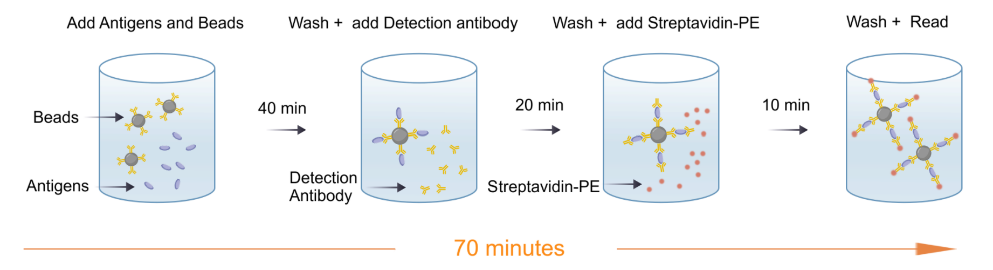
| Assay time | 70 minutes |
| Species reactivity | Rat |
Background
Interleukin-4 (IL-4) is a pleiotropic cytokine that acts as a master regulator of type 2 immunity and humoral immune responses. Mature rat IL-4 is a secreted 123-amino-acid glycoprotein (~14 kDa unglycosylated) structured as a compact four α-helix bundle stabilized by three intramolecular disulfide bonds and carrying N-linked glycosylation sites. It signals through Type I (IL-4Rα/γc) receptors on hematopoietic cells or Type II (IL-4Rα/IL-13Rα1) receptors on non-hematopoietic cells, activating the JAK1/JAK3–STAT6 and IRS-2/PI3K pathways. Secreted predominantly by Th2 cells, basophils, mast cells, eosinophils, and ILC2s, IL-4 drives naive T-cell polarization toward the Th2 phenotype, induces B-cell IgE/IgG1 class switching, promotes alternative (M2) macrophage activation, and counter-regulates Th1-driven inflammation. Mature rat IL-4 shares ~59% amino acid sequence identity with mouse IL-4 and ~41% with human IL-4, displaying pronounced species specificity in receptor binding and antigenicity. In basic and preclinical research, quantifying rat IL-4 in serum, plasma, or cell culture supernatants provides a key readout for allergic and airway inflammation models (such as asthma and atopic dermatitis), Th1/Th2 balance analysis, fibrosis research, and anti-allergic drug evaluation.
Picture
Picture
CBA
Dilution Linearity
Spiked serum and plasma (EDTA, Heparin, Citrate) samples from SD, SHR, and Lewis rats, along with spiked cell culture supernatant, were pre-diluted 1:1 (v/v) with sample diluent (labeled as "Undiluted") and then serially diluted 2X, 4X, and 8X with sample diluent prior to assaying for Rat IL-4. Data shown on the y-axis represent the measured Rat IL-4 concentrations multiplied by their respective serial dilution factors (pg/mL).
Accuracy and Spike Recovery
Serum and plasma (EDTA, Heparin, Citrate) matrices from SD, SHR, and Lewis rats—pre-diluted 1:1 (v/v) in sample diluent—along with cell culture supernatant, were spiked with high, medium, and low levels of Rat IL-4. The y-axis displays the calculated spike recovery percentages (Spike Recovery%) across each tested matrix, demonstrating consistent recovery performance across different rat strains and biological matrices.
Sample Reactivity
Cell culture supernatants from rat spleens left untreated or stimulated with 4 μg/mL Con A for 24 h (n = 3) were assayed for Rat IL-4 (pg/mL). Mean Rat IL-4 concentrations increased from 2.3 pg/mL in untreated controls to 1669.8 pg/mL in Con A-treated cells. Data are presented as mean ± SD.
Protocol Diagram