Standard curve
Example of Rat IL-1β standard curve in Assay Diluent .
Rat IL-1β Single Plex Kit (Flow Cytometry Bead Assay)
Rat IL-1β Single Plex Kit (Flow Cytometry Bead Assay)
Price:
Regular price
$500 USD
Regular price
Sale price
$500 USD
Unit price
per
For shipping services or bulk orders, you may request a quotation.
Secure checkout with

View full details
Product Details
Product Details
Product Specification
| Antigen | IL-1β |
| Reactivity | Rat |
| Stability & Storage | 12 months from date of receipt / reconstitution, 2 to 8°C as supplied. |
Kit
| Precision |
Intra-assay: 5.76% Inter-assay: 6.73% |
||||||||||||||||||||||||||||||
| Sample type | Serum; Plasma-EDTA; Plasma-Heparin; Plasma-Citrate; Cell Culture Supernatant |
||||||||||||||||||||||||||||||
| Assay type | Sandwich (quantitative) |
||||||||||||||||||||||||||||||
| Sensitivity | 7.83 pg/mL |
||||||||||||||||||||||||||||||
| Range | 82.3 pg/mL-60000 pg/mL |
||||||||||||||||||||||||||||||
| Recovery |
|
||||||||||||||||||||||||||||||
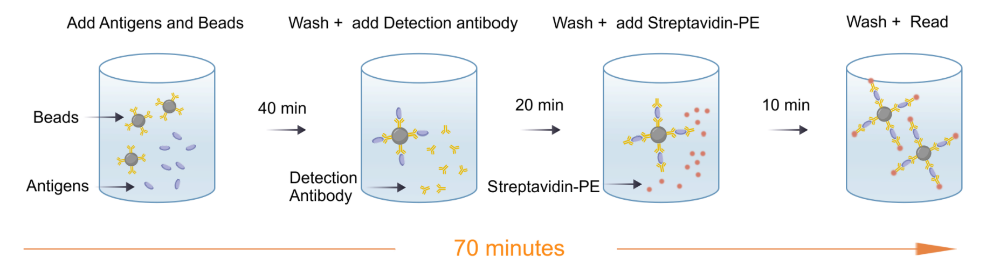
| Assay time | 70 minutes |
||||||||||||||||||||||||||||||
| Species reactivity | Rat |
||||||||||||||||||||||||||||||
Background
Interleukin-1 beta (IL-1β) is a potent pro-inflammatory cytokine central to innate immunity, host defense, and inflammatory signaling. Synthesized as an inactive 268-amino-acid precursor (pro-IL-1β, ~31 kDa) lacking a classical signal peptide, rat IL-1β requires proteolytic cleavage by inflammasome-activated caspase-1 to release the biologically active 152-amino-acid mature monomer (~17 kDa, unglycosylated) adopting a β-trefoil fold. Mature IL-1β binds the cell-surface receptor IL-1R1 and recruits the accessory protein IL-1RAcP, triggering MyD88-dependent NF-κB and MAPK pathways. Secreted predominantly by monocytes, macrophages, dendritic cells, and microglia upon pathogen- or damage-associated stimulation, it induces fever, acute-phase responses, leukocyte recruitment, and Th17 differentiation. Although mature rat IL-1β shares ~90% amino acid sequence identity with mouse IL-1β and ~78% with human IL-1β, species-specific epitopes necessitate rat-specific detection assays. In basic and preclinical research, quantifying rat IL-1β in serum, plasma, or cell culture supernatants serves as a core biomarker for studying inflammasome activation and pyroptosis, inflammatory and autoimmune models (such as arthritis, colitis, and sepsis), neuroinflammation, and the efficacy or safety of anti-inflammatory therapeutics.
Picture
Picture
CBA
Dilution Linearity
Spiked serum and plasma (EDTA, Heparin, Citrate) samples from SD, SHR, and Lewis rats, along with spiked cell culture supernatant, were pre-diluted 1:1 (v/v) with sample diluent (labeled as "Undiluted") and then serially diluted 2X, 4X, and 8X with sample diluent prior to assaying for Rat IL-1β. Data shown on the y-axis represent the measured Rat IL-1β concentrations multiplied by their respective serial dilution factors (pg/mL).
Accuracy and Spike Recovery
Serum and plasma (EDTA, Heparin, Citrate) matrices from SD, SHR, and Lewis rats—pre-diluted 1:1 (v/v) in sample diluent—along with cell culture supernatant, were spiked with high, medium, and low levels of Rat IL-1β. The y-axis displays the calculated spike recovery percentages (Spike Recovery%) across each tested matrix, demonstrating consistent recovery performance across different rat strains and biological matrices.
Sample Reactivity
Cell culture supernatants from rat splenocytes left untreated or stimulated with 1 μg/ml LPS for 24 h (n = 1) were assayed for Rat IL-1β (pg/mL). Mean Rat IL-1β concentrations increased from 5.6 pg/mL in untreated controls to 112.7 pg/mL in LPS -treated cells.
Protocol Diagram