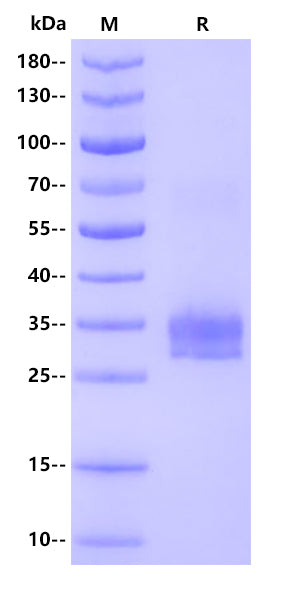
2μg(R: reducing conditions)
Rat IgA Protein, His Tag
Rat IgA Protein, His Tag
Price:
Regular price
$15 USD
Regular price
Sale price
$15 USD
Unit price
per
For shipping services or bulk orders, you may request a quotation.
Secure checkout with

View full details
Product Details
Product Details
Product Specification
| Species | Rat |
| Synonyms | Immunoglobulin A |
| Accession | CAD52870.1 |
| Amino Acid Sequence | Protein sequence (CAD52870.1, Pro110-Try339, with C-His Tag) PRLSLQRPALEDLLLGSEASLTCTLRGLKEPTGAVFTWQPTTGKDAVQKEAVQDSCGCYTVSSVLPGCAERWNNGETFTCTATHPEFETPLTGEIAKVTENTFPPQVHLLPPPSEELALNELVSLTCLVRGFNPKDVLVRWLQGNEELPSESYLVFEPLREPGEGAITYLVTSVLRVSAETWKQGAQYSCMVGHEALPMSFTQKTIDRLSGKPTNVNVSVIMSEGDGICY |
| Expression System | HEK293 |
| Molecular Weight | Predicted MW: 26.8 kDaObserved MW: 27-35 kDa |
| Purity | >95% by SDS-PAGE |
| Endotoxin | <1EU/μg |
| Conjugation | Unconjugated |
| Tag | with C-His Tag |
| Physical Appearance | Lyophilized powder |
| Storage Buffer | Lyophilized from a 0.2 μm filtered solution of PBS, pH7.4 with 3% trehalose. |
| Reconstitution | Reconstitute no more than 1 mg/mL according to the size in deionized water after rapid centrifugation. |
| Stability & Storage | 12 months from date of receipt, -20 to -70 °C as supplied. |
Background
Rat Immunoglobulin A (IgA) is a key antibody isotype mediating mucosal immunity in rodents. It exists predominantly in a dimeric form stabilized by the joining (J) chain, facilitating polymeric immunoglobulin receptor (pIgR)-dependent transcytosis across epithelial surfaces into secretions such as bile, intestinal lumen, and milk. In rats, IgA plays a critical role in gut homeostasis by neutralizing pathogens and regulating commensal microbiota without eliciting pro-inflammatory responses. Structurally, rat IgA features four heavy chain constant region domains (Cα1–Cα4) and is heavily glycosylated, which influences its stability and interaction with immune cells via Fcα receptors. It is widely utilized in preclinical models to study mucosal vaccine efficacy, inflammatory bowel disease, and hepatobiliary transport mechanisms.
Picture
Picture
SDS-PAGE