Standard Curve
Example of Rat Complement C5a standard curve in Assay Diluent TA2. Plotted are the background-subtracted data.
This standard curve is provided for demonstration only.
Rat Complement C5a OneStep competitive ELISA Kit
Rat Complement C5a OneStep competitive ELISA Kit
Price:
Regular price
$495 USD
Regular price
Sale price
$495 USD
Unit price
per
For shipping services or bulk orders, you may request a quotation.
Secure checkout with

View full details
Product Details
Product Details
Product Specification
| Antigen | C5a; Complement C5a |
| Immunogen | Recombinant Protein |
| Antibody Type | Recombinant mAb |
| Reactivity | Rt |
| Purification | Protein A |
| Stability & Storage | 12 months from date of receipt / reconstitution, 2 to 8°C as supplied. |
Kit
| Precision | Intra-assay: 6.7%; Inter-assay: 8.1% |
| Sample type | Serum; EDTA Plasma, Heparin Plasma, Citrate Plasma; Cell Culture Supernatant |
| Assay type | Sandwich (quantitative) |
| Sensitivity | 3.48 ng/mL |
| Range | 15.6 ng/mL – 1000 ng/mL |
| Recovery | Serum: 113% EDTA Plasma: 99% Heparin Plasma: 109% Citrate plasma: 90% Cell Culture Supernatant: 101% |
| Assay time | 60 minutes |
| Species reactivity | Rt |
| CROSS REACTIVITY | Ms, Gp |
Background
Rat C5a is a 74-amino-acid peptide generated by proteolytic cleavage of the complement component C5 during activation of the complement cascade. As a potent anaphylatoxin and chemotactic factor, it binds to the G-protein-coupled receptor C5aR (CD88), which is expressed on neutrophils, macrophages, mast cells, and endothelial cells. Upon receptor activation, C5a induces strong chemotaxis of neutrophils and monocytes to sites of inflammation, promotes degranulation and oxidative burst, and increases vascular permeability. In rats, C5a also stimulates the release of proinflammatory cytokines such as TNF-α and IL-6, thereby amplifying the innate immune response. Notably, rat C5a has been widely used in experimental models to study complement-mediated diseases, including sepsis, acute lung injury, and ischemia-reperfusion injury. Its biological activity is tightly regulated by carboxypeptidase R, which removes the C-terminal arginine to produce the less potent C5a-desArg form. Therefore, rat C5a serves as a critical mediator of inflammatory responses and a valuable tool for investigating complement-targeted therapies in preclinical research.
Picture
Picture
ELISA
Spike Recovery
The recovery of Rat Complement C5a was evaluated in activated samples spiked with concentrations spanning the entire assay range.
Dilution Linearity
The concentrations of Rat Complement C5a were measured and interpolated from the target standard curves and corrected for sample dilution.
The leftmost bar in the graph shows biological samples diluted in Assay Diluent to 50% concentration. "undiluted" was defined as 50% biological sample. The subsequent bars represent two-fold serial dilutions of this reference.
The mean target concentration was determined to be 151.8 ng/mL in Lewis EDTA plasma.
The mean target concentration was determined to be 541.3 ng/mL in SD serum.
Serum levels in healthy individual rats
Duplicate measurements were performed on serum samples obtained from nine individual healthy rats. Data are reported as dilution factor-corrected interpolated values. The resultant mean Rat Complement C5a concentration was 118.0 ng/mL, with a distribution spanning 14.45 to 600.18 ng/mL across the rat cohort.
Intra-Assay Precision (Precision within an assay)
Three samples of known concentration were tested fifteen times on one plate to assess intra-assay precision.
Inter-Assay Precision (Precision between assays).
Three samples of known concentration were tested in separate assays to assess inter-assay precision. Assays were performed with at least three lots of components.
Determination of Minimum Detectable Dose (MDD)
The MDD was determined using three independent lots of assay components. For each lot, 19 replicate measurements of the diluent (zero calibrator) were performed. The mean (AVERAGE) and standard deviation (STDEV) of the 19 replicates were calculated. The MDD for each lot was then calculated according to the following formula:
MDD = 2 × STDEV + AVERAGE
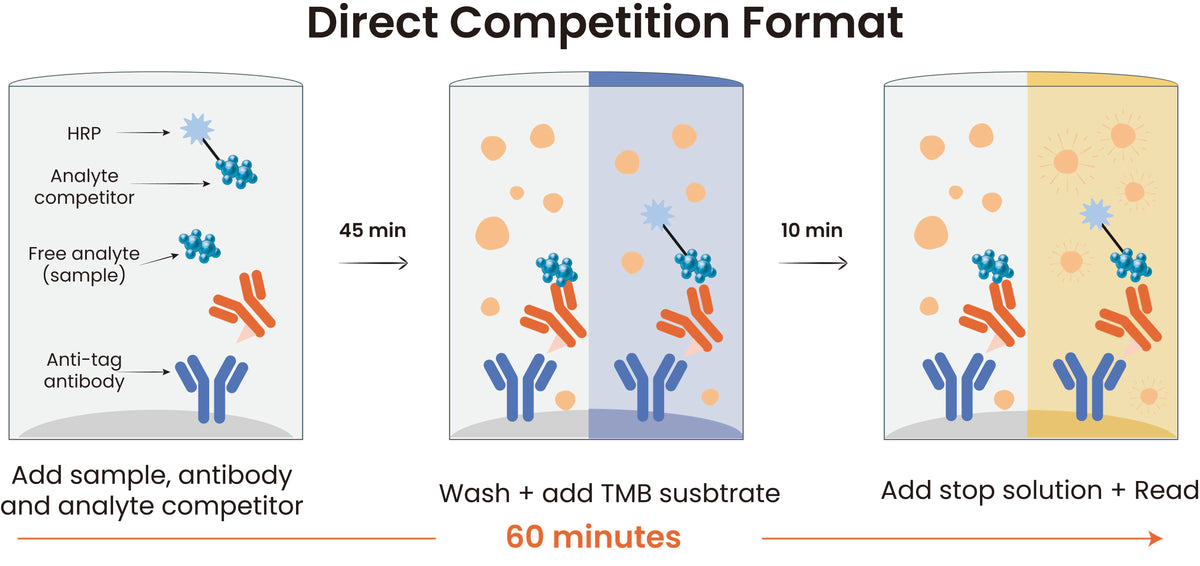
Protocol Diagram