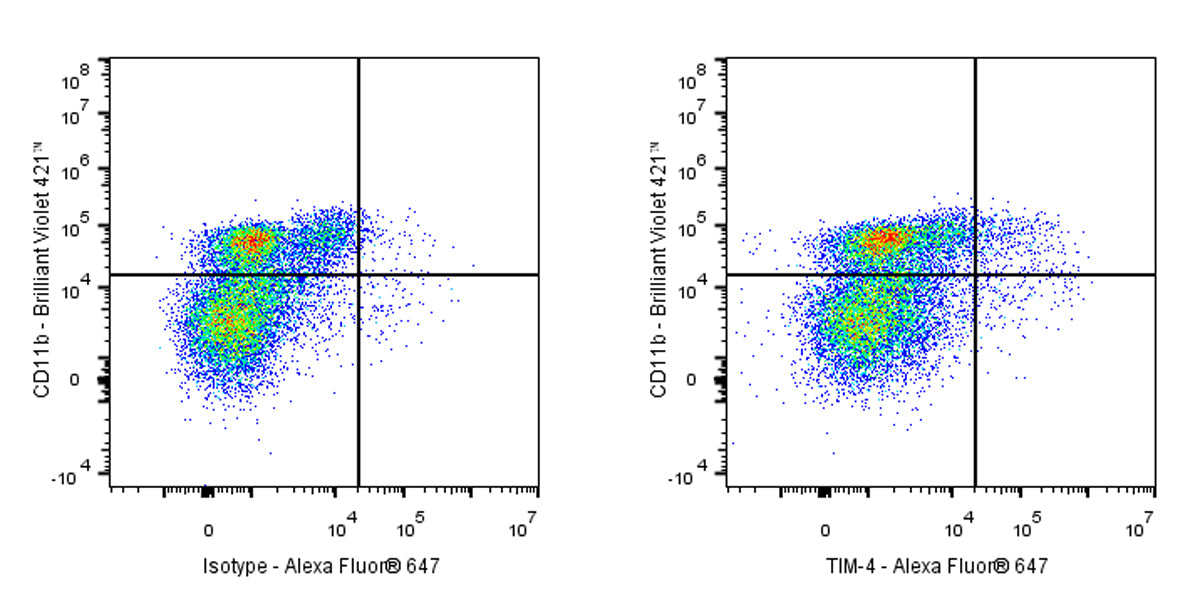
Flow cytometric analysis of Fresh BALB/c mouse peritoneal exudates cells labelling Mouse TIM-4 antibody at 1/200 dilution (1 μg) / (Right panel) compared with a Rat IgG2a, κ Isotype Control / (Left panel). Goat Anti-Rat IgG Alexa Fluor® 647 was used as the secondary antibody. Then cells were stained with CD11b - Brilliant Violet 421™ Antibody separately.
Rat Anti-Mouse TIM-4 Antibody (S-R685)
Rat Anti-Mouse TIM-4 Antibody (S-R685)
Price:
Regular price
$100 USD
Regular price
Sale price
$100 USD
Unit price
per
For shipping services or bulk orders, you may request a quotation.
Secure checkout with

View full details
Product Details
Product Details
Product Specification
| Host | Rat |
| Antigen | TIM-4 |
| Synonyms | T-cell immunoglobulin and mucin domain-containing protein 4; TIMD-4; Spleen; mucin-containing; knockout of lymphotoxin protein (SMUCKLER); T-cell immunoglobulin mucin receptor 4 (TIM-4); T-cell membrane protein 4; Tim4; Timd4 |
| Location | Membrane |
| Accession | Q6U7R4 |
| Clone Number | S-R685 |
| Antibody Type | Rat mAb |
| Isotype | IgG2a,k |
| Application | FCM |
| Reactivity | Ms |
| Positive Sample | Fresh BALB/c mouse peritoneal exudates |
| Purification | Protein G |
| Concentration | 2 mg/ml |
| Conjugation | Unconjugated |
| Physical Appearance | Liquid |
| Storage Buffer | PBS pH7.4 |
| Stability & Storage | 12 months from date of receipt / reconstitution, 2 to 8 °C as supplied |
Dilution
| application | dilution | species |
| FCM | 1:200 | Ms |
Background
TIM-4 (T-cell immunoglobulin and mucin domain 4) is a phosphatidylserine-recognizing receptor expressed mainly on antigen-presenting cells such as macrophages and dendritic cells, where it mediates the efficient clearance of apoptotic cells, thereby maintaining immune homeostasis, and can also bind to TIM-1 on activated T cells to either co-stimulate or inhibit T-cell proliferation and cytokine production in a context- and dose-dependent manner, thus regulating both innate and adaptive immunity and influencing diseases ranging from infection and allergy to cancer and ischemia–reperfusion injury.
Picture
Picture
FC