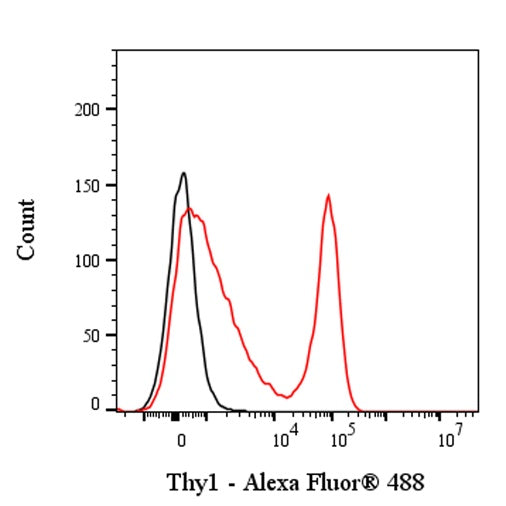
Flow cytometric analysis of Mouse Thy1 (CD90) expression on C57BL/6 mouse splenocytes. C57BL/6 mouse splenocytes were labeled with either Rat IgG2a Isotype Control (black line histogram) or SDT Rat Anti-Mouse Thy1 antibody (red line histogram) at 1/200 dilution (1·μg). Goat Anti - Rat IgG Alexa Fluor® 488 was used as the secondary antibody. Total viable cells, as determined by Fixable Viability Dye 452 (S0D0021), were used for analysis. Flow cytometry and data analysis were performed using Agilent NovoCyte Quanteon and FlowJo™ software.
Rat Anti-Mouse Thy1 (CD90) Antibody (S-4038)
Rat Anti-Mouse Thy1 (CD90) Antibody (S-4038)
Price:
Regular price
$100 USD
Regular price
Sale price
$100 USD
Unit price
per
For shipping services or bulk orders, you may request a quotation.
Secure checkout with

View full details
Product Details
Product Details
Product Specification
| Host | Rat |
| Antigen | Thy1 (CD90) |
| Synonyms | Thy-1 membrane glycoprotein; Thy-1 antigen; Thy-1 |
| Location | Cell membrane |
| Accession | P01831 |
| Clone Number | S-4038 |
| Antibody Type | Rat mAb |
| Isotype | IgG2a |
| Application | FCM |
| Reactivity | Ms |
| Positive Sample | C57BL/6 mouse splenocytes |
| Purification | Protein G |
| Concentration | 2 mg/ml |
| Conjugation | Unconjugated |
| Physical Appearance | Liquid |
| Storage Buffer | PBS pH7.4 |
| Stability & Storage | 12 months from date of receipt / reconstitution, 2 to 8 °C as supplied |
Dilution
| application | dilution | species |
| FCM | 1:200 | Ms |
Background
Thy1 (also known as CD90) is a glycosylphosphatidylinositol (GPI)-anchored glycoprotein widely expressed on the surface of various cell types and belongs to the immunoglobulin superfamily; it was originally named after its discovery in mouse thymocytes. As a critical marker for stem cells and specific differentiated cells, Thy1 is highly expressed on hematopoietic stem cells, mesenchymal stem cells (MSCs), neurons, fibroblasts, and activated T cells, with its functions varying significantly depending on the cell type: in the nervous system, it participates in axon growth, synaptic plasticity, and neural repair; in the immune system, it regulates T cell activation, adhesion, and migration; and in stem cell research, it serves as a key surface antigen for identifying and isolating MSCs (typically characterized as CD90-positive). Although its precise downstream signaling mechanisms remain not fully understood due to the lack of a transmembrane domain, Thy1 is generally believed to mediate cell-cell and cell-matrix adhesion by interacting with extracellular matrix components or other membrane proteins, thereby influencing cell proliferation, differentiation, and tissue homeostasis, making it a vital target in regenerative medicine, neurobiology, and oncology.
Picture
Picture
FC