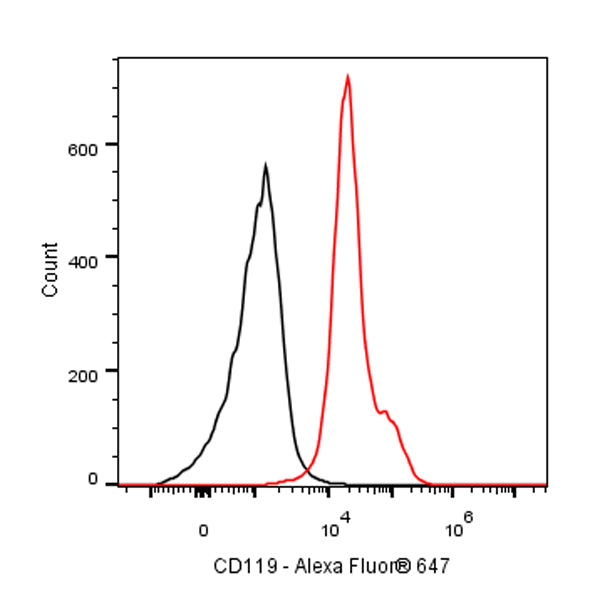
Flow cytometric analysis of C57BL/6 mouse splenocytes labeled with anti-CD119 antibody at 1/200 dilution (1 μg) / (red) compared with a Rat IgG2a, κ Isotype Control / (black). Goat Anti-Rat IgG Alexa Fluor® 647 was used as the secondary antibody.
Rat Anti-Mouse CD119 Antibody (GR-20)
Rat Anti-Mouse CD119 Antibody (GR-20)
Price:
Regular price
$100 USD
Regular price
Sale price
$100 USD
Unit price
per
For shipping services or bulk orders, you may request a quotation.
Secure checkout with

View full details
Product Details
Product Details
Product Specification
| Host | Rat |
| Antigen | CD119 |
| Synonyms | Interferon gamma receptor 1; IFN-gamma receptor 1; IFN-gamma-R1; Interferon gamma receptor alpha-chain (IFN-gamma-R-alpha); Ifngr; Ifngr1 |
| Location | Cell membrane |
| Accession | P15261 |
| Clone Number | GR-20 |
| Antibody Type | Rat mAb |
| Isotype | IgG2a,k |
| Application | FCM |
| Reactivity | Ms |
| Positive Sample | C57BL/6 mouse splenocytes |
| Purification | Protein G |
| Concentration | 2 mg/ml |
| Conjugation | Unconjugated |
| Physical Appearance | Liquid |
| Storage Buffer | PBS pH7.4 |
| Stability & Storage | 12 months from date of receipt / reconstitution, 2 to 8 °C as supplied |
Dilution
| application | dilution | species |
| FCM | 1:200 | Ms |
Background
CD119, also termed IFN-γ receptor 1 (IFNGR1), is a 54 kDa type-II cytokine receptor that forms, together with IFNGR2, the high-affinity heterotetrameric receptor for interferon-γ; upon IFN-γ binding it recruits JAK1 and JAK2 to phosphorylate STAT1, thereby driving transcription of antiviral, antigen-presentation and pro-inflammatory genes that activate macrophages, enhance Th1 responses and enforce host defence against intracellular pathogens, while inherited mutations in CD119 cause Mendelian susceptibility to mycobacterial disease.
Picture
Picture
FC