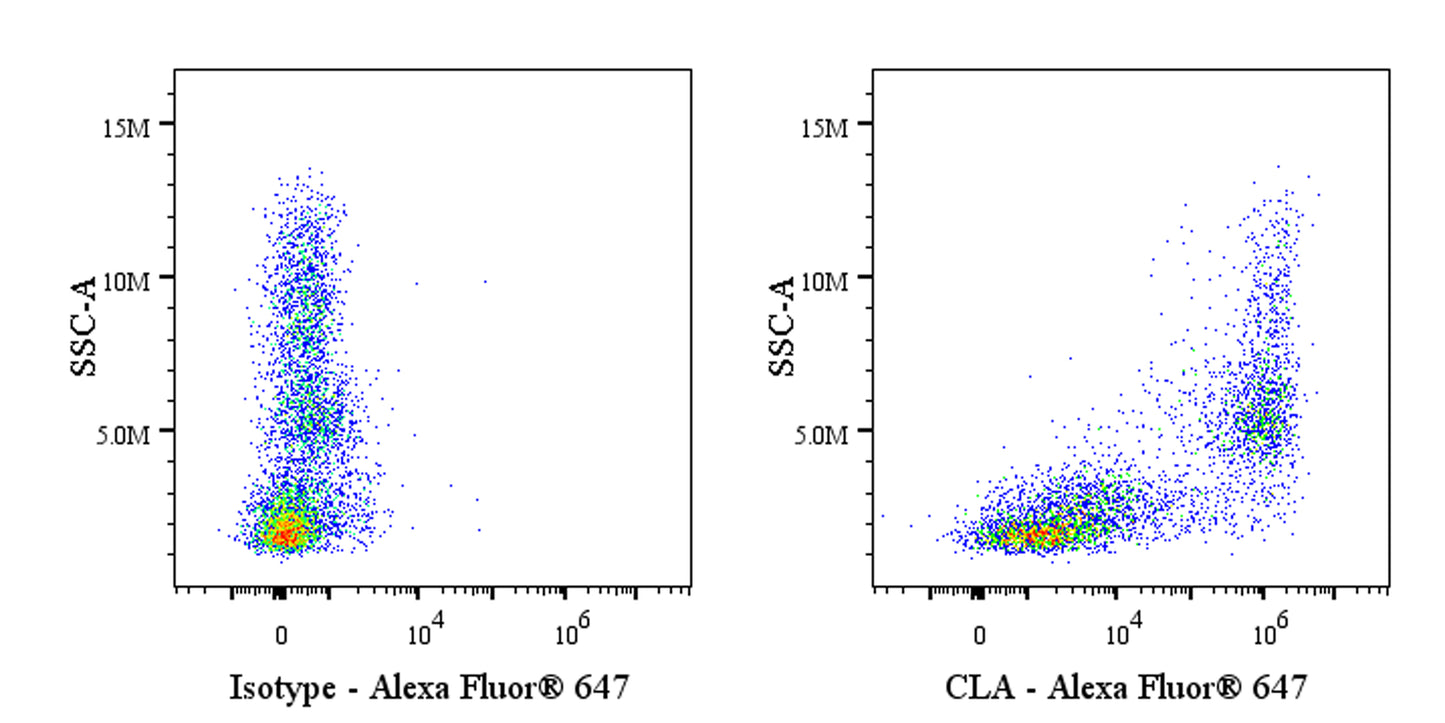
Flow cytometric analysis of human peripheral blood cells labeled with anti-CLA antibody at 1/200 dilution (1 μg) / (right panel) compared with a Rat IgM, κ Isotype Control / (left panel). Goat Anti-Rat IgM Alexa Fluor® 647 was used as the secondary antibody. Total viable cells, as determined by Fixable Viability Dye 545 (S0B88802), were used for analysis. Flow cytometry and data analysis were performed using Agilent NovoCyte Quanteon and FlowJo™ software.
Rat Anti-Human/Mouse CLA Antibody (S-R679)
Rat Anti-Human/Mouse CLA Antibody (S-R679)
Price:
Regular price
$45 USD
Regular price
Sale price
$45 USD
Unit price
per
For shipping services or bulk orders, you may request a quotation.
Secure checkout with

View full details
Product Details
Product Details
Product Specification
| Host | Rat |
| Antigen | CLA |
| Synonyms | Cutaneous Lymphocyte-associated Antigen |
| Location | Cell membrane |
| Clone Number | S-R679 |
| Antibody Type | Rat mAb |
| Isotype | IgM,k |
| Application | FCM |
| Reactivity | Hu, Ms |
| Positive Sample | Human peripheral blood cells |
| Concentration | 2 mg/ml |
| Conjugation | Unconjugated |
| Physical Appearance | Liquid |
| Storage Buffer | PBS pH7.4 |
| Stability & Storage | 12 months from date of receipt / reconstitution, 2 to 8 °C as supplied |
Dilution
| application | dilution | species |
| FCM | 1:200 | Hu, Ms |
Background
CD42a, also known as glycoprotein IX (GPIX), is a small, single-pass transmembrane glycoprotein expressed on platelets and megakaryocytes that non-covalently associates with glycoproteins Ibα, Ibβ, and V to form the GPIb-V-IX complex, which acts as the platelet receptor for von Willebrand factor (vWF), enabling vWF-dependent platelet adhesion to injured vessel walls and initiating arterial hemostasis; CD42a contains leucine-rich repeats, is encoded by GP9 on chromosome 3q21.3, and mutations in this gene cause Bernard–Soulier syndrome, a bleeding disorder characterized by giant platelets and impaired aggregation.
Picture
Picture
FC