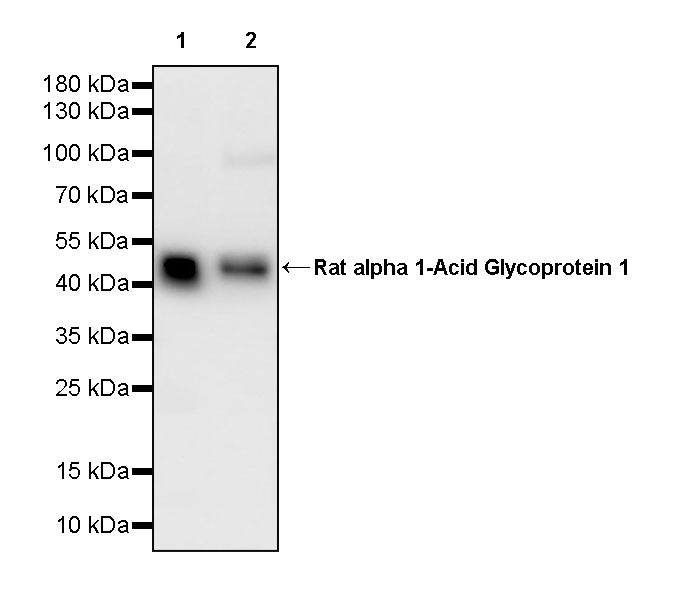
WB result of Rat alpha 1-Acid Glycoprotein 1 Recombinant Rabbit mAb
Primary antibody: Rat alpha 1-Acid Glycoprotein 1 Recombinant Rabbit mAb at 1/1000 dilution
Lane 1: mouse serum lysate 20 µg
Lane 2: rat serum lysate 20 µg
Secondary antibody: Goat Anti- rabbit IgG, (H+L), HRP conjugated at 1/10000 dilution
Predicted MW: 23 kDa
Observed MW: 47 kDa
Rat alpha 1-Acid Glycoprotein 1 Recombinant mAb (S-2962-4)
Rat alpha 1-Acid Glycoprotein 1 Recombinant mAb (S-2962-4)
Price:
Regular price
$100 USD
Regular price
Sale price
$100 USD
Unit price
per
For shipping services or bulk orders, you may request a quotation.
Secure checkout with

View full details
Product Details
Product Details
Product Specification
| Host | Rabbit |
| Antigen | alpha 1-Acid Glycoprotein 1 |
| Synonyms | Orm1 |
| Immunogen | Recombinant Protein |
| Location | Secreted |
| Accession | P02764 |
| Clone Number | S-2962-4 |
| Antibody Type | Recombinant mAb |
| Isotype | IgG |
| Application | WB |
| Reactivity | Ms, Rt |
| Positive Sample | Mouse serum, rat serum |
| Purification | Protein A |
| Concentration | 0.5 mg/ml |
| Conjugation | Unconjugated |
| Physical Appearance | Liquid |
| Storage Buffer | PBS, 40% Glycerol, 0.05% BSA, 0.03% Proclin 300 |
| Stability & Storage | 12 months from date of receipt / reconstitution, -20 °C as supplied |
Dilution
| application | dilution | species |
| WB | 1:1000 | Ms, Rt |
Background
Alpha 1-Acid Glycoprotein 1 (AGP1), also known as orosomucoid, is a major acute-phase plasma protein primarily synthesized by hepatocytes in response to inflammatory stimuli such as interleukin-1, interleukin-6, and tumor necrosis factor-alpha. As a member of the lipocalin superfamily, this heavily N-glycosylated, single-chain glycoprotein exhibits significant structural heterogeneity due to variable sialylation and fucosylation patterns, which profoundly influence its half-life, solubility, and biological activity in the circulation. Under physiological conditions, AGP1 functions as a crucial transport protein for basic and neutral drugs, steroids, and hormones, thereby modulating their pharmacokinetics and bioavailability, while during acute inflammation, its serum concentration can increase several-fold, contributing to immune modulation by suppressing neutrophil adhesion, inhibiting platelet aggregation, and protecting tissues from excessive proteolytic damage. Furthermore, recent studies highlight its role in regulating vascular permeability and acting as an endogenous immunosuppressant, making it a significant biomarker for monitoring inflammatory diseases, liver function, and pathological states in rat models used for pharmaceutical and biomedical research.
Picture
Picture
Western Blot