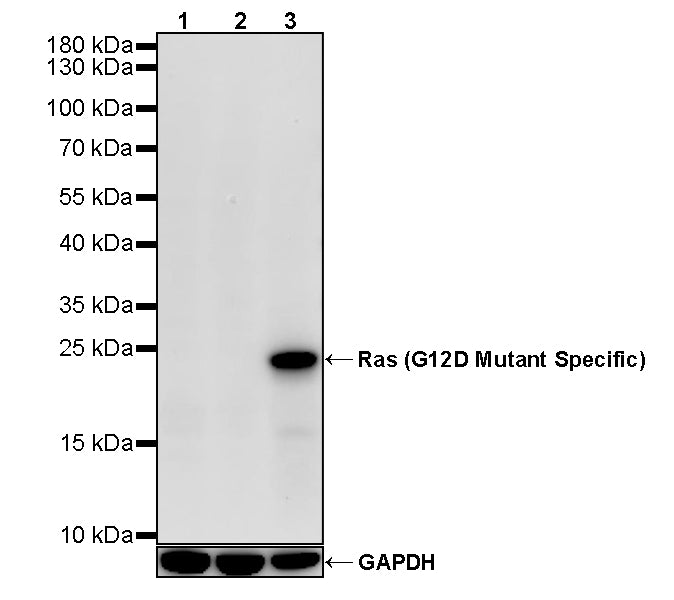
WB result of Ras (G12D Mutant Specific) Recombinant Rabbit mAb
Primary antibody: Ras (G12D Mutant Specific) Recombinant Rabbit mAb at 1/1000 dilution
Primary antibody incubation conditions: overnight at 4°C
Lane 1: HCT 116 whole cell lysate 20 µg
Lane 2: SW620 whole cell lysate 20 µg
Lane 3: THP-1 whole cell lysate 20 µg
Negative control: HCT 116 whole cell lysate, SW620 whole cell lysate
Secondary antibody: Goat Anti-rabbit IgG (H+L), HRP conjugated at 1/10000 dilution
Predicted MW: 21 kDa
Observed MW: 24 kDa
Ras (G12D Mutant Specific) Recombinant Rabbit mAb (S-5958)
Ras (G12D Mutant Specific) Recombinant Rabbit mAb (S-5958)
Price:
Regular price
$100 USD
Regular price
Sale price
$100 USD
Unit price
per
For shipping services or bulk orders, you may request a quotation.
Secure checkout with

View full details
Product Details
Product Details
Product Specification
| Host | Rabbit |
| Antigen | Ras (G12D Mutant Specific) |
| Synonyms | GTPase NRas; HRAS1; NRAS |
| Location | Cell membrane |
| Accession | P01111、P01112、P01116 |
| Clone Number | S-5958 |
| Antibody Type | Recombinant mAb |
| Isotype | IgG |
| Application | WB |
| Reactivity | Hu |
| Positive Sample | THP-1 |
| Purification | Protein A |
| Concentration | 0.5 mg/ml |
| Conjugation | Unconjugated |
| Physical Appearance | Liquid |
| Storage Buffer | PBS, 40% Glycerol, 0.05% BSA, 0.02% sodium azide |
| Stability & Storage | 12 months from date of receipt / reconstitution, -20 °C as supplied |
Dilution
| application | dilution | species |
| WB | 1:1000 | Hu |
Background
The KRAS G12D mutant-specific designation refers to a class of therapeutic agents designed to selectively target the glycine-to-aspartate substitution at codon 12 of the KRAS oncoprotein, which is the most prevalent KRAS mutation in human cancers, occurring in approximately 40% of pancreatic ductal adenocarcinomas, 15% of colorectal cancers, and 5% of lung cancers. Unlike the G12C mutant, which possesses a reactive cysteine residue amenable to covalent inhibition, the G12D mutant lacks such a handle and has historically been considered "undruggable," necessitating the development of non-covalent inhibitors that exploit the mutant aspartate for selectivity. A landmark achievement in this field is MRTX1133, a potent, non-covalent inhibitor that binds the Switch II pocket with picomolar affinity (Kd ~0.2 pM for GDP-bound KRAS G12D) and exhibits ~700-fold selectivity over wild-type KRAS by forming key electrostatic interactions—including a salt bridge—with the Asp12 side chain. Mechanistically, MRTX1133 "freezes" the nucleotide-binding site conformation, arresting the GTPase cycle in both GDP- and GTP-bound states and attenuating downstream ERK phosphorylation and tumor growth in preclinical models. Beyond MRTX1133, several other G12D-selective agents are advancing through development, including VS-7375 (GFH375), an oral dual ON/OFF inhibitor with picomolar affinity and sustained pathway inhibition compared to ON-only inhibitors; RNK08954, which has demonstrated an unconfirmed objective response rate of 58.33% in NSCLC patients in early-phase trials; and setidegrasib (ASP3082), a first-in-class PROTAC degrader targeting KRAS G12D. In the clinical context, KRAS G12D-mutant tumors exhibit a propensity to activate the PI3K/AKT pathway and foster an immunosuppressive microenvironment, and emerging evidence suggests that resistance to G12D-selective inhibitors involves autophagy-mediated glutathione synthesis and a shift toward histone acetylation that can be overcome by BET inhibition, informing rational combination strategies.
Picture
Picture
Western Blot