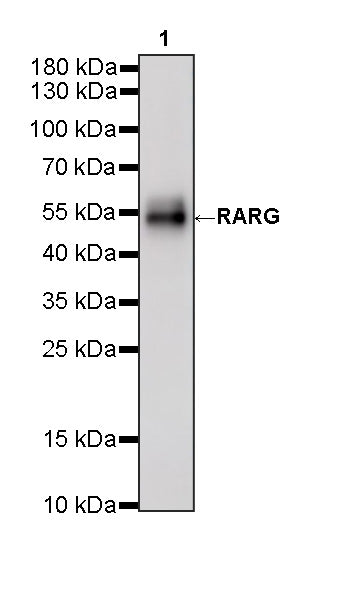
WB result of RARG Recombinant Rabbit mAb
Primary antibody: RARG Recombinant Rabbit mAb at 1/1000 dilution
Primary antibody incubation conditions: 1.5 hours at RT
Lane 1: THP-1 whole cell lysate 20 μg
Lane 2: HeLa whole cell lysate 20 μg
Lane 3: MCF7 whole cell lysate 20 μg
Lane 4: BxPC-3 whole cell lysate 20 μg
Lane 5: HaCaT whole cell lysate 20 μg
Negative control: THP-1 whole cell lysate
Secondary antibody: Goat Anti-Rabbit IgG (H+L), HRP conjugated at 1/10000 dilution
Predicted MW: 50 kDa
Observed MW: 50 kDa
This blot was developed with high sensitivity substrate
RARG Recombinant Rabbit mAb (S-4448-23)
RARG Recombinant Rabbit mAb (S-4448-23)
Price:
Regular price
$100 USD
Regular price
Sale price
$100 USD
Unit price
per
For shipping services or bulk orders, you may request a quotation.
Secure checkout with

View full details
Product Details
Product Details
Product Specification
| Host | Rabbit |
| Antigen | RARG |
| Immunogen | Synthetic Peptide |
| Location | Cytoplasm, Nucleus |
| Accession | P13631 |
| Clone Number | S-4448-23 |
| Antibody Type | Recombinant mAb |
| Isotype | IgG |
| Application | WB |
| Reactivity | Hu, Ms, Mk |
| Positive Sample | HeLa, MCF7, BxPC-3, HaCaT, F9, COS-7 |
| Purification | Protein A |
| Concentration | 1 mg/ml |
| Conjugation | Unconjugated |
| Physical Appearance | Liquid |
| Storage Buffer | PBS, 40% Glycerol, 0.05% BSA, 0.02% sodium azide |
| Stability & Storage | 12 months from date of receipt / reconstitution, -20 °C as supplied |
Dilution
| application | dilution | species |
| WB | 1:1000 | Hu, Ms, Mk |
Background
RARG (retinoic acid receptor gamma) is a nuclear hormone receptor encoded by the RARG gene located on human chromosome 12q13.13. It belongs to the retinoic acid receptor (RAR) family and is a ligand-dependent transcriptional regulator. Its structure consists of an N-terminal regulatory domain, a DNA-binding domain, and a C-terminal ligand-binding domain. It preferentially binds retinoic acid response elements (RAREs) in the promoters of target genes as a heterodimer with RXR, activating transcription in the presence of ligand (all-trans or 9-cis retinoic acid) while repressing transcription in the absence of ligand. RARG is the predominant RAR expressed in skin and is broadly involved in limb bud development, skeletal growth, stromal homeostasis, and maintenance of growth plate function. In spermatogenesis, RARG cell-autonomously transduces retinoic acid signaling in undifferentiated spermatogonia, driving the transition from A(al) to A(1) spermatogonia. Dysregulation of RARG is associated with multiple diseases: its variants can increase susceptibility to anthracycline-induced cardiotoxicity, the NUP98-RARG fusion gene has been identified in acute myeloid leukemia, and histone lactylation-mediated inhibition of RARγ in macrophages promotes colorectal tumorigenesis by activating TRAF6-IL-6-STAT3 signaling.
Picture
Picture
Western Blot
WB result of RARG Recombinant Rabbit mAb
Primary antibody: RARG Recombinant Rabbit mAb at 1/1000 dilution
Primary antibody incubation conditions: 1.5 hours at RT
Lane 1: F9 whole cell lysate 20 μg
Secondary antibody: Goat Anti-Rabbit IgG (H+L), HRP conjugated at 1/10000 dilution
Predicted MW: 50 kDa
Observed MW: 50 kDa
This blot was developed with high sensitivity substrate
WB result of RARG Recombinant Rabbit mAb
Primary antibody: RARG Recombinant Rabbit mAb at 1/1000 dilution
Primary antibody incubation conditions: 1.5 hours at RT
Lane 1: COS-7 whole cell lysate 20 μg
Secondary antibody: Goat Anti-Rabbit IgG (H+L), HRP conjugated at 1/10000 dilution
Predicted MW: 50 kDa
Observed MW: 50 kDa
This blot was developed with high sensitivity substrate