Raptor Recombinant Rabbit mAb (S-5325)
Raptor Recombinant Rabbit mAb (S-5325)
Price:
Regular price
$100 USD
Regular price
Sale price
$100 USD
Unit price
per
For shipping services or bulk orders, you may request a quotation.
Secure checkout with

View full details
Product Details
Product Details
Product Specification
| Host | Rabbit |
| Antigen | Raptor |
| Synonyms | Regulatory-associated protein of mTOR; KIAA1303; RAPTOR s; RPTOR |
| Location | Cytoplasm, Lysosome |
| Accession | Q8N122 |
| Clone Number | S-5325 |
| Antibody Type | Recombinant mAb |
| Isotype | IgG |
| Application | WB |
| Reactivity | Hu, Ms, Rt, Mk |
| Positive Sample | MCF7, HepG2, HeLa, HEK-293, PANC-1, RD, A204 |
| Purification | Protein A |
| Concentration | 0.5 mg/ml |
| Conjugation | Unconjugated |
| Physical Appearance | Liquid |
| Storage Buffer | PBS, 40% Glycerol, 0.05% BSA, 0.02% sodium azide |
| Stability & Storage | 12 months from date of receipt / reconstitution, -20 °C as supplied |
Dilution
| application | dilution | species |
| WB | 1:1000 | Hu, Ms, Rt, Mk |
Background
Raptor (regulatory-associated protein of mTOR) is a critical scaffold protein and regulatory subunit of the mTORC1 complex. Through its N-terminal RNC domain and C-terminal WD40 repeat domain, it not only provides a binding platform for mTOR and downstream substrates (such as S6K1 and 4E-BP1) but also recognizes and recruits substrates containing the TOS motif, thereby ensuring precise phosphorylation of substrates by mTORC1. As a core regulatory node in intracellular nutrient sensing and energy metabolism, Raptor responds to changes in amino acid and energy levels—for example, it promotes mTORC1 translocation to the lysosomal surface to activate its kinase activity under amino acid sufficiency, while its function is suppressed under energy deprivation, thereby coordinating cell growth, proliferation, and metabolism. Furthermore, Raptor is regulated by various post-translational modifications, such as phosphorylation and ubiquitination, which finely tune its activity and stability under conditions of metabolic stress or DNA damage. Consequently, Raptor dysfunction is closely associated with various diseases—its hyperactivation often drives tumorigenesis and metabolic disorders, while its loss of function may affect development, leading to neurodegenerative diseases or accelerated aging processes.
Picture
Picture
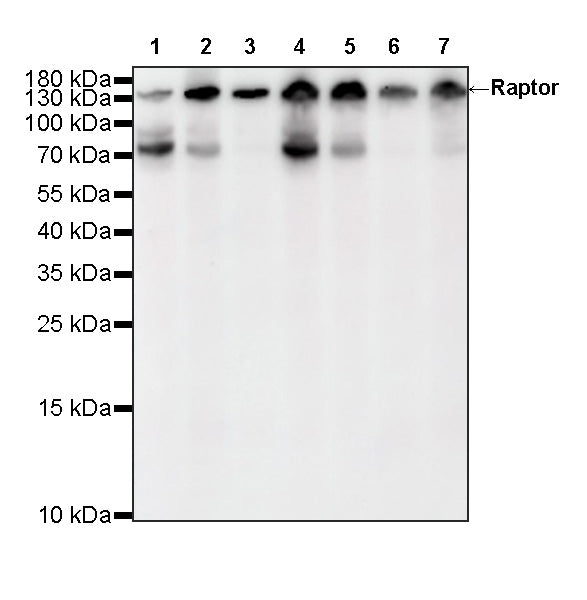
Western Blot
WB result of Raptor Recombinant Rabbit mAb
Primary antibody: Raptor Recombinant Rabbit mAb at 1/1000 dilution
Lane 1: MCF7 whole cell lysate 20 µg
Lane 2: HepG2 whole cell lysate 20 µg
Lane 3: HeLa whole cell lysate 20 µg
Lane 4: HEK-293 whole cell lysate 20 µg
Lane 5: PANC-1 whole cell lysate 20 µg
Lane 6: RD whole cell lysate 20 µg
Lane 7: A204 whole cell lysate 20 µg
Secondary antibody: Goat Anti-Rabbit IgG, (H+L), HRP conjugated at 1/10000 dilution
Predicted MW: 149 kDa
Observed MW: 149 kDa