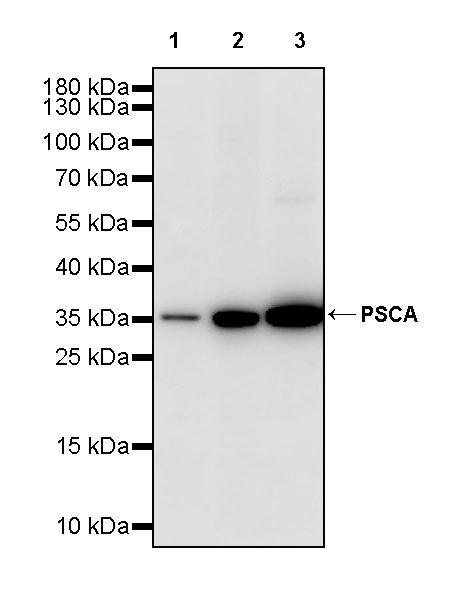
WB result of PSCA Recombinant Rabbit mAb
Primary antibody: PSCA Recombinant Rabbit mAb at 1/1000 dilution
Lane 1: mouse skeletal muscle lysate 20 µg
Lane 2: mouse kidney lysate 20 µg
Lane 3: mouse prostate lysate 20 µg
Secondary antibody: Goat Anti- rabbit IgG, (H+L), HRP conjugated at 1/10000 dilution
Predicted MW: 13 kDa
Observed MW: 35 kDa
PSCA Recombinant Rabbit mAb (S-3475-72)
PSCA Recombinant Rabbit mAb (S-3475-72)
Price:
Regular price
$100 USD
Regular price
Sale price
$100 USD
Unit price
per
For shipping services or bulk orders, you may request a quotation.
Secure checkout with

View full details
Product Details
Product Details
Product Specification
| Host | Rabbit |
| Antigen | PSCA |
| Synonyms | Prostate stem cell antigen; Psca |
| Immunogen | Synthetic Peptide |
| Location | Cell membrane |
| Accession | P57096 |
| Clone Number | S-3475-72 |
| Antibody Type | Recombinant mAb |
| Isotype | IgG |
| Application | WB |
| Reactivity | Ms, Rt |
| Positive Sample | Mouse skeletal muscle, mouse kidney, mouse prostate, rat skeletal muscle, rat kidney, rat prostate |
| Purification | Protein A |
| Concentration | 0.5 mg/ml |
| Conjugation | Unconjugated |
| Physical Appearance | Liquid |
| Storage Buffer | PBS, 40% Glycerol, 0.05% BSA, 0.03% Proclin 300 |
| Stability & Storage | 12 months from date of receipt / reconstitution, -20 °C as supplied |
Dilution
| application | dilution | species |
| WB | 1:1000 | Ms, Rt |
Background
Prostate Stem Cell Antigen (PSCA) is a glycosylphosphatidylinositol (GPI)-anchored cell surface protein belonging to the Ly-6/Thy-1 family of cell surface antigens, originally identified through subtractive hybridization in the LAPC-4 prostate cancer xenograft model. While it is expressed at low levels in normal tissues such as the prostate, bladder, kidney, and placenta, PSCA is significantly overexpressed in various malignancies, particularly in a high percentage of prostate cancers (including androgen-independent and metastatic forms), as well as in bladder, pancreatic, gastric, and renal cell carcinomas, where its expression often correlates with higher tumor grade, stage, and poor prognosis. Functionally, PSCA is implicated in promoting cell proliferation, survival, and metastasis, potentially by modulating signal transduction pathways, although its precise molecular mechanism remains under investigation; due to its restricted normal tissue distribution and prominent upregulation on the surface of tumor cells, PSCA has emerged as a highly promising therapeutic target and biomarker, driving the development of diverse clinical interventions including monoclonal antibodies (e.g., enoblituzumab), antibody-drug conjugates, bispecific T-cell engagers, and chimeric antigen receptor (CAR) T-cell therapies aimed at harnessing the immune system to specifically recognize and eliminate PSCA-positive cancer cells.
Picture
Picture
Western Blot
WB result of PSCA Recombinant Rabbit mAb
Primary antibody: PSCA Recombinant Rabbit mAb at 1/1000 dilution
Lane 1: rat skeletal muscle lysate 20 µg
Lane 2: rat kidney lysate 20 µg
Lane 3: rat prostate lysate 20 µg
Secondary antibody: Goat Anti- rabbit IgG, (H+L), HRP conjugated at 1/10000 dilution
Predicted MW: 13 kDa
Observed MW: 35 kDa