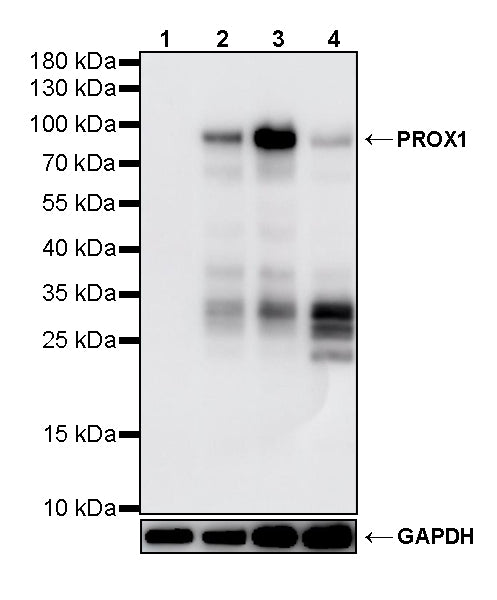
WB result of PROX1 Mouse mAb
Primary antibody: PROX1 Mouse mAb at 1/1000 dilution
Lane 1: MDA-MB-231 whole cell lysate 20 µg
Lane 2: HepG2 whole cell lysate 20 µg
Lane 3: SH-SY5Y whole cell lysate 20 µg
Lane 4: SW620 whole cell lysate 20 µg
Negative control: MDA-MB-231 whole cell lysate
Secondary antibody: Goat Anti-Mouse IgG, (H+L), HRP conjugated at 1/10000 dilution
Predicted MW: 83 kDa
Observed MW: 90 kD
PROX1 Mouse mAb
PROX1 Mouse mAb
Price:
Regular price
$100 USD
Regular price
Sale price
$100 USD
Unit price
per
For shipping services or bulk orders, you may request a quotation.
Secure checkout with

View full details
Product Details
Product Details
Product Specification
| Host | Mouse |
| Antigen | PROX1 |
| Synonyms | Prospero homeobox protein 1 |
| Location | Nucleus |
| Accession | Q92786 |
| Antibody Type | Mouse mAb |
| Isotype | IgG2b |
| Application | WB |
| Reactivity | Hu |
| Positive Sample | HepG2, SH-SY5Y, SW620 |
| Purification | Protein A |
| Concentration | 2 mg/ml |
| Conjugation | Unconjugated |
| Physical Appearance | Liquid |
| Storage Buffer | PBS, 40% Glycerol, 0.05% BSA, 0.02% sodium azide |
| Stability & Storage | 12 months from date of receipt / reconstitution, -20 °C as supplied |
Dilution
| application | dilution | species |
| WB | 1:1000-1:2000 | Hu |
Background
PROX1 (Prospero homeobox protein 1) is a highly conserved transcription factor of the Homeobox family that plays an irreplaceable core role in embryonic development, cell fate determination, and lymphangiogenesis. As the master regulator of the lymphatic lineage, PROX1 guides embryonic venous endothelial cells to differentiate into lymphatic endothelial cells by directly activating lymphatic endothelial cell-specific genes (such as VEGFR-3, PDPN, and LYVE-1) while repressing blood endothelial cell fate determinants (such as COUP-TFII), serving as the essential "master switch" for lymphatic system development. In adult tissues, PROX1 expression maintains the differentiated state and functional integrity of lymphatic endothelial cells, and its loss of function leads to diseases such as lymphedema. However, in the tumor field, PROX1 exhibits an extremely complex and context-dependent dual role: in most solid tumors (such as hepatocellular carcinoma, colorectal cancer, gastric cancer, and pancreatic cancer), PROX1 overexpression is generally associated with enhanced tumor aggressiveness, activation of epithelial-mesenchymal transition (EMT), increased metastatic propensity, and poor prognosis, as it directly regulates pathways such as Wnt/β-catenin and TGF-β to promote tumor cell migration and invasion; whereas in specific cancer types such as breast cancer, PROX1 has been reported to exert tumor-suppressive effects, possibly through interfering with estrogen receptor signaling. Furthermore, PROX1 is deeply involved in tumor lymphangiogenesis and tumor microenvironment remodeling by regulating the generation of tumor-associated lymphatic endothelial cells to promote the formation of pre-metastatic niches. Therefore, PROX1 is not only a research hotspot in lymphatic development and regeneration but also a highly clinically translatable prognostic biomarker and therapeutic target in oncology, although precise interpretation of its functional context remains a critical prerequisite for successful targeted therapy.
Picture
Picture
Western Blot