2μg (R: reducing condition, N:non-reducing condition).
Prolactin R/PRLR Fc Chimera Protein, Human
Prolactin R/PRLR Fc Chimera Protein, Human
Price:
Regular price
$215 USD
Regular price
Sale price
$215 USD
Unit price
per
For shipping services or bulk orders, you may request a quotation.
Secure checkout with

View full details
Product Details
Product Details
Product Specification
| Species | Human |
| Synonyms | Prolactin receptor, PRL-R |
| Accession | P16471 |
| Amino Acid Sequence | Gln25-Asp234 with hIgG1 Fc Tag at the C-Terminus |
| Expression System | HEK293 |
| Molecular Weight | 55-70kDa (Reducing) |
| Purity | >90% by SDS-PAGE,> 80% by HPLC |
| Conjugation | Unconjugated |
| Tag | Human IgG1 Fc |
| Physical Appearance | Lyophilized powder |
| Storage Buffer | PBS, PH7.4, 5% trehalose |
| Reconstitution | Reconstitute at 0.1-1 mg/ml according to the size in ultrapure water after rapid centrifugation. |
| Stability & Storage | · 12 months from date of receipt, lyophilized powder stored at -20 to -80℃. |
| Reference | 1.Harris J, Stanford PM, Oakes SR, Ormandy CJ. Prolactin and the prolactin receptor: new targets of an old hormone. Ann Med. 2004;36(6):414-25. |
Background
Prolactin receptor (PRLR) is a member of the cytokine receptor superfamily, composed of an extracellular ligand-binding domain, a single transmembrane domain, and an intracellular signaling domain, with three isoforms (long, short, and intermediate). Upon binding to prolactin, it activates the JAK2-STAT5 signaling pathway to regulate physiological processes including mammary gland development, lactation, metabolism, and immune modulation. Clinical studies have demonstrated that PRLR is highly expressed in various tumors such as breast and prostate cancers, promoting cancer cell proliferation, invasion, and drug resistance through autocrine/paracrine loops, making it an emerging therapeutic target for antitumor treatment, with monoclonal antibodies and small molecule antagonists currently under clinical development.
Picture
Picture
SDS-PAGE
SEC-HPLC
The purity of Prolactin R/PRLR Fc Chimera Protein, Human is more than 80% determined by SEC-HPLC.
ELISA
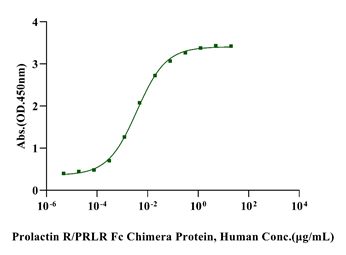
Immobilized Human PRL, His tag (Cat. No. S0A0016) at 1.0μg/mL (100μL/well) can bind Prolactin R/PRLR Fc Chimera Protein, Human (Cat. No. UA016068) with EC50 of 4.11-7.47 ng/mL.
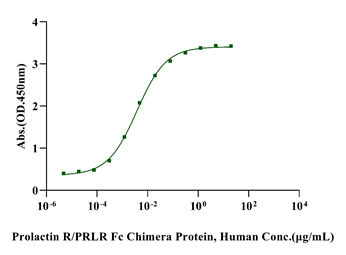
Immobilized Human GH Protein, His Tag (Cat. No. S0A8004) at 2.0μg/mL (100μL/well) can bind Prolactin R/PRLR Fc Chimera Protein, Human (Cat. No. UA016068) with EC50 of 3.3-4.4 ng/mL.