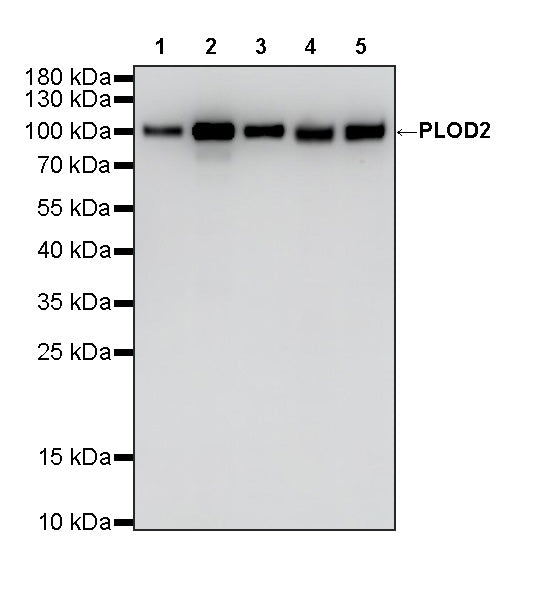
WB result of PLOD2 Mouse mAb
Primary antibody: PLOD2 Mouse mAb at 1/2000 dilution
Lane 1: A431 whole cell lysate 20 µg
Lane 2: A549 whole cell lysate 20 µg
Lane 3: HeLa whole cell lysate 20 µg
Lane 4: HEK-293 whole cell lysate 20 µg
Lane 5: HepG2 whole cell lysate 20 µg
Secondary antibody: Goat Anti-Mouse IgG, (H+L), HRP conjugated at 1/10000 dilution
Predicted MW: 85 kDa
Observed MW: 100 kDa
PLOD2 Mouse mAb
PLOD2 Mouse mAb
Price:
Regular price
$100 USD
Regular price
Sale price
$100 USD
Unit price
per
For shipping services or bulk orders, you may request a quotation.
Secure checkout with

View full details
Product Details
Product Details
Product Specification
| Host | Mouse |
| Antigen | PLOD2 |
| Synonyms | Procollagen-lysine,2-oxoglutarate 5-dioxygenase 2 |
| Location | Cytoplasm, Endoplasmic reticulum |
| Accession | O00469 |
| Antibody Type | Mouse mAb |
| Isotype | IgA |
| Application | WB |
| Reactivity | Hu |
| Positive Sample | A431, A549, HeLa, HEK-293, HepG2 |
| Concentration | 1 mg/ml |
| Conjugation | Unconjugated |
| Physical Appearance | Liquid |
| Storage Buffer | PBS, 40% Glycerol, 0.05% BSA, 0.02% sodium azide |
| Stability & Storage | 12 months from date of receipt / reconstitution, -20 °C as supplied |
Dilution
| application | dilution | species |
| WB | 1:1000-1:2000 | Hu |
Background
PLOD2 (i.e., procollagen-lysine, 2-oxoglutarate 5-dioxygenase 2, also known as lysyl hydroxylase 2) is a key collagen cross-linking enzyme encoded by the PLOD2 gene, localized in the endoplasmic reticulum lumen, where it catalyzes the hydroxylation of specific lysine residues in collagen molecules to generate hydroxylysine. This post-translational modification is critical for collagen maturation, as hydroxylysine serves not only as an essential precursor for the formation of covalent cross-links between collagen molecules but also provides the structural basis for collagen microfibril assembly and mechanical stability, exerting a decisive influence particularly on the tensile strength of collagen-rich tissues such as bone, tendons, and vascular walls. The activity of PLOD2 depends on iron ions (Fe²⁺), vitamin C (ascorbic acid), and molecular oxygen as cofactors; deficiency of these cofactors directly leads to reduced catalytic efficiency, which clinically can manifest as poor wound healing associated with scurvy. This protein also plays an important role in tissue fibrosis—its expression is upregulated by the TGF-β signaling pathway and is significantly elevated in pathological states such as liver fibrosis, pulmonary fibrosis, and scleroderma, promoting excessive cross-linked collagen deposition and exacerbating tissue stiffening. In addition, pathogenic mutations in the PLOD2 gene can lead to Bruck syndrome type 2 (a rare autosomal recessive disorder), characterized by congenital joint contractures and recurrent fractures, directly associated with increased bone fragility due to collagen cross-linking defects, while aberrant expression of this protein is also linked to keloid formation and the invasion and metastasis of certain malignancies.
Picture
Picture
Western Blot