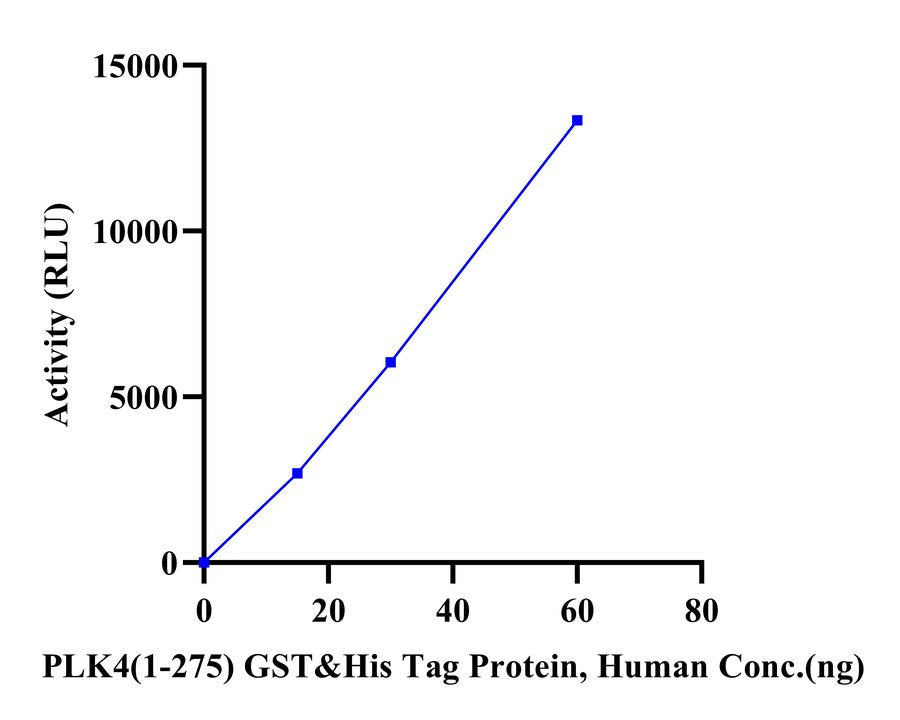
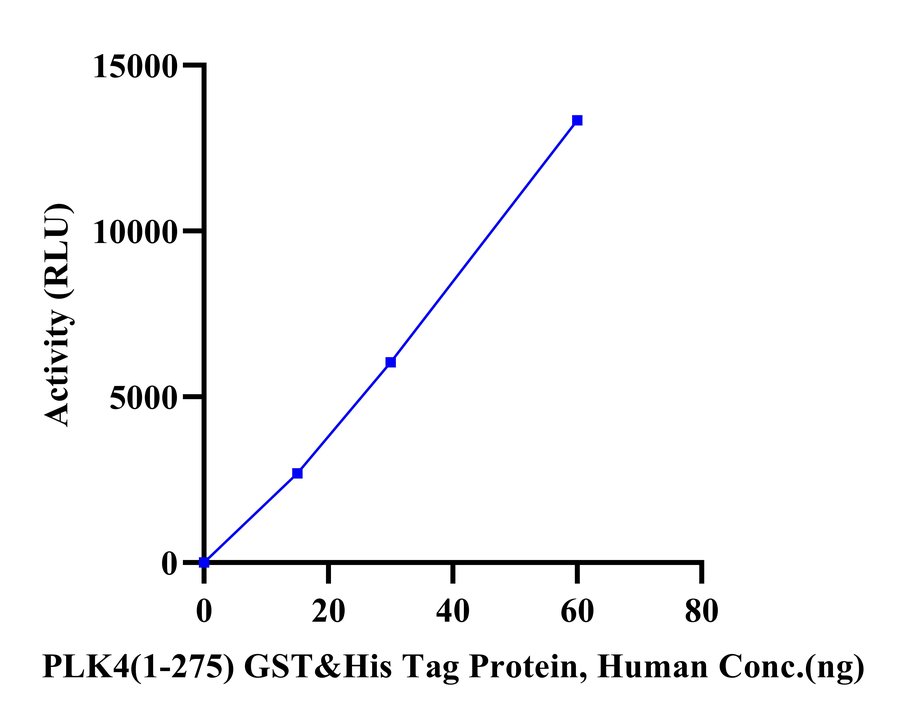
The specific activity of PLK4(1-275) GST&His
Tag Protein, Human was determined to be >14 pmol/min/ug as per activity
assay protocol.
PLK4(1-275) GST&His Tag Protein, Human
PLK4(1-275) GST&His Tag Protein, Human
Price:
Regular price
$1,000 USD
Regular price
Sale price
$1,000 USD
Unit price
per
For shipping services or bulk orders, you may request a quotation.
Secure checkout with

View full details
Product Details
Product Details
Product Specification
| Species | Human |
| Synonyms | PLK4, SAK, STK18 |
| Accession | O00444 |
| Amino Acid Sequence | Met1-Asp275 with GST Tag at the N-Terminus &His Tag at the C-Terminus |
| Expression System | E. coli |
| Molecular Weight | 55-70kDa (Reducing) |
| Endotoxin | <0.1EU/μg |
| Conjugation | Unconjugated |
| Tag | His Tag, GST Tag |
| Physical Appearance | Liquid |
| Storage Buffer | 25mM Tris, 150mM NaCl, pH7.5, 1mM DTT,10%Glycerol |
| Stability & Storage | Stable for 12 months upon stored at -80℃ from the date ofreceipt. And avoid repeated freeze-thaws cycles. |
| Reference |
1.TEC-family kinases: regulators of T-helper-cell differentiation. Nature ReviewsImmunology, 2005, 5(4), 284–295. 2. T-Cell Signaling Regulated by the Tec FamilyKinase, Itk. Cold Spring Harbor Perspectives in Biology, 2010, 2(7), a002287. |
Background
PLK4(Polo-like kinase 4) is the most divergent member of the Polo-like kinase (PLK)family of serine/threonine protein kinases. Structurally, PLK4 differssignificantly from other family members, with its N-terminal kinase domain andC-terminal Polo box domain regulating its catalytic activity and subcellularlocalization in distinct ways.
PLK4 is recognized as the master regulator ofcentriole duplication, responsible for initiating the formation of aprocentriole on the mother centriole wall. Autonomous oscillations of PLK4levels precisely regulate the centriole assembly process. Overexpression ofPLK4 induces centriole overduplication, leading to centrosome amplification—ahallmark of cancer. Conversely, PLK4 depletion leads to failure of newcentriole assembly and subsequent centrosome duplication defects. Studies haveshown that PLK4 is overexpressed in breast cancer, controlling cancer cellinvasion through regulation of the actin cytoskeleton, and Plk4⁺/⁻ mice arepredisposed to liver and lung cancer.
Protocol
Principle: The PLK4 assayis performed using the ADP-GloTM Kinase Assay kit which quantifiesthe amount of ADP produced by the PLK4 reaction. The ADP-GloTM Reagentis added to terminate the kinase reaction and to deplete the remaining ATP, andthen the Kinase Detection Reagent is added to convert ADP to ATP and to measurethe newly synthesized ATP using luciferase/luciferin reaction.
Materials
1. Kinase assay buffer(5X): 200 mM Tris-HCl, pH 7.4,100 mM MgCl2 and 0.5 mg/mL BSA, 250 μM DTT
2. Kinase assay buffer(1X): 40 mM Tris-HCl, pH 7.4, 20mM MgCl2, 0.1 mg/mL BSA, 50 μM DTT
3. PLK4(1-275) GST&His Tag Protein, Human(Catalog # UA085095)
4. ADP-Glo Kinase Assay (UA, Catalog # UA070101)
5. Substrate: PLK4tide peptide substrate(Sinobiological, Catalog #P44-58)
6. Solid white multi-well plate (384-well plate)(absin, Catalog # abs7311)
7. Plate Reader (PerkinElmer)
Produce
1. Prepare a substrate/ATP mixture as follows (25 μMexample).
| Amount (μL) | |
| 10 mM ATP Solution | 1 |
| Kinase Assay Buffer III (5x) | 79 |
| Substrate at 1 mg/mL | 80 |
2. Dilute the PLK4 to 20 µg/mL, 10 µg/mL and 5µg/mL in Kinase Assay Buffer (1x) and dispense 3 μL into each well of a384-well plate.
3. Initiate the reaction by adding 2 μL of thedetection system prepared in Step 1 to each well. Include a detection systemwith 3 μL Kinase Assay Buffer (1x) as Blank. The reaction volume is 5 μL.
4. Incubate the reaction at room temperature(22–25℃) for 40 minutes.
5.Add 5 μL of ADP-Glo Reagent to the completedreaction, mix briefly and incubate for 40 minutes at room temperature (22–25℃).
6.Add 10 μL of Detection Reagent and incubate theplate for 30 minutes at room temperature (22–25 ℃).
7.Read at luminescence, respectively in endpointmode.
8.Calculate specific activity.
• Standard Curve
1. Dilute the ATP and ADP to 25 μM in Kinase AssayBuffer (1x).
2. Mix 25 μΜ ATP and 25 μM ADP to form an ATP+ADPsolution provided below and dispense 5 μL into each well of a 384-well plate.
| Well Number | 1 | 2 | 3 | 4 | 5 | 6 | 7 | 8 | 9 | 10 | 11 | 12 |
| 25μM ADP (μL) | 100 | 80 | 60 | 40 | 20 | 10 | 5 | 4 | 3 | 2 | 1 | 0 |
| 25μM ATP (μL) | 0 | 20 | 40 | 60 | 80 | 90 | 95 | 96 | 97 | 98 | 99 | 100 |
3. Add 5 μL of ADP-Glo Reagent to the completedreaction, mix briefly and incubate for 40 minutes at room temperature (22–25℃).
4. Add 10 μL of Detection Reagent and incubate theplate for 30 minutes at room temperature (22–25 ℃).
5. Read at luminescence, respectively in endpointmode.
6. Detect optical signals and establish conversioncurves.
| Specific Activity (pmol/min/μg) = | ATP (pmol)-Blank |
| Incubation time(min) ×amount of enzyme (μg) |
Picture
Picture
Bioactivity
SDS-PAGE
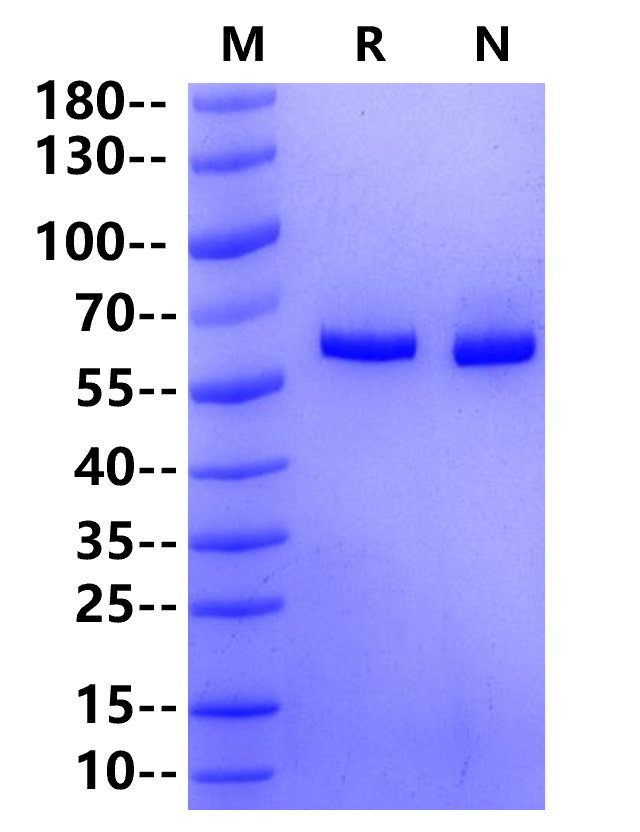
2μg (R: reducing condition, N: non-reducing
condition).
SEC-HPLC

The purity of PLK4(1-275) GST&His Tag
Protein, Human is more than 90% determined by SEC-HPLC.