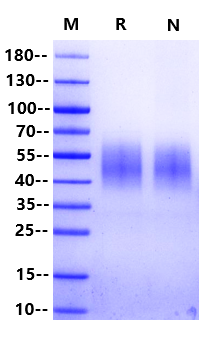
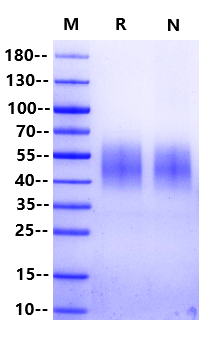
1μg (R: reducing condition, N:non-reducing condition).
Plectin His Tag Protein, Rhesus macaque/Cynomolgus
Plectin His Tag Protein, Rhesus macaque/Cynomolgus
Price:
Regular price
$235 USD
Regular price
Sale price
$235 USD
Unit price
per
For shipping services or bulk orders, you may request a quotation.
Secure checkout with

View full details
Product Details
Product Details
Product Specification
| Species | Cynomolgus, Rhesus macaque |
| Synonyms | PCN, PLTN, Plectin-1, PLEC1 |
| Accession | Rhesus macaque :F7ABN9、Cynomolgus: XP_065375884.1 |
| Amino Acid Sequence | Rhesus macaque :Ala4555-Ala4862 with His Tag at the N-Terminus |
| Expression System | HEK293 |
| Molecular Weight | 40-60kDa (Reducing) |
| Purity | >90% by SDS-PAGE |
| Conjugation | Unconjugated |
| Tag | His Tag |
| Physical Appearance | Lyophilized powder |
| Storage Buffer | PBS, pH7.4, 5% trehalose |
| Reconstitution | Reconstitute at 0.1-1 mg/ml according to the size in ultrapure water after rapid centrifugation. |
| Stability & Storage | · 12 months from date of receipt, lyophilized powder stored at -20 to -80℃. |
| Reference | 1.Natsuga K, Nishie W, Akiyama M, Nakamura H, Shinkuma S, McMillan JR, Nagasaki A, Has C, Ouchi T, Ishiko A, Hirako Y, Owaribe K, Sawamura D, Bruckner-Tuderman L, Shimizu H. Plectin expression patterns determine two distinct subtypes of epidermolysis bullosa simplex. Hum Mutat. 2010 Mar;31(3):308-16. |
Background
Plectin is a large cytolinker protein composed of an N-terminal actin-binding domain, a central rod-shaped α-helical coiled-coil region, and a C-terminal intermediate filament-binding domain, with multiple alternatively spliced isoforms enabling diverse subcellular localization; its functional core lies in bridging microfilaments, intermediate filaments, and microtubule networks to maintain cellular mechanical stability, while also participating in hemidesmosome assembly, myofibril integrity maintenance, and signal transduction regulation. Clinically, PLEC gene mutations cause epidermolysis bullosa simplex (EBS) and its variant subtypes with muscular dystrophy, pyloric atresia, or cardiomyopathy, collectively termed "plectinopathies," with pathological mechanisms involving dermal-epidermal junction disruption, desmin aggregation in muscle fibers, and mitochondrial dysfunction, while recent therapeutic strategies such as chemical chaperone approaches have provided new directions for treatment.
Picture
Picture
SDS-PAGE