WB result of PLA2G2A Recombinant Rabbit mAb
Primary antibody: PLA2G2A Recombinant Rabbit mAb at 1/1000 dilution
Primary antibody incubation conditions: overnight at 4°C
Lane 1: THP-1 whole cell lysate 25 µg
Lane 2: SK-OV-3 whole cell lysate 25 µg
Lane 3: HT-29 whole cell lysate 25 µg
Lane 4: Hep G2 whole cell lysate 25 µg
Lane 5: LNCaP whole cell lysate 25 µg
Lane 6: A549 whole cell lysate 25 µg
Secondary antibody: Goat Anti-rabbit IgG (H+L), HRP conjugated at 1/10000 dilution
Predicted MW: 16 kDa
Observed MW: 14 kDa
PLA2G2A Recombinant Rabbit mAb
PLA2G2A Recombinant Rabbit mAb
Price:
Regular price
$100 USD
Regular price
Sale price
$100 USD
Unit price
per
For shipping services or bulk orders, you may request a quotation.
Secure checkout with

View full details
Product Details
Product Details
Product Specification
| Host | Rabbit |
| Antigen | PLA2G2A |
| Synonyms | Phospholipase A2, membrane associated; GIIC sPLA2; Group IIA phospholipase A2; Non-pancreatic secretory phospholipase A2 (NPS-PLA2); Phosphatidylcholine 2-acylhydrolase 2A; PLA2B; PLA2L; RASF-A; PLA2G2A |
| Location | Secreted, Mitochondrion, Cell membrane |
| Accession | P14555 |
| Antibody Type | Recombinant mAb |
| Isotype | IgG |
| Application | WB |
| Reactivity | Hu, Ms, Rt |
| Positive Sample | THP-1, SK-OV-3, HT-29, Hep G2, LNCaP, A549, EL-4, mouse small intestine, mouse liver, mouse colon, C6, rat small intestine, rat liver, rat colon |
| Purification | Protein A |
| Concentration | 0.8 mg/ml |
| Conjugation | Unconjugated |
| Physical Appearance | Liquid |
| Storage Buffer | PBS, 40% Glycerol, 0.05% BSA, 0.02% sodium azide |
| Stability & Storage | 12 months from date of receipt / reconstitution, -20 °C as supplied |
Dilution
| application | dilution | species |
| WB | 1:1000-1:6000 | Hu, Ms, Rt |
Background
PLA2G2A, i.e., type IIA secreted phospholipase A2 (sPLA2-IIA), is a calcium-dependent secreted phospholipase of approximately 14 kDa; the mature protein contains about 144 amino acids and possesses a conserved calcium-binding loop and a catalytic His-Asp dyad active center, enabling it to hydrolyze the sn-2 ester bond of membrane phospholipids to release arachidonic acid and lysophospholipids. As an acute-phase protein, its plasma concentration can rise markedly in systemic inflammatory states such as sepsis and rheumatoid arthritis, and it is regarded as a biomarker of inflammatory responses. In terms of host defense, sPLA2-IIA exhibits potent bactericidal activity against Gram-positive bacteria; the high concentration of sPLA2-IIA in tears accounts for the major antibacterial function of tears, and transgenic mice overexpressing this protein show reduced mortality after Staphylococcus aureus infection. In addition, the protein participates in inflammatory regulation through catalysis-independent mechanisms, for example, promoting COX-2 expression and prostaglandin E2 production in a manner independent of catalytic activity. In tumor biology, the role of sPLA2-IIA is context-dependent: in prostate and breast cancer, its high expression is associated with aggressive progression and poor prognosis, and inhibiting its expression or activity can attenuate tumor growth and metastasis, whereas in colorectal cancer it may exert tumor-suppressive functions. Serum sPLA2-IIA levels are elevated in patients with various advanced malignancies and correlate with inflammatory and coagulation markers, suggesting its potential value as a prognosis-related biomarker.
Picture
Picture
Western Blot
WB result of PLA2G2A Recombinant Rabbit mAb
Primary antibody: PLA2G2A Recombinant Rabbit mAb at 1/1000 dilution
Primary antibody incubation conditions: overnight at 4°C
Lane 1: EL4 whole cell lysate 25 µg
Lane 2: mouse small intestine lysate 25 µg
Lane 3: mouse liver lysate 25 µg
Lane 4: mouse colon lysate 25 µg
Secondary antibody: Goat Anti-rabbit IgG (H+L), HRP conjugated at 1/10000 dilution
Predicted MW: 16 kDa
Observed MW: 14 kDa
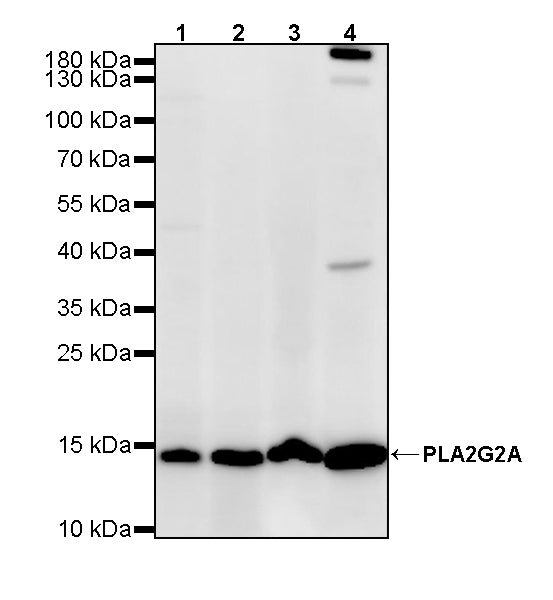
WB result of PLA2G2A Recombinant Rabbit mAb
Primary antibody: PLA2G2A Recombinant Rabbit mAb at 1/1000 dilution
Primary antibody incubation conditions: overnight at 4°C
Lane 1: C6 whole cell lysate 25 µg
Lane 2: rat small intestine lysate 25 µg
Lane 3: rat liver lysate 25 µg
Lane 4: rat colon lysate 25 µg
Secondary antibody: Goat Anti-rabbit IgG (H+L), HRP conjugated at 1/10000 dilution
Predicted MW: 16 kDa
Observed MW: 14 kDa