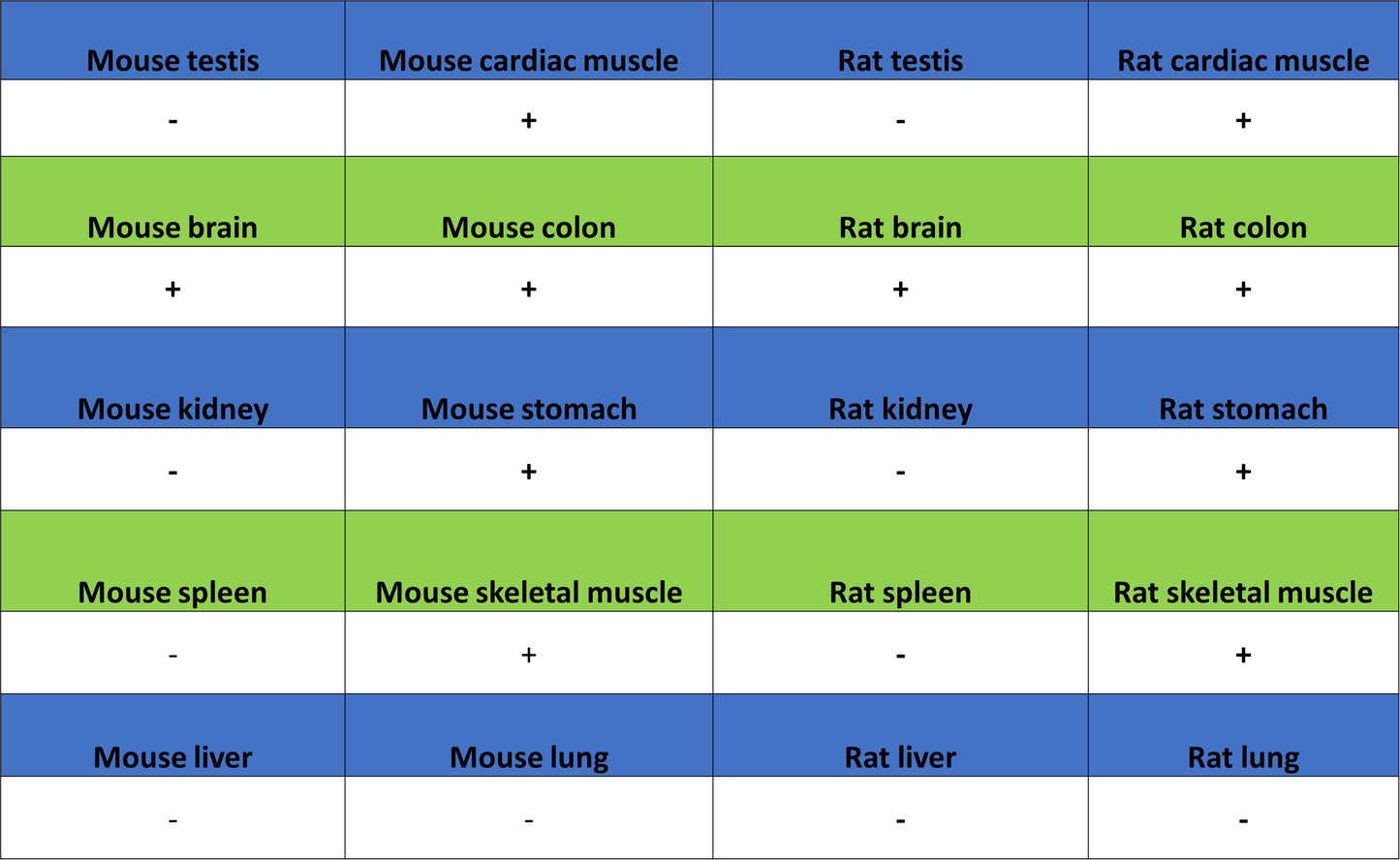
WB result of PITX2 Recombinant Rabbit mAb
Primary antibody: PITX2 Recombinant Rabbit mAb at 1/1000 dilution
Lane 1: mouse cerebellum lysate 20 µg
Lane 2: mouse brain lysate 20 µg
Lane 3: mouse skeletal muscle lysate 20 µg
Secondary antibody: Goat Anti- rabbit IgG, (H+L), HRP conjugated at 1/10000 dilution
Predicted MW: 35 kDa
Observed MW: 44 kDa
PITX2 Recombinant Rabbit mAb (S-4009-54)
PITX2 Recombinant Rabbit mAb (S-4009-54)
Price:
Regular price
$100 USD
Regular price
Sale price
$100 USD
Unit price
per
For shipping services or bulk orders, you may request a quotation.
Secure checkout with

View full details
Product Details
Product Details
Product Specification
| Host | Rabbit |
| Antigen | PITX2 |
| Synonyms | Pituitary homeobox 2; ALL1-responsive protein ARP1; BRX1 homeoprotein; Bicoid-related homeobox protein 1; Homeobox protein PITX2; Orthodenticle-like homeobox 2; Arp1; Brx1; Otlx2; Ptx2; Rgs; Rieg; Pitx2 |
| Immunogen | Synthetic Peptide |
| Location | Cytoplasm |
| Accession | P97474 |
| Clone Number | S-4009-54 |
| Antibody Type | Recombinant mAb |
| Isotype | IgG |
| Application | WB, IHC-P, IF |
| Reactivity | Ms, Rt |
| Positive Sample | mouse cerebellum, mouse brain, mouse skeletal muscle, rat cerebellum, rat brain, rat skeletal muscle |
| Purification | Protein A |
| Concentration | 0.5 mg/ml |
| Conjugation | Unconjugated |
| Physical Appearance | Liquid |
| Storage Buffer | PBS, 40% Glycerol, 0.05% BSA, 0.02% sodium azide |
| Stability & Storage | 12 months from date of receipt / reconstitution, -20 °C as supplied |
Dilution
| application | dilution | species |
| WB | 1:1000-1:2000 | Ms, Rt |
| IHC-P | 1:1000 | Ms, Rt |
| IF | 1:500 | Ms, Rt |
Background
PITX2 is a transcription factor containing a homeodomain, encoded by the PITX2 gene, and belongs to the RIEG/PITX family, playing a critically regulatory role during embryonic development. Through its highly conserved DNA-binding domain, this protein specifically recognizes and binds to the TAAT(G) core motif in the promoters of target genes, thereby activating or repressing the expression of downstream genes. As a core regulator of vertebrate left-right asymmetric development, PITX2 is specifically expressed in the left lateral plate mesoderm of the embryo and serves as a key downstream effector molecule of the nodal signaling pathway, responsible for regulating the asymmetric rotation and positioning of organs such as the heart, lungs, stomach, and intestines. In addition to its classical role in asymmetric morphogenesis, PITX2 is also widely involved in the development of various tissues, including iris and corneal formation in the eye, craniofacial skeletal development, and differentiation of hair follicles and the pituitary gland. Mutations or aberrant expression of the PITX2 gene are closely associated with multiple human genetic diseases, most notably Axenfeld-Rieger syndrome, which is a visceral mesodermal developmental disorder characterized by anterior segment dysgenesis of the eye, dental anomalies, and redundant periumbilical skin; furthermore, abnormal PITX2 expression has also been observed in certain tumors, such as prostate cancer and breast cancer, suggesting its potential regulatory role in tumorigenesis. Overall, PITX2 is an important multifunctional transcription factor that bridges embryonic development, organ formation, and disease pathogenesis.
Picture
Picture
Western Blot
WB result of PITX2 Recombinant Rabbit mAb
Primary antibody: PITX2 Recombinant Rabbit mAb at 1/1000 dilution
Lane 1: rat cerebellum lysate 20 µg
Lane 2: rat brain lysate 20 µg
Lane 3: rat skeletal muscle lysate 20 µg
Secondary antibody: Goat Anti- rabbit IgG, (H+L), HRP conjugated at 1/10000 dilution
Predicted MW: 35 kDa
Observed MW: 44 kDa
Immunohistochemistry
IHC shows positive staining in paraffin-embedded mouse cerebral cortex. Anti-PITX2 antibody was used at 1/1000 dilution, followed by a HRP Polymer for Rabbit IgG (ready to use). Counterstained with hematoxylin. Heat mediated antigen retrieval with Tris/EDTA buffer pH9.0 was performed before commencing with IHC staining protocol.
Negative control: IHC shows negative staining in paraffin-embedded mouse spleen. Anti-PITX2 antibody was used at 1/1000 dilution, followed by a HRP Polymer for Rabbit IgG (ready to use). Counterstained with hematoxylin. Heat mediated antigen retrieval with Tris/EDTA buffer pH9.0 was performed before commencing with IHC staining protocol.
Negative control: IHC shows negative staining in paraffin-embedded mouse liver. Anti-PITX2 antibody was used at 1/1000 dilution, followed by a HRP Polymer for Rabbit IgG (ready to use). Counterstained with hematoxylin. Heat mediated antigen retrieval with Tris/EDTA buffer pH9.0 was performed before commencing with IHC staining protocol.
IHC shows positive staining in paraffin-embedded rat cerebral cortex. Anti-PITX2 antibody was used at 1/1000 dilution, followed by a HRP Polymer for Rabbit IgG (ready to use). Counterstained with hematoxylin. Heat mediated antigen retrieval with Tris/EDTA buffer pH9.0 was performed before commencing with IHC staining protocol.
Negative control: IHC shows negative staining in paraffin-embedded rat liver. Anti-PITX2 antibody was used at 1/1000 dilution, followed by a HRP Polymer for Rabbit IgG (ready to use). Counterstained with hematoxylin. Heat mediated antigen retrieval with Tris/EDTA buffer pH9.0 was performed before commencing with IHC staining protocol.
Immunofluorescence
IF shows positive staining in paraffin-embedded mouse cerebral cortex. Anti-PITX2 antibody was used at 1/500 dilution (Green) and incubated overnight at 4°C. Goat polyclonal Antibody to Rabbit IgG - H&L (Alexa Fluor® 488) was used as secondary antibody at 1/1000 dilution. Counterstained with DAPI (Blue). Heat mediated antigen retrieval with EDTA buffer pH9.0 was performed before commencing with IF staining protocol.
IF shows positive staining in paraffin-embedded rat cerebral cortex. Anti-PITX2 antibody was used at 1/500 dilution (Green) and incubated overnight at 4°C. Goat polyclonal Antibody to Rabbit IgG - H&L (Alexa Fluor® 488) was used as secondary antibody at 1/1000 dilution. Counterstained with DAPI (Blue). Heat mediated antigen retrieval with EDTA buffer pH9.0 was performed before commencing with IF staining protocol.