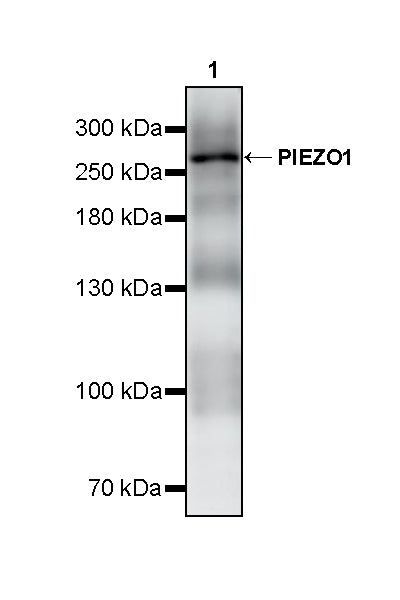
WB result of PIEZO1 Recombinant Rabbit mAb
Primary antibody: PIEZO1 Recombinant Rabbit mAb at 1/1000 dilution
Primary antibody incubation conditions: room temperature for 1.5 hours
Lane 1: unboiled mouse lung lysate 20 µg
Secondary antibody: Goat Anti-rabbit IgG (H+L), HRP conjugated at 1/10000 dilution
Predicted MW: 292 kDa
Observed MW: 305 kDa
This blot was developed with high sensitivity substrate
PIEZO1 Recombinant Rabbit mAb (S-4008-76)
PIEZO1 Recombinant Rabbit mAb (S-4008-76)
Price:
Regular price
$100 USD
Regular price
Sale price
$100 USD
Unit price
per
For shipping services or bulk orders, you may request a quotation.
Secure checkout with

View full details
Product Details
Product Details
Product Specification
| Host | Rabbit |
| Antigen | PIEZO1 |
| Synonyms | Piezo-type mechanosensitive ion channel component 1; Fam38a; Piezo1 |
| Immunogen | Synthetic Peptide |
| Location | Cell membrane |
| Accession | E2JF22 |
| Clone Number | S-4008-76 |
| Antibody Type | Recombinant mAb |
| Isotype | IgG |
| Application | WB |
| Reactivity | Ms, Rt |
| Purification | Protein A |
| Concentration | 1 mg/ml |
| Conjugation | Unconjugated |
| Physical Appearance | Liquid |
| Storage Buffer | PBS, 40% Glycerol, 0.05% BSA, 0.02% sodium azide |
| Stability & Storage | 12 months from date of receipt / reconstitution, -20 °C as supplied |
Dilution
| application | dilution | species |
| WB | 1:1000 | Ms, Rt |
Background
PIEZO1 is an evolutionarily highly conserved mechanosensitive non-selective cation channel encoded by the PIEZO1 gene, with its name derived from the Greek word "piesi" (pressure). In humans, the protein consists of approximately 2,520 amino acids with a molecular weight of about 287 kDa, making it one of the largest ion channel proteins known, and it shares no sequence homology with any known cation channel family. PIEZO1 assembles as a homotrimer to form a distinctive three-bladed propeller-like structure: each subunit comprises a distal mechanosensory "blade" module composed of 38 transmembrane helices, a "beam" and "anchor" module that transmits mechanical force, and a central ion-conducting pore module. When the cell membrane is subjected to mechanical forces such as shear stress, membrane tension, or hydrostatic pressure, the blade undergoes a flattening conformational transition, transmitting the mechanical signal to the central pore via a "nano-lever" mechanism, which opens the pore and allows influx of cations including Ca²⁺, Na⁺, and K⁺. PIEZO1 plays critical roles in multiple human systems, including vascular and lymphatic development, red blood cell volume regulation, bone formation, and cardiovascular homeostasis. Its dysfunction is closely associated with various human diseases: gain-of-function mutations cause dehydrated hereditary stomatocytosis (a hemolytic anemia), while loss-of-function mutations lead to autosomal recessive generalized lymphatic dysplasia with non-immune fetal hydrops. In addition, genetic variants of PIEZO1 are also associated with pathological processes such as familial osteoarthritis susceptibility, lower extremity varicose veins, and cardiac hypertrophy. Given its broad physiological and pathological significance, PIEZO1 has become a highly attractive drug target in fields such as cardiovascular disease, lymphedema, and cancer, and the small-molecule agonist Yoda1 and its derivatives are being explored for pharmacological modulation.
Picture
Picture
Western Blot
WB result of PIEZO1 Recombinant Rabbit mAb
Primary antibody: PIEZO1 Recombinant Rabbit mAb at 1/1000 dilution
Primary antibody incubation conditions: room temperature for 1.5 hours
Lane 1: unboiled rat lung lysate 20 µg
Secondary antibody: Goat Anti-rabbit IgG (H+L), HRP conjugated at 1/10000 dilution
Predicted MW: 292 kDa
Observed MW: 260 kDa
This blot was developed with high sensitivity substrate