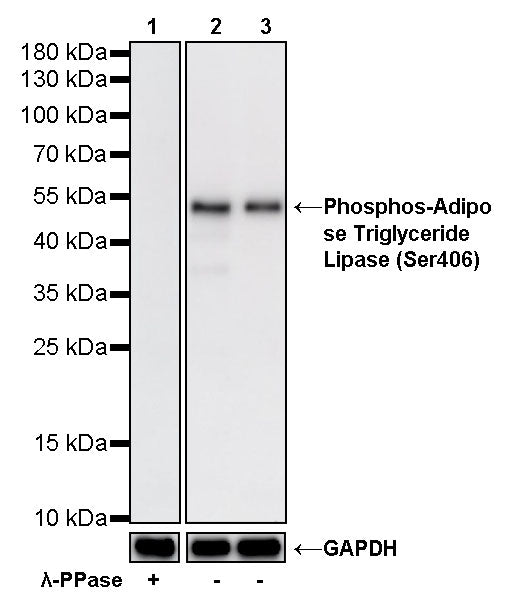
WB result of Phosphos-Adipose Triglyceride Lipase (Ser406) Rabbit pAb
Primary antibody: Phosphos-Adipose Triglyceride Lipase (Ser406) Rabbit pAb at 1/1000 dilution
Lane 1: mouse white fat lysate 20 µg (phosphatase treated membrane)
Lane 2: mouse white fat lysate 20 µg
Lane 3: mouse brown adipose lysate 20 µg
Secondary antibody: Goat Anti-rabbit IgG (H+L), HRP conjugated at 1/10000 dilution
Predicted MW: 54 kDa
Observed MW: 54 kDa
Phosphos-Adipose Triglyceride Lipase (Ser406) Rabbit Polyclonal Antibody
Phosphos-Adipose Triglyceride Lipase (Ser406) Rabbit Polyclonal Antibody
Price:
Regular price
$100 USD
Regular price
Sale price
$100 USD
Unit price
per
For shipping services or bulk orders, you may request a quotation.
Secure checkout with

View full details
Product Details
Product Details
Product Specification
| Host | Rabbit |
| Antigen | Phosphos-Adipose Triglyceride Lipase (Ser406) |
| Synonyms | Patatin-like phospholipase domain-containing protein 2; Adipose triglyceride lipase; Calcium-independent phospholipase A2-zeta (iPLA2-zeta); Desnutrin; Atgl; Pnpla2 |
| Immunogen | Synthetic Peptide |
| Location | Cytoplasm, Cell membrane |
| Accession | Q8BJ56 |
| Antibody Type | Polyclonal antibody |
| Isotype | IgG |
| Application | WB |
| Reactivity | Ms, Rt |
| Purification | Immunogen Affinity |
| Concentration | 0.5 mg/ml |
| Conjugation | Unconjugated |
| Physical Appearance | Liquid |
| Storage Buffer | PBS, 40% Glycerol, 0.05% BSA, 0.02% sodium azide |
| Stability & Storage | 12 months from date of receipt / reconstitution, -20 °C as supplied |
Dilution
| application | dilution | species |
| WB | 1:1000 | Ms, Rt |
Background
Adipose Triglyceride Lipase (ATGL), also known as PNPLA2, is the rate-limiting enzyme that catalyzes the first step of triglyceride hydrolysis, converting triacylglycerols into diacylglycerols and free fatty acids. It is a member of the patatin-like phospholipase domain-containing protein family and contains a conserved N-terminal patatin domain (approximately spanning amino acids 10–178) that harbors a catalytic dyad consisting of Ser47 and Asp166. ATGL is highly expressed in white and brown adipose tissue but is also present at lower levels in most other tissues, where it plays important roles in cellular lipid mobilization. Its enzymatic activity is tightly regulated by protein-protein interactions: it is co-activated by Comparative Gene Identification-58 (CGI-58) and inhibited by G0/G1 Switch Gene 2 (G0S2). Mutations in the ATGL gene cause Neutral Lipid Storage Disease with Myopathy (NLSDM), characterized by triglyceride accumulation in multiple tissues and severe skeletal and cardiac myopathy. While hormone-sensitive lipase (HSL) was traditionally considered the key lipolytic enzyme, ATGL is now recognized as essential for maintaining basal lipolytic activity, whereas HSL is more responsive to stimulated lipolysis.
Picture
Picture
Western Blot
WB result of Phosphos-Adipose Triglyceride Lipase (Ser406) Rabbit pAb
Primary antibody: Phosphos-Adipose Triglyceride Lipase (Ser406) Rabbit pAb at 1/1000 dilution
Lane 1: rat white fat lysate 20 µg (phosphatase treated membrane)
Lane 2: rat white fat lysate 20 µg
Lane 3: rat brown adipose lysate 20 µg
Secondary antibody: Goat Anti-rabbit IgG (H+L), HRP conjugated at 1/10000 dilution
Predicted MW: 54 kDa
Observed MW: 54 kDa