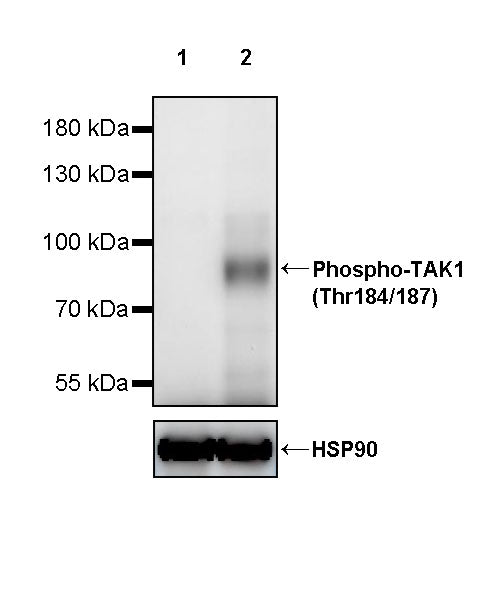
WB result of Phospho-TAK1 (Thr184/187) Recombinant Rabbit mAb
Blocking/Diluting buffer and concentration: 5% NFDM/TBST
Primary antibody incubation conditions: overnight at 4°C
Primary antibody: Phospho-TAK1 (Thr184/187) Recombinant Rabbit mAb at 1/1000 dilution
Lane 1: untreated HeLa whole cell lysate 20 µg
Lane 2: HeLa treated with 100nM Calyculin A for 10 minutes and 20 ng/ml IL-1ß for 10 minutes whole cell lysate 20 µg
Secondary antibody: Goat Anti- rabbit IgG, (H+L), HRP conjugated at 1/10000 dilution
Predicted MW: 67 kDa
Observed MW: 85 kDa
Phospho-TAK1 (Thr184/187) Recombinant Rabbit mAb (S-4146)
Phospho-TAK1 (Thr184/187) Recombinant Rabbit mAb (S-4146)
Price:
Regular price
$100 USD
Regular price
Sale price
$100 USD
Unit price
per
For shipping services or bulk orders, you may request a quotation.
Secure checkout with

View full details
Product Details
Product Details
Product Specification
| Host | Rabbit |
| Antigen | Phospho-TAK1 (Thr184/187) |
| Synonyms | Mitogen-activated protein kinase kinase kinase 7; Transforming growth factor-beta-activated kinase 1 (TGF-beta-activated kinase 1); TAK1; MAP3K7 |
| Location | Cytoplasm, Cell membrane |
| Accession | O43318 |
| Clone Number | S-4146 |
| Antibody Type | Recombinant mAb |
| Isotype | IgG |
| Application | WB |
| Reactivity | Hu |
| Positive Sample | HeLa treated with 100nM Calyculin A for 10 minutes and 20 ng/ml IL-1ß for 10 minutes |
| Purification | Protein A |
| Concentration | 0.5 mg/ml |
| Conjugation | Unconjugated |
| Physical Appearance | Liquid |
| Storage Buffer | PBS, 40% Glycerol, 0.05% BSA, 0.03% Proclin 300 |
| Stability & Storage | 12 months from date of receipt / reconstitution, -20 °C as supplied |
Dilution
| application | dilution | species |
| WB | 1:1000 | Hu |
Background
Phospho-TAK1 (Thr184/187) refers to the activated form of transforming growth factor-β-activated kinase 1 (TAK1) that is doubly phosphorylated at threonine residues 184 and 187 within its activation loop. TAK1 is an important member of the mitogen-activated protein kinase kinase kinase (MAP3K) family and participates in regulating various biological processes, including inflammation, immune responses, and cell differentiation. Upon stimulation by pro-inflammatory cytokines (such as TNF-α or IL-1β) or pathogen-associated molecular patterns, upstream signaling molecules (such as TRAF6 and TAK1-binding proteins) promote the ubiquitination and multimerization of TAK1, thereby inducing phosphorylation at Thr184 and Thr187. This dual phosphorylation at these two sites is a critical event for TAK1 activation, significantly enhancing its kinase activity. Subsequently, TAK1 phosphorylates downstream substrates such as the IKK complex (initiating the NF-κB pathway) and MKKs (activating the JNK and p38 MAPK pathways), thereby coordinating cell survival, apoptosis, and gene expression in response to stress and inflammation. Therefore, detecting the phosphorylation status of Thr184/187 is widely used as a marker to assess TAK1 kinase activity and holds significant importance in research on inflammation, autoimmune diseases, and the tumor microenvironment.
Picture
Picture
Western Blot