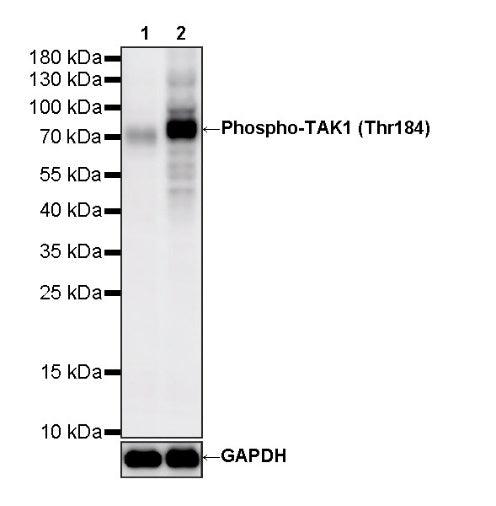
WB result of Phospho-TAK1 (Thr184) Recombinant Rabbit mAb
Primary antibody: Phospho-TAK1 (Thr184) Recombinant Rabbit mAb at 1/1000 dilution
Lane 1: untreated Raw 264.7 whole cell lysate 20 μg
Lane 2: Raw 264.7 treated with Calyculin A 100ng/mL for 30min whole cell lysate 20 μg
Secondary antibody: Goat Anti-Rabbit IgG (H+L), HRP conjugated at 1/10000 dilution
Predicted MW: 67 kDa
Observed MW: 82 kDa
Phospho-TAK1 (Thr184) Recombinant Rabbit mAb (S-3526-6)
Phospho-TAK1 (Thr184) Recombinant Rabbit mAb (S-3526-6)
Price:
Regular price
$100 USD
Regular price
Sale price
$100 USD
Unit price
per
For shipping services or bulk orders, you may request a quotation.
Secure checkout with

View full details
Product Details
Product Details
Product Specification
| Host | Rabbit |
| Antigen | Phospho-TAK1 (Thr184) |
| Synonyms | Mitogen-activated protein kinase kinase kinase 7; Transforming growth factor-beta-activated kinase 1 (TGF-beta-activated kinase 1); TAK1; MAP3K7 |
| Immunogen | Synthetic Peptide |
| Location | Cytoplasm, Cell membrane |
| Accession | O43318 |
| Clone Number | S-3526-6 |
| Antibody Type | Recombinant mAb |
| Isotype | IgG |
| Application | WB |
| Reactivity | Ms |
| Purification | Protein A |
| Concentration | 0.5 mg/ml |
| Conjugation | Unconjugated |
| Physical Appearance | Liquid |
| Storage Buffer | PBS, 40% Glycerol, 0.05% BSA, 0.02% sodium azide |
| Stability & Storage | 12 months from date of receipt / reconstitution, -20 °C as supplied. |
Dilution
| application | dilution | species |
| WB | 1:1000-1:5000 | Ms |
Background
Phospho-TAK1 (Thr184) is the activated form of transforming growth factor-β-activated kinase 1 (TAK1), generated by phosphorylation at the threonine 184 residue within the activation loop (T-loop) of its N-terminal kinase domain, and this modification, together with the adjacent Thr178 site, constitutes the key phosphorylation event required for full TAK1 activation. This phosphorylation is triggered by the binding of TAK1-binding protein 1 (TAB1), which stabilizes the active conformation of the kinase by relieving TAK1's autoinhibitory state and promoting its autophosphorylation. Once phosphorylated and activated, Phospho-TAK1 (Thr184) serves as a core member of the mitogen-activated protein kinase kinase kinase (MAP3K) family and functions as a critical hub for inflammatory and stress signaling pathways: on one hand, it initiates the NF-κB signaling pathway by phosphorylating IKKβ; on the other hand, it drives JNK and p38 MAPK cascades through activation of MKK4/7 and MKK3/6, thereby regulating diverse biological processes including inflammatory cytokine production, apoptosis, and cell survival. Phosphorylation at this site is essential for optimal NF-κB and AP-1 transcriptional activation as well as IL-6 gene expression induced by cytokines such as interleukin-1 (IL-1); mutagenesis studies have demonstrated that alanine substitution severely impairs TAK1-mediated downstream signaling, whereas phosphomimetic mutations enhance the activity of these pathways. Therefore, as an important biomarker for assessing TAK1 kinase activity, Phospho-TAK1 (Thr184) holds significant value not only in basic signal transduction research, but its aberrant sustained activation is also considered to be closely associated with the pathogenesis and progression of chronic inflammatory and proliferative diseases such as rheumatoid arthritis, inflammatory bowel disease, and cancer, making it a highly promising therapeutic intervention target.
Picture
Picture
Western Blot