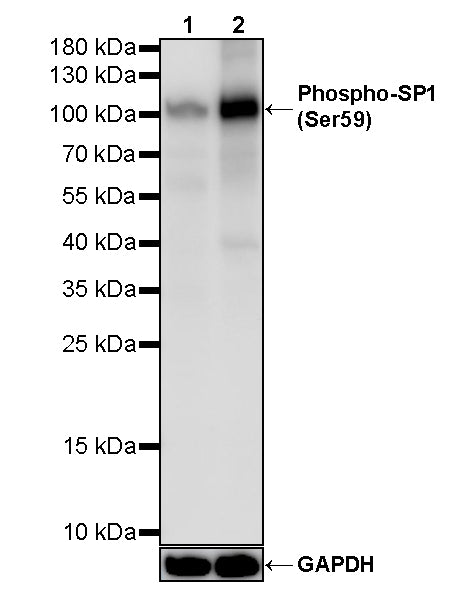
WB result of Phospho-SP1 (Ser59) Recombinant Rabbit mAb
Primary antibody: Phospho-SP1 (Ser59) Recombinant Rabbit mAb at 1/1000 dilution
Lane 1: untreated HeLa whole cell lysate 20 µg
Lane 2: HeLa treated with 100 ng/ml Calyculin A for 30 minutes whole cell lysate 20 µg
Secondary antibody: Goat Anti-rabbit IgG (H+L), HRP conjugated at 1/10000 dilution
Predicted MW: 67 kDa
Observed MW: 105 kDa
Phospho-SP1 (Ser59) Recombinant Rabbit mAb (S-3714-13)
Phospho-SP1 (Ser59) Recombinant Rabbit mAb (S-3714-13)
Price:
Regular price
$100 USD
Regular price
Sale price
$100 USD
Unit price
per
For shipping services or bulk orders, you may request a quotation.
Secure checkout with

View full details
Product Details
Product Details
Product Specification
| Host | Rabbit |
| Antigen | Phospho-SP1 (Ser59) |
| Immunogen | Synthetic Peptide |
| Location | Cytoplasm, Nucleus |
| Accession | P08047 |
| Clone Number | S-3714-13 |
| Antibody Type | Recombinant mAb |
| Isotype | IgG |
| Application | WB |
| Reactivity | Hu |
| Positive Sample | HeLa treated with 100 ng/ml Calyculin A for 30 minutes |
| Purification | Protein A |
| Concentration | 0.5 mg/ml |
| Conjugation | Unconjugated |
| Physical Appearance | Liquid |
| Storage Buffer | PBS, 40% Glycerol, 0.05% BSA, 0.02% sodium azide |
| Stability & Storage | 12 months from date of receipt / reconstitution, -20 °C as supplied |
Dilution
| application | dilution | species |
| WB | 1:1000 | Hu |
Background
Phospho-Sp1 (Ser59) refers to the phosphorylation of the transcription factor Sp1 at serine residue 59, a post-translational modification that regulates Sp1's transcriptional activity, proteolytic processing, and protein stability. Sp1 contains multiple phosphorylation sites, but Ser59 is notable for being within a Cyclin A/cdk2 consensus motif (QPSP sequence), and its phosphorylation induces removal of the inhibitory domain through proteolytic cleavage, thereby activating Sp1's DNA-binding transcriptional activity. This modification is catalyzed by several kinases: Cyclin A/cdk2 phosphorylates Ser59 upon S-phase entry, which is necessary for subsequent recognition, ubiquitination, and degradation of Sp1 by the SUMO-targeted E3 ubiquitin ligase RNF4, a process required for removing Sp1 and 53BP1 from DNA double-strand breaks to permit homologous recombination. Senescence-associated ERK1/2 (SA-pErk1/2), downstream of PKCα activated by reactive oxygen species, also phosphorylates Sp1 specifically at Ser59 in vivo (but not threonine residues) during cellular senescence, enhancing p21Sdi1 transcription and contributing to cell cycle arrest. Additionally, aPKC-ι directly phosphorylates Sp1 at Ser59 to increase Sp1 binding to the Snail promoter, promoting epithelial-mesenchymal transition and immunosuppression in cholangiocarcinoma cells.
Picture
Picture
Western Blot