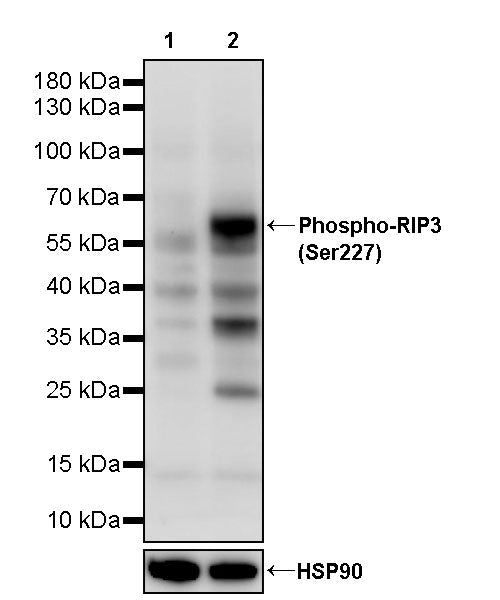
WB result of Phospho-RIP3 (Ser227) Recombinant Rabbit mAb
Blocking/Diluting buffer and concentration: 5% NFDM/TBST
Primary antibody incubation conditions: overnight at 4°C
Primary antibody: Phospho-RIP3 (Ser227) Recombinant Rabbit mAb at 1/1000 dilution
Lane 1: untreated HT-29 whole cell lysate 20 µg
Lane 2: HT-29 treated with 20 μM Z-VAD for 30 minutes, then 20 ng/ml hTNF-α and 100 nM SM-164 were added for 7 hours whole cell lysate 20 µg
Secondary antibody: Goat Anti- rabbit IgG, (H+L), HRP conjugated at 1/10000 dilution
Predicted MW: 57 kDa
Observed MW: 62 kDa
This blot was developed with high sensitivity substrate
Phospho-RIP3 (Ser227) Recombinant Rabbit mAb (S-3488)
Phospho-RIP3 (Ser227) Recombinant Rabbit mAb (S-3488)
Price:
Regular price
$100 USD
Regular price
Sale price
$100 USD
Unit price
per
For shipping services or bulk orders, you may request a quotation.
Secure checkout with

View full details
Product Details
Product Details
Product Specification
| Host | Rabbit |
| Antigen | Phospho-RIP3 (Ser227) |
| Synonyms | Receptor-interacting serine/threonine-protein kinase 3; RIP-like protein kinase 3; Receptor-interacting protein 3 (RIP-3); RIP3; RIPK3 |
| Location | Cytoplasm, Nucleus |
| Accession | Q9Y572 |
| Clone Number | S-3488 |
| Antibody Type | Recombinant mAb |
| Isotype | IgG |
| Application | WB |
| Reactivity | Hu |
| Positive Sample | HT-29 (treated with 20 μM Z-VAD for 30 minutes, then 20 ng/ml hTNF-α and 100 nM SM-164 were added for 7 hours) |
| Purification | Protein A |
| Concentration | 2 mg/ml |
| Conjugation | Unconjugated |
| Physical Appearance | Liquid |
| Storage Buffer | PBS, 40% Glycerol, 0.05% BSA, 0.03% Proclin 300 |
| Stability & Storage | 12 months from date of receipt / reconstitution, -20 °C as supplied |
Dilution
| application | dilution | species |
| WB | 1:1000 | Hu |
Background
Phospho-RIP3 (Ser227) refers to the phosphorylated form of Receptor-Interacting Protein Kinase 3 (RIP3) at serine residue 227, a critical post-translational modification that plays a pivotal role in regulating necroptosis—a programmed form of necrotic cell death. This specific phosphorylation event, typically mediated by upstream kinases such as RIP1 or other stimuli, serves as a molecular switch that activates RIP3's kinase activity and promotes its interaction with downstream effectors like MLKL (mixed lineage kinase domain-like protein). The phosphorylation at Ser227 is essential for the assembly of the necrosome complex, propagation of death signals, and execution of necroptotic cell death, making it a key biomarker for studying inflammatory responses, tissue injury, and various pathological conditions including neurodegenerative diseases and ischemia-reperfusion injury.
Picture
Picture
Western Blot