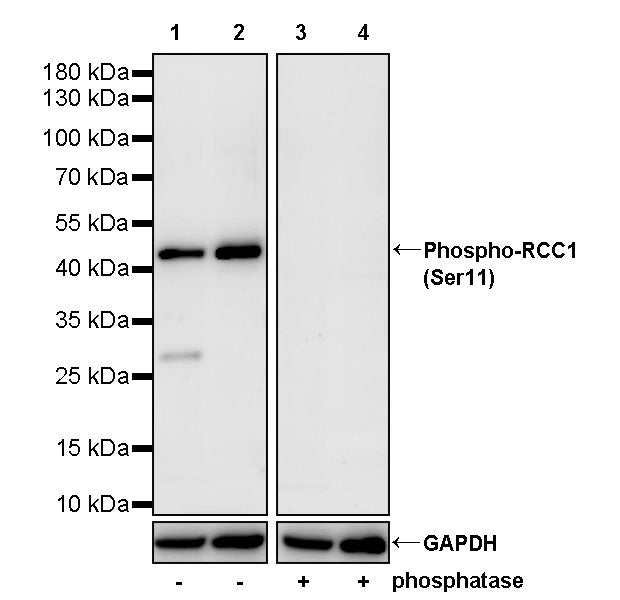
WB result of Phospho-RCC1 (Ser11) Recombinant Rabbit mAb
Blocking/Diluting buffer and concentration: 5% NFDM/TBST
Primary antibody incubation conditions: overnight at 4°C
Primary antibody: Phospho-RCC1 (Ser11) Recombinant Rabbit mAb at 1/1000 dilution
Lane 1: HT-29 whole cell lysate 20 µg
Lane 2: HeLa whole cell lysate 20 µg
Lane 3: HT-29 whole cell lysate 20 µg (phosphatase treated membrane)
Lane 4: HeLa whole cell lysate 20 µg (phosphatase treated membrane)
Secondary antibody: Goat Anti- rabbit IgG, (H+L), HRP conjugated at 1/10000 dilution
Predicted MW: 45 kDa
Observed MW: 45 kDa
Phospho-RCC1 (Ser11) Recombinant Rabbit mAb (S-4988)
Phospho-RCC1 (Ser11) Recombinant Rabbit mAb (S-4988)
Price:
Regular price
$100 USD
Regular price
Sale price
$100 USD
Unit price
per
For shipping services or bulk orders, you may request a quotation.
Secure checkout with

View full details
Product Details
Product Details
Product Specification
| Host | Rabbit |
| Antigen | Phospho-RCC1 (Ser11) |
| Synonyms | Regulator of chromosome condensation; Cell cycle regulatory protein; Chromosome condensation protein 1; CHC1; RCC1 |
| Location | Cytoplasm, Nucleus |
| Accession | P18754 |
| Clone Number | S-4988 |
| Antibody Type | Recombinant mAb |
| Isotype | IgG |
| Application | WB |
| Reactivity | Hu |
| Positive Sample | HT-29, HeLa |
| Purification | Protein A |
| Concentration | 0.5 mg/ml |
| Conjugation | Unconjugated |
| Physical Appearance | Liquid |
| Storage Buffer | PBS, 40% Glycerol, 0.05% BSA, 0.03% Proclin 300 |
| Stability & Storage | 12 months from date of receipt / reconstitution, -20 °C as supplied |
Dilution
| application | dilution | species |
| WB | 1:1000 | Hu |
Background
Phospho-RCC1 (Ser11) refers to the specific form of the RCC1 (Regulator of Chromosome Condensation 1) protein that undergoes phosphorylation at the serine residue at position 11. RCC1 is the primary Ran guanine nucleotide exchange factor (RanGEF) in the nucleus. By catalyzing the conversion of Ran from its GDP-bound state (RanGDP) to its GTP-bound state (RanGTP), it establishes a RanGTP gradient between the nucleus and cytoplasm, thereby regulating nucleocytoplasmic transport, spindle assembly, nuclear envelope reconstruction, and mitotic progression. Phosphorylation at the Ser11 site is an important post-translational modification, typically catalyzed by specific kinases such as CDK1 during particular phases of the cell cycle, especially the G2/M phase. This phosphorylation modification finely regulates RCC1's GEF activity, its binding affinity for chromatin, and its dynamic localization on chromosomes, consequently influencing the establishment and maintenance of the RanGTP gradient. Studies have shown that abnormal levels of Phospho-RCC1 (Ser11) or mutations at this site can interfere with the proper progression of mitosis, leading to chromosome segregation errors, aneuploidy, and genomic instability—phenomena commonly observed in various tumor cells. Therefore, this phosphorylation event is regarded as an important molecular node in cell cycle regulation and tumor development.
Picture
Picture
Western Blot